 Birch Bay Siding
 Why Cottonwood Beach Roofs Wear Differently
Cottonwood Beach sits close enough to the water that salt air is a daily fact of life for every roof in the neighborhood, not an occasional nuisance. Combine that with the wind-driven rain that rolls in off the Strait of Georgia and the long, damp moss season that Whatcom County is known for, and you get a set of conditions that ages a roof faster than most manufacturers' warranty literature assumes. A roof built to a generic national spec will often show its age here in half the time it would somewhere drier and further inland.
Three things do most of the damage. Salt-laden air accelerates corrosion on exposed fasteners, flashing, and any metal component that isn't rated for coastal exposure. Wind-driven rain doesn't fall straight down — it gets pushed sideways and upward under shingle edges and around penetrations, which means standard installation tolerances that work fine in a calm climate can leak here. And the region's mild, wet winters give moss and algae months at a time to establish themselves on north-facing and shaded slopes, working their way under shingle tabs and holding moisture against the roof deck.
None of this means Cottonwood Beach homes need exotic materials or gimmicks. It means the installation details — fastener choice, underlayment coverage, flashing sequencing, and ventilation — have to be done correctly and matched to this specific environment, not just to code minimums.
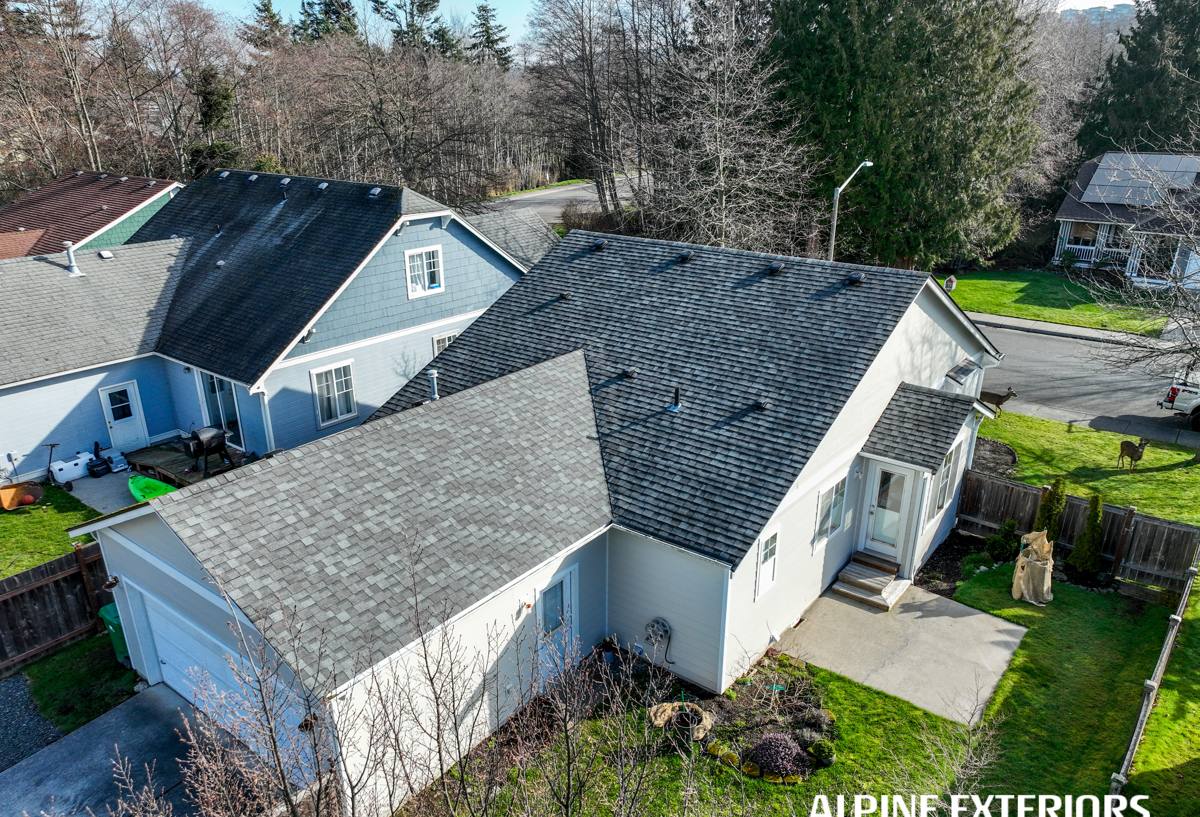
What a Correct New Roof Installation Involves Here
Decking and Underlayment
Every new roof starts with the deck. Before anything goes down, the sheathing gets inspected for soft spots, delamination, or water staining from the old roof's failures — any of that gets replaced, not covered over. From there, a full synthetic or self-adhering underlayment goes down across the whole roof, with self-adhering ice-and-water membrane specifically at eaves, valleys, and around every penetration. In a climate where wind can drive rain uphill under shingles, this underlayment layer is the actual waterproofing system — the shingles are the wear layer on top of it.
Flashing
Flashing failures cause more roof leaks than worn-out shingles do, and they're almost always the result of a rushed installation rather than a bad product. Step flashing at wall intersections, counter-flashing where a roof meets siding, and properly sequenced flashing at chimneys and skylights all matter more in a wind-driven-rain climate than they would somewhere calmer. We use corrosion-resistant flashing metals appropriate for coastal exposure, not the cheapest galvanized stock available.
Fastening for Wind
Coastal exposure in Whatcom County means gusts strong enough to lift improperly fastened shingles, especially at rakes, ridges, and hips. Correct nail placement — count, position, and depth — is a detail that's invisible once the roof is finished but is the difference between a roof that holds through a winter storm and one that starts losing shingles in year three.
Material Options for This Stretch of Birch Bay
There's no single "best" roofing material for Cottonwood Beach — the right choice depends on your home's exposure, your budget, and how much long-term maintenance you want to take on. Here's how the common options compare for this specific environment.
| Material | Salt Air / Corrosion | Wind-Driven Rain | Moss Resistance | Typical Lifespan |
|---|---|---|---|---|
| Architectural asphalt shingle | Good with corrosion-resistant fasteners | Good with proper underlayment | Moderate — benefits from algae-resistant granules | 25-30 years |
| Standing seam metal | Excellent when properly coated/finished | Excellent — minimal seams for wind to exploit | Good — sheds moss more readily than shingles | 40-50+ years |
| Synthetic/composite shingle | Good — non-porous surface resists corrosion issues | Good with correct installation | Good | 30-50 years |
| Wood shake | Fair — requires more upkeep near salt air | Fair — more seams and gaps | Poor without regular treatment | 20-30 years with maintenance |
For most Cottonwood Beach homes, an architectural asphalt shingle with algae-resistant granules is the practical middle ground — good performance, reasonable cost, and a wide range of colors that fit the neighborhood's look. Homeowners planning to stay long-term or wanting the lowest-maintenance option often lean toward standing seam metal, which handles both the salt exposure and the moss problem better than any other option, for a higher upfront cost.
Our Installation Process
- On-site inspection. We walk the roof, check the decking, assess ventilation, and look at how your specific lot is exposed to wind and rain before recommending anything.
- Tear-off and deck assessment. The old roofing comes off down to the deck, and any damaged sheathing is identified and replaced.
- Underlayment and flashing. Full underlayment coverage goes down first, with ice-and-water membrane at vulnerable areas, followed by new flashing at every wall, valley, chimney, and penetration.
- Roofing installation. Shingles, panels, or shakes go on with fastening patterns matched to the coastal wind exposure rather than bare code minimums.
- Ventilation check. Intake and exhaust ventilation are verified and corrected if the existing setup is inadequate for the new roof system.
- Cleanup and walkthrough. The property is cleared of debris and nails with a magnetic sweep, and we walk the finished roof with you before calling the job done.
Ventilation and Moss Prevention
A new roof is also the right time to fix ventilation problems, because once the roofing material is down, the intake and exhaust venting underneath it is far harder to correct. Poor attic ventilation traps moisture against the underside of the deck, which shortens the life of the roof from the inside out and makes moss and mildew problems worse, not better. We check soffit intake and ridge or roof-vent exhaust as part of every installation and correct any gaps in the system.
Moss is a maintenance issue as much as an installation issue. A correctly installed roof with algae-resistant shingles and good ventilation will resist moss far longer than an older roof, but no roof in this climate is moss-proof forever. We recommend periodic gentle cleaning rather than pressure washing, which can strip granules and shorten shingle life faster than the moss itself would.
Cost Factors for a Cottonwood Beach Roof Replacement
Every roof is priced based on its own specifics, but the same handful of factors drive cost up or down on almost every job in this area.
| Factor | Why It Matters Here |
|---|---|
| Roof size and complexity | More valleys, hips, and dormers mean more flashing work and labor time |
| Deck condition | Water damage from a failed old roof often means sheathing replacement, which adds cost but shouldn't be skipped |
| Material choice | Asphalt shingle, synthetic, and metal carry very different material and labor costs |
| Access and site conditions | Steep slopes, tree cover, or tight lot access affect labor time and staging |
| Ventilation upgrades | Adding or correcting intake/exhaust venting is inexpensive during a tear-off, costly to retrofit later |
We provide a written estimate that breaks these factors down for your specific roof rather than a flat per-square number that doesn't reflect what your home actually needs.
Why a Crew That Already Works Cottonwood Beach Matters
A roofing crew that works this specific stretch of Birch Bay regularly already knows which slopes hold moss the longest, which fastening details actually hold up against the winter wind off the water, and what Whatcom County's permitting and inspection process requires before you even ask. That local familiarity shows up in fewer surprises during the job and a roof that's built for the conditions it will actually face, not a generic spec sheet.
It also matters after the installation is done. A local crew is the one you can actually reach if a question comes up two years down the road, not a name on an invoice from a company that moved on to the next region. We stand behind our installations because we're not going anywhere — this is our own community too.
New Roof Installation Checklist
- Full tear-off to the deck, with damaged sheathing identified and replaced
- Ice-and-water membrane at eaves, valleys, and all penetrations
- Full-coverage synthetic or self-adhering underlayment across the whole roof
- New corrosion-resistant flashing at every wall, chimney, and valley
- Fastening pattern matched to coastal wind exposure, not just code minimums
- Verified intake and exhaust ventilation before final roofing goes on
- Algae-resistant shingle option considered for moss-prone slopes
- Full magnetic nail sweep and debris cleanup at completion
- Written estimate that itemizes material, labor, and any deck repair
When Replacement Makes More Sense Than Repair
Not every roofing problem calls for full replacement, and a straightforward local crew will tell you honestly when a repair is the smarter move. But a few signs usually point toward replacement rather than another patch: widespread granule loss across multiple slopes, soft spots in the decking found during a repair, recurring leaks in different locations rather than one isolated spot, or a roof that's already past the point where the underlayment beneath it can be trusted. If your roof is showing more than one of these signs, a full inspection is worth doing before you spend more money chasing individual repairs.
If you're weighing a new roof for your Cottonwood Beach home, we're happy to take a look and give you a straight answer about what your roof actually needs. Reach out for a free, no-pressure estimate using the form below.