 Birch Bay Siding
 What Primed Spruce Siding Actually Is
Primed spruce siding is solid wood lap or bevel siding, milled from spruce (sometimes mixed with pine or fir depending on the supplier), then coated with a factory primer before it ships. It's been a staple of Pacific Northwest home building for decades, and there's a reason it's still on the shelves at lumberyards from Bellingham to Blaine. It looks like real wood because it is real wood, it takes paint well, and it's usually cheaper per square foot than engineered or fiber cement alternatives at the time of purchase.
We get asked about it often, usually by homeowners re-siding an older Birch Bay home that already has painted wood siding and want to match what's there. This page explains why, after years of doing exterior work in Whatcom County's climate, we stopped installing it, and why we now install James Hardie fiber cement exclusively.
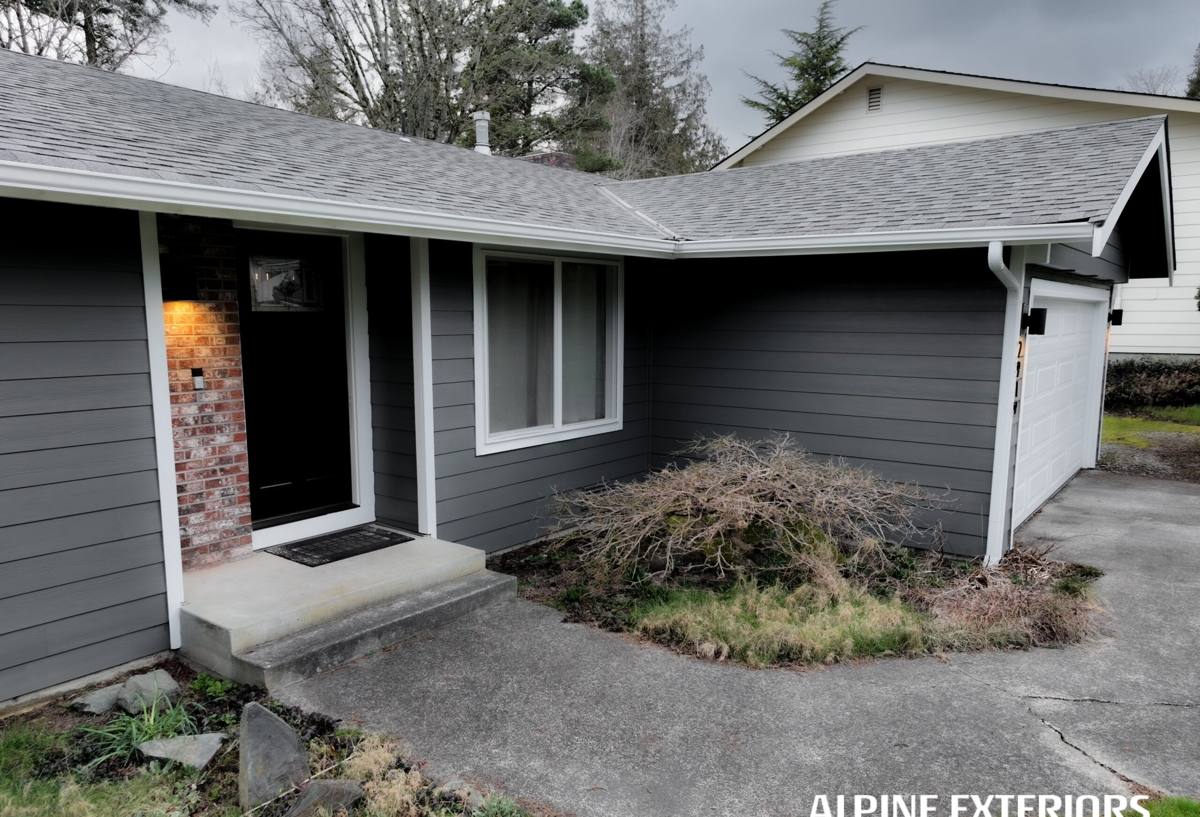
What Primed Spruce Gets Right
To be fair to the product: primed spruce siding has real advantages, and we're not going to pretend otherwise.
- Authentic look. It's actual wood grain, actual wood texture, and it profiles and cuts the way traditional lap siding always has.
- Lower material cost. Board for board, it typically costs less upfront than fiber cement or engineered wood siding.
- Easy to work with. It cuts, nails, and fits trim details the way carpenters have handled wood siding for generations, which keeps labor straightforward on standard walls.
- Repairable in sections. A damaged board can be cut out and replaced without much fuss, at least in the early years before rot spreads.
If a home sat somewhere dry, low-humidity, and shielded from wind-driven rain, primed spruce could hold up reasonably well with diligent upkeep. That's just not the environment most Birch Bay homes sit in.
Primer Is a Head Start, Not a Finish
This is the core issue, and it's often misunderstood at the point of sale. The primer coat on spruce siding is designed to seal the wood long enough to get it installed and topcoated, not to protect it indefinitely. Once boards are cut to length, every end cut, every notch around a window or outlet, and every nail hole is bare, unprimed wood exposed to the weather unless a painter goes back and seals every one of those cut edges by hand.
In practice, that step gets rushed or skipped on a lot of job sites, because it's slow and it's easy to miss on a busy crew. Wood siding doesn't fail first in the open field of a wall. It fails at the joints, the end cuts, and the fastener holes, exactly the places primer coverage is weakest to begin with.
The Painted Wood Maintenance Cycle
Even installed and finished correctly, primed spruce siding is a paint-film product. Its protection lives entirely in that topcoat, and that topcoat has a shelf life. Sun breaks it down, temperature swings crack it at the seams, and once it fails anywhere, moisture gets under the film and starts working on the wood from the inside, where you can't see it until the paint is already bubbling or the wood is already soft.
Birch Bay's Climate Is Exactly the Wrong Test for Wood Siding
Birch Bay sits right on the water, and that's the whole problem for painted wood. Salt air off the bay accelerates the breakdown of paint film and corrodes fasteners faster than an inland location would. Driving rain off winter storms drives moisture sideways into every lap joint and seam on a wall, not just straight down where overhangs can catch it. And the long, damp, shaded moss season here means north-facing and tree-shaded walls stay wet for months at a time rather than drying out between storms.
Wood siding needs to dry out between wetting cycles to survive long-term. In a lot of Whatcom County, especially close to the water in Birch Bay, that drying window is short in summer and barely exists from October through April. That's the environment primed spruce is being asked to perform in, and it's a tough one for any painted wood product, not just this one.
Moss, Algae, and Constant Shade
Moss doesn't just grow on roofs here. It colonizes damp wood siding too, especially on the shaded and north-facing walls that are common on wooded Birch Bay lots. Moss and algae hold moisture against the surface, which keeps that section of wall wet even longer and speeds up paint failure and wood softening underneath it.
Cost Over the Life of the Siding
The sticker price at installation isn't the real comparison. What matters is what a homeowner spends over 20 or 30 years of ownership, and that's where the math shifts.
| Factor | Primed Spruce (Wood) | James Hardie Fiber Cement |
|---|---|---|
| Repainting cycle in coastal climate | Roughly every 5-8 years, sooner on exposed walls | ColorPlus factory finish holds significantly longer; field-painted Hardie still outlasts wood |
| Moisture absorption | Wood fiber absorbs and swells; rot risk at joints and end cuts | Engineered to resist moisture-driven swelling and rot |
| Insect vulnerability | Susceptible to carpenter ants and wood-boring insects | Not a food or nesting source for wood-destroying insects |
| Fire performance | Combustible | Non-combustible fiber cement |
| Manufacturer warranty | Typically none on the wood itself; primer/paint warranties only | Long-term transferable manufacturer warranty when installed to spec |
| Upfront material cost | Lower | Higher |
The lower upfront cost of spruce is real. It's also usually offset within a decade or two by more frequent repainting, earlier board replacement, and in the worst cases, rot repair to the sheathing behind the siding.
Where Spruce Siding Fails First
After enough exterior work in this area, the failure pattern is predictable. It's rarely the whole wall going bad at once.
- Butt joints between boards, where two cut ends meet and end grain is exposed to weather.
- Bottom courses near grade, where splashback and ground moisture keep wood wet longer.
- Under windows and around trim, where caulk joints eventually crack and let water track behind the siding.
- North-facing and shaded walls, where moss holds moisture and paint breaks down faster.
- Nail heads, where rust bleeds through paint and moisture wicks in around the fastener.
Signs Existing Spruce Siding Is Already in Trouble
If you're evaluating a Birch Bay home with existing wood lap siding, these are worth checking before deciding whether to repaint or replace:
- Soft or spongy spots when pressed with a thumb, especially near the bottom courses
- Paint that's peeling or alligatoring rather than just fading
- Visible gaps opening up at butt joints or around trim
- Moss or dark staining that keeps returning within a season of cleaning
- Rust streaking below nail heads
- Any bulging or waviness in the wall plane, which can indicate swelling underneath
Why We Standardized on James Hardie Instead
We made a decision to install one siding system, James Hardie fiber cement, and to stop installing primed spruce, LP SmartSide, vinyl, and other engineered wood products alongside it. That's not a marketing position, it's an operational one. Running one product line means our crews install it the same way every time, to the manufacturer's spec, and we can stand behind the result.
Fiber cement doesn't rely on a paint film sitting on top of raw wood fiber for its core protection. It's a cement-based composite that resists moisture-driven swelling, rot, and insect damage by its nature, and Hardie's HZ product lines are engineered specifically for climate zones like ours. The ColorPlus factory finish is baked on under controlled conditions rather than field-applied, which is a meaningfully different proposition than brush or spray painting bare wood on site. Hardie also backs it with a long-term, transferable warranty, something that isn't typically available on primed lumber siding at all.
For a home a few blocks from the water in Birch Bay, sitting through salt spray, sideways rain, and a shaded moss season most of the year, that's the system we're willing to put our name on.
Getting an Honest Look at Your Home
Every property is different. Sun exposure, tree cover, distance from the water, and how the last siding job was installed all matter more than any brand name on its own. If you're weighing a repaint, a repair, or a full re-side in Birch Bay or elsewhere in Whatcom County, we're happy to take a look and give you a straight answer about what your walls actually need. Reach out for a free, no-pressure estimate using the form below.