 Birch Bay Siding
 Siding Built for Point Whitehorn's Coastal Exposure
Point Whitehorn sits along the Whatcom County shoreline near Birch Bay, close enough to the water that homes here deal with a different set of exterior stresses than houses ten miles inland. Salt-laden air off the Strait of Georgia, wind-driven rain that comes in sideways during winter storms, and a wet season that stretches from fall through spring all put steady pressure on siding, trim, and roofing. Add the tree cover common to the area's rural and wooded lots, and you get long stretches of shade that keep surfaces damp and feed moss and algae growth for much of the year.
None of that is unusual for this stretch of the Pacific Northwest coast. But it does mean that siding choices which hold up fine in a drier climate, or even in a less exposed part of Whatcom County, can underperform here. We install exclusively James Hardie fiber cement siding because it's the product we've found consistently handles this combination of salt, moisture, and shade without the maintenance headaches that come with softer materials.
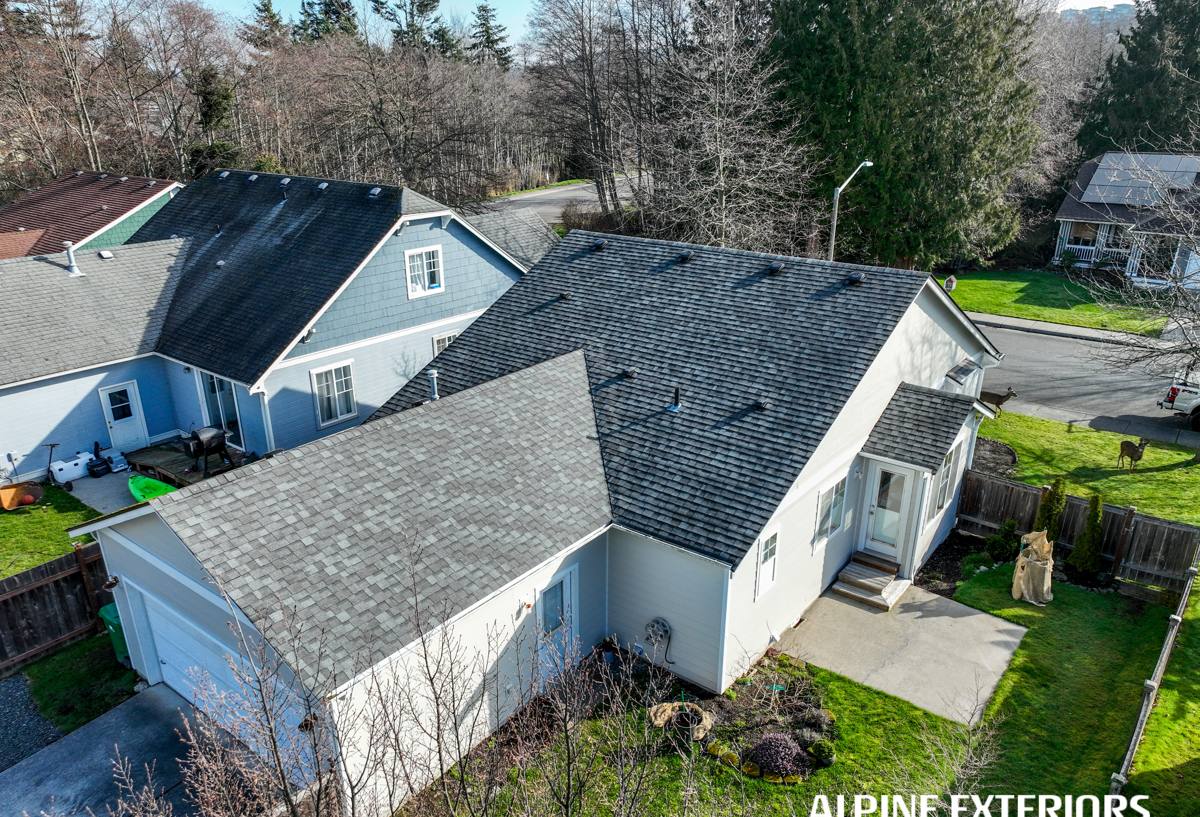
What Coastal Exposure Actually Does to a House
Salt Air and Metal Fasteners
Airborne salt doesn't just sit on the surface of your siding — it accelerates corrosion on anything metal it touches, including fasteners, flashing, and trim hardware. Over years, corroding fasteners can loosen siding panels or create small gaps where water intrudes. This is one of several reasons fastener selection and flashing details matter more here than they would on a home twenty miles from the water.
Wind-Driven Rain
Rain that falls straight down is far less of a threat to a home's exterior than rain that gets pushed sideways by wind. Point Whitehorn's exposure to weather rolling in off the water means siding, window flashing, and butt joints take on rain from angles that a more sheltered installation might never see. Any weak point in the water-management system — a poorly lapped joint, a caulked seam instead of a properly flashed one — gets tested repeatedly.
Moss, Algae, and Shade
Wooded lots and the region's long damp season mean north-facing walls and shaded siding can stay wet for days after a storm passes. That's an ideal environment for moss and algae, which hold moisture against the siding surface and, on materials that aren't dimensionally stable, can contribute to swelling, cracking, or coating breakdown over time.
Why We Standardized on James Hardie Fiber Cement
We don't install vinyl siding, LP SmartSide, primed wood, or engineered wood products like Cemplank or Allura. That's not a marketing position — it's a decision built around what we see holding up in this climate versus what doesn't.
- Non-combustible core: Hardie's fiber cement composition doesn't burn, feed, or spread flame the way wood-based siding can, which matters for insurance considerations as much as safety.
- Dimensional stability: Fiber cement doesn't swell and shrink with moisture cycles the way engineered wood products can, which reduces the risk of joint failure and paint cracking over time.
- Factory-applied ColorPlus finish: The baked-on finish resists fading and holds up to UV and salt exposure far longer than field-applied paint, and it comes with its own dedicated warranty.
- Climate-engineered HZ5 formulation: Hardie makes region-specific product lines, and the HZ5 formulation is built for exactly the wet, freeze-thaw-adjacent Pacific Northwest conditions Whatcom County sees.
- Long transferable warranty: A strong, transferable warranty matters more on a home near the water, where exterior materials are working harder from day one.
None of this means other products are junk — vinyl and engineered wood siding both have legitimate uses and reasonable track records in milder, more sheltered settings. But for a coastal Whatcom County installation, we'd rather stand behind one product we trust completely than offer several and hope the wrong one doesn't end up on a house exposed to salt air and driving rain.
Signs Your Siding Is Losing the Fight
Coastal exposure doesn't announce itself with a single dramatic failure — it shows up gradually. Homeowners in Point Whitehorn should watch for:
- Soft or spongy spots when you press on siding, especially near the bottom courses or around window trim
- Persistent moss or dark streaking that comes back within weeks of cleaning
- Paint that's peeling, bubbling, or chalking rather than just fading evenly
- Visible gaps or separation at butt joints and corner boards
- Warping, cupping, or bowing panels, particularly on shaded north- or west-facing walls
- Rising utility bills that might point to moisture-compromised insulation behind the siding
- Rust streaks below fasteners or flashing, a sign metal hardware is corroding
Any one of these on its own might be minor. Several together, especially on a home that's fifteen-plus years old with its original siding, usually means it's time for a real assessment rather than another round of caulk and paint.
What Correct Installation Looks Like Here
Fiber cement performs well over the long run, but only when it's installed to spec. In an exposed coastal setting like Point Whitehorn, a few details matter more than they might elsewhere:
Water Management First
Proper house wrap, correctly lapped flashing at every window and door, and rainscreen or drainage gap detailing where called for all matter more here because wind-driven rain will find any shortcut in the water-management plan. Siding is the visible layer, but what's behind it determines whether moisture actually stays out.
Fastener and Hardware Choice
We use corrosion-resistant fasteners appropriate for coastal exposure, not just whatever's fastest to run through a nail gun. This is a small line-item cost that prevents a much bigger problem ten years down the road.
Manufacturer Spec Compliance
James Hardie's warranty depends on installation following their published specifications — nailing patterns, clearances from grade and roofing, joint treatment, and paint or caulk compatibility. Skipping these details doesn't just risk premature failure, it can void the warranty you're paying for.
Comparing Siding Options for a Coastal Whatcom County Home
| Factor | Vinyl | Engineered Wood (LP/Cemplank/Allura) | James Hardie Fiber Cement |
|---|---|---|---|
| Moisture resistance | Doesn't rot, but can warp and gap with heat/cold cycling | Vulnerable to swelling and edge deterioration if moisture reaches the core | Dimensionally stable; engineered for wet climates |
| Fire performance | Combustible | Combustible (wood-based) | Non-combustible |
| Salt air durability | Generally holds up, can chalk/fade | Coating and joints under more stress near salt exposure | Factory finish rated for UV and coastal exposure |
| Maintenance | Low, but repairs can be visually mismatched | Requires ongoing paint and caulk upkeep | Low; repaint cycle is much longer than field-painted products |
| Typical lifespan (installed to spec) | 20–30 years | Variable, often shorter in wet climates | 30–50+ years |
This isn't a knock on the alternatives — it's simply why, weighing all of this against what this specific climate does to a house, we install one product and stand fully behind it.
Siding Rarely Stands Alone
A siding project is a good time to take stock of the rest of the exterior envelope, because water intrusion at the roofline or around windows often shows up as siding damage even when the siding itself isn't the root cause. We handle roofing, windows, and decks alongside siding, which means:
- Roof-to-wall flashing gets addressed as part of the same water-management plan, not treated as someone else's problem
- Window replacement can be coordinated with siding removal, avoiding a second round of trim and flashing work later
- Deck ledger connections and siding meet cleanly instead of being patched around after the fact
For a home exposed to the amount of moisture Point Whitehorn sees, having one crew accountable for how these systems tie together is worth more than it might seem at first.
Why a Local Crew Matters Here
Point Whitehorn isn't a large market, and it's easy for out-of-area crews to treat it as a stop on the way to somewhere else. We're based in Birch Bay and work this part of Whatcom County regularly, which means we've seen how homes here actually age — which walls take the worst weather, where moss builds up fastest, and what installation shortcuts show up as problems five years later. That local pattern recognition shapes how we bid and how we install, not just what we say in a sales pitch.
Cost Factors to Expect
Every home is different, but a few factors consistently move the price on a Point Whitehorn siding job:
- Square footage and the number of stories, which affects both material and labor scope
- How much of the existing siding, sheathing, or house wrap needs to be removed and replaced versus reused
- Trim complexity — corners, window and door surrounds, and architectural detailing add labor time
- Access and site conditions, including tree cover, slope, and how close the home sits to neighboring structures
- Whether roofing, window, or deck work is bundled into the same project
We won't quote a number without seeing the house, but we'll always walk you through what's driving the estimate line by line.
If your Point Whitehorn home is showing signs of wear from salt air, moss, or years of coastal weather, we'll come take a look and give you a straightforward, no-pressure estimate — just fill out the form below to get started.