 Birch Bay Siding
 Siding in Terrell Creek: A Coastal Whatcom County Neighborhood
Terrell Creek sits inland from the Birch Bay shoreline, but "inland" here doesn't mean sheltered. Homes in this part of Whatcom County still sit inside the same marine air mass that rolls in off the Salish Sea, and the creek corridor itself adds its own dose of dampness — low-lying, tree-shaded, and slow to dry out after a soaking Pacific Northwest winter. If you own a home here, your siding is doing more work than siding does almost anywhere else in the country. It's not just weatherproofing; it's the first line of defense against a climate that never really lets a house dry all the way out.
We've worked on homes throughout the Birch Bay area long enough to see the pattern repeat itself: siding that looks fine from the street but is quietly failing at the seams, the trim, and the north-facing wall nobody looks at closely. This page is about what that failure looks like, why it happens faster here than in drier parts of the state, and what we do differently.
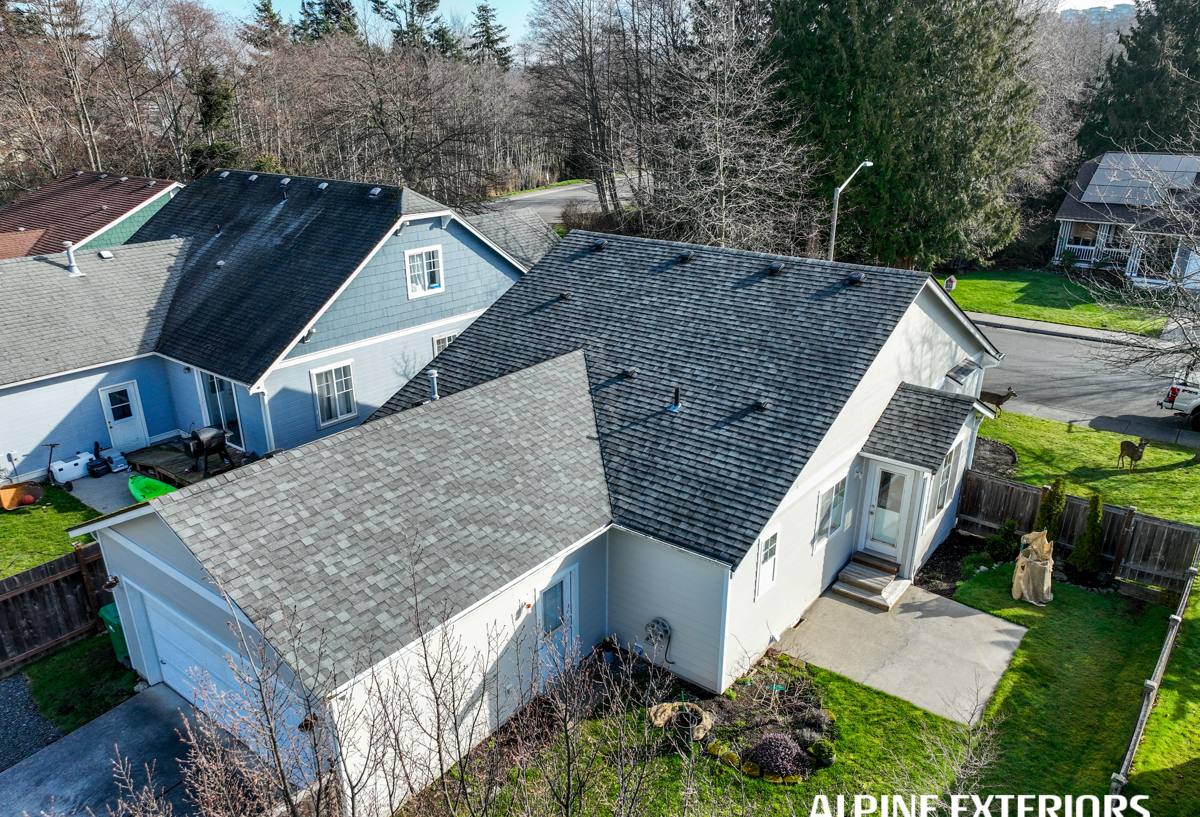
Why Terrell Creek Homes Show Moss, Mildew, and Moisture Damage Sooner
Three things stack up against exterior surfaces in this neighborhood:
- Salt-laden air. Even a few miles from Birch Bay itself, airborne salt settles on siding, trim, and fasteners. It accelerates corrosion on anything metal and slowly breaks down finishes not built to handle it.
- Driving rain. Whatcom County storms don't just fall straight down — wind pushes rain sideways into wall assemblies, working into laps, seams, and butt joints that a calm-weather installation would never expose.
- A long moss season. Cool, wet, shaded conditions for much of the year mean moss, algae, and mildew get a long runway to establish themselves on north- and west-facing walls, especially where tree cover from the creek corridor keeps siding from drying between rain events.
Individually, none of these is unusual for Western Washington. Together, over years, they're exactly the combination that exposes weak points in lower-grade siding products — swelling at cut edges, paint that chalks and peels early, and moisture that gets in and has nowhere to go.
Salt Air and Driving Rain: The Two Forces We Design Against
Most siding failures we get called out to inspect aren't dramatic. They're slow. Caulk lines open up a hairline crack, wind-driven rain finds it, and the wall assembly behind the siding stays damp longer than it should. Repeat that cycle enough winters in a row and you get soft trim, stained fascia, or siding that's swollen and separating at the joints — often before the homeowner even notices from the ground.
That's why the details matter more here than the material specs alone. Flashing above windows and doors, proper lap sequencing, correct fastener spacing, and gaps sized to let the assembly breathe and drain are what actually keep water out — not just what the siding is made of. A high-quality product installed loosely will still fail early in this climate. A well-detailed installation is what buys you decades, not years.
What "Correct Installation" Actually Involves
- Weather-resistant barrier installed and lapped correctly behind the siding, not just stapled up as an afterthought
- Flashing integrated at every window, door, and roof-to-wall transition — the spots wind-driven rain targets first
- Proper clearance between siding and grade, decks, and roof lines so water has somewhere to go
- Fasteners matched to the product and driven to manufacturer spec — not overdriven, not underdriven
- Caulking used only where the manufacturer calls for it, not as a substitute for proper flashing
Why We Install Only James Hardie Fiber Cement
We made a decision a while back to stop installing several products that are common elsewhere: vinyl, LP SmartSide, primed spruce, cedar, and composite panels like Cemplank or Allura. It wasn't about any one of them being a bad product in every circumstance — it's that on the Birch Bay and Whatcom County coastline, they each have a real-world weak point that this climate finds and exploits.
Vinyl can warp and become brittle over time and doesn't hold paint if you ever want to change your home's color. Engineered wood products like LP SmartSide depend on their factory coating and edge-sealing staying intact — any breach lets moisture into the wood substrate, and once that happens in a wet climate, it doesn't reverse itself. Untreated or primed wood siding needs a maintenance schedule most homeowners don't actually keep up with, and in a moss-prone, salt-air environment, that gap shows up as rot faster than in drier regions.
James Hardie fiber cement doesn't have organic material for moisture to feed on. It's non-combustible, holds its factory finish far longer than field-painted alternatives, and it was engineered with climate zones like ours specifically in mind.
HZ5 and Climate-Engineered Product Lines
Hardie's HZ5 formulation is engineered for the wetter, harsher weather patterns of the Pacific Northwest — different from the version sold in dry, hot climates. Combined with the factory-applied ColorPlus finish, which is baked on under controlled conditions rather than brushed on at the jobsite, you get a finish that resists fading, chipping, and cracking far longer than site-applied paint, and a substrate that simply doesn't rot, swell, or feed mold the way wood-based products can.
What This Means for a Terrell Creek Home Specifically
In a location dealing with salt air, wind-driven rain, and a long wet season, the practical benefit is straightforward: less repainting, less caulk maintenance, no swelling at cut edges, and a much lower chance that a small breach in the surface turns into structural rot behind the wall. It's not a magic material — it still needs to be installed correctly, with the right flashing and clearances — but it removes the single biggest failure mode we see in this climate: moisture getting into an organic substrate and staying there.
Siding Product Comparison for This Climate
| Product | Moisture Behavior in Wet Climates | Maintenance | Our Position |
|---|---|---|---|
| Vinyl | Doesn't rot, but can warp, crack in cold, and fade unevenly | Low, but not repaintable | Not installed |
| LP SmartSide / engineered wood | Vulnerable at cut edges and coating breaches; wood substrate can swell and rot | Moderate — coating integrity must be maintained | Not installed |
| Cedar / primed spruce | Organic material; needs consistent sealing to resist rot and moss | High — regular refinishing required | Not installed |
| Cemplank / Allura fiber cement | Similar base material to Hardie, but different finish and warranty structure | Low to moderate depending on finish | Not installed |
| James Hardie fiber cement | Non-combustible, doesn't rot or feed mold; factory finish resists our climate | Low — occasional washing | What we install |
Beyond Siding: Roofing, Windows, and Decks That Work Together
Siding doesn't work in isolation. On a Terrell Creek home, the roof, windows, siding, and any exterior deck all interact at the same vulnerable transition points — roof-to-wall flashing, window head flashing, deck ledger connections. A siding job that ignores what's happening at the roofline or around window openings just moves the water problem somewhere else.
Because we handle roofing, windows, decks, and siding, we look at these transitions as one system rather than four separate scopes of work. A window replacement done alongside a siding project means the flashing gets integrated properly the first time, instead of a second contractor working around whatever's already there. The same goes for deck ledger flashing, which is one of the most common hidden rot locations we find on older Pacific Northwest homes.
What to Expect From a Siding Project in Terrell Creek
Every home is different, but the general process looks similar for most projects in this area:
- An on-site inspection of existing siding, trim, and any moisture or rot already present
- Removal of old siding and inspection of the sheathing underneath for hidden damage
- Repair of any compromised sheathing or framing before new material goes up
- Installation of a properly lapped weather-resistant barrier and correct flashing at every penetration
- James Hardie panel or lap siding installation to manufacturer spec, including fastener pattern and clearances
- Final trim, caulking only where specified, and a walkthrough of the finished work
Homes closer to the creek or under heavier tree cover sometimes need extra attention to ventilation and drainage planning, since those areas dry out more slowly after a storm. We flag that during the initial inspection rather than after the fact.
Cost Factors for Siding Replacement
Every home is priced individually after an on-site look, but the factors that move the number are consistent across Whatcom County projects:
| Factor | Why It Matters |
|---|---|
| Home size and wall complexity | More corners, gables, and dormers mean more cutting, flashing, and labor time |
| Condition of existing sheathing | Hidden rot found during tear-off adds repair scope before new siding can go up |
| Siding profile chosen | Lap, shingle, and panel styles vary in material and installation time |
| Trim and accessory work | Window trim, corner boards, and fascia detailing add labor and material |
| Access and site conditions | Tree cover, slope, and staging space near the creek can affect scheduling and setup |
Why a Local Crew Matters Here
A crew that mostly works inland or in drier parts of the state doesn't build the same instincts a crew working Birch Bay and the surrounding Whatcom County coastline does. Knowing which walls take the worst of the wind-driven rain, which corners of a lot stay shaded and damp long after a storm passes, and how salt air behaves on fasteners and trim over a decade isn't something you get from a spec sheet — it's something you learn by doing the work here, year after year, and going back to see how it held up.
That's the standard we hold ourselves to on every Terrell Creek project: not just meeting code, but building for the specific way this stretch of coastline actually behaves in bad weather.
Ready to Talk About Your Home?
If your siding is showing moss, chalking paint, soft trim, or you're just planning ahead before it becomes a problem, we're happy to take a look. Reach out for a free, no-pressure estimate — we'll walk the exterior with you, point out anything we see, and give you a straight answer on what your home actually needs.