 Birch Bay Siding
 Siding That Holds Up in Lynden's Climate
Lynden sits inland from the water compared to towns right on Birch Bay or the Strait, but it's still very much part of Whatcom County's marine-influenced weather pattern. Moist air moves up the Nooksack River valley and settles over the flat farmland and residential streets here for days at a time. Add in a long, gray Pacific Northwest winter and you get a climate that's genuinely hard on exterior building materials: siding stays damp for extended stretches, gets minimal direct sun exposure on north- and east-facing walls, and spends a good chunk of the year hosting moss, algae, and mildew rather than shedding it.
Homes in Lynden also deal with wide seasonal swings — warm, dry summer stretches followed by cold, wet winters with frequent freeze-thaw cycling. That combination of prolonged moisture exposure and temperature swings is exactly the kind of environment that separates siding products that perform for 30-plus years from products that start showing problems in year eight or ten. We install James Hardie fiber cement siding exclusively because it's engineered to handle that cycle without the maintenance headaches that come with other materials.
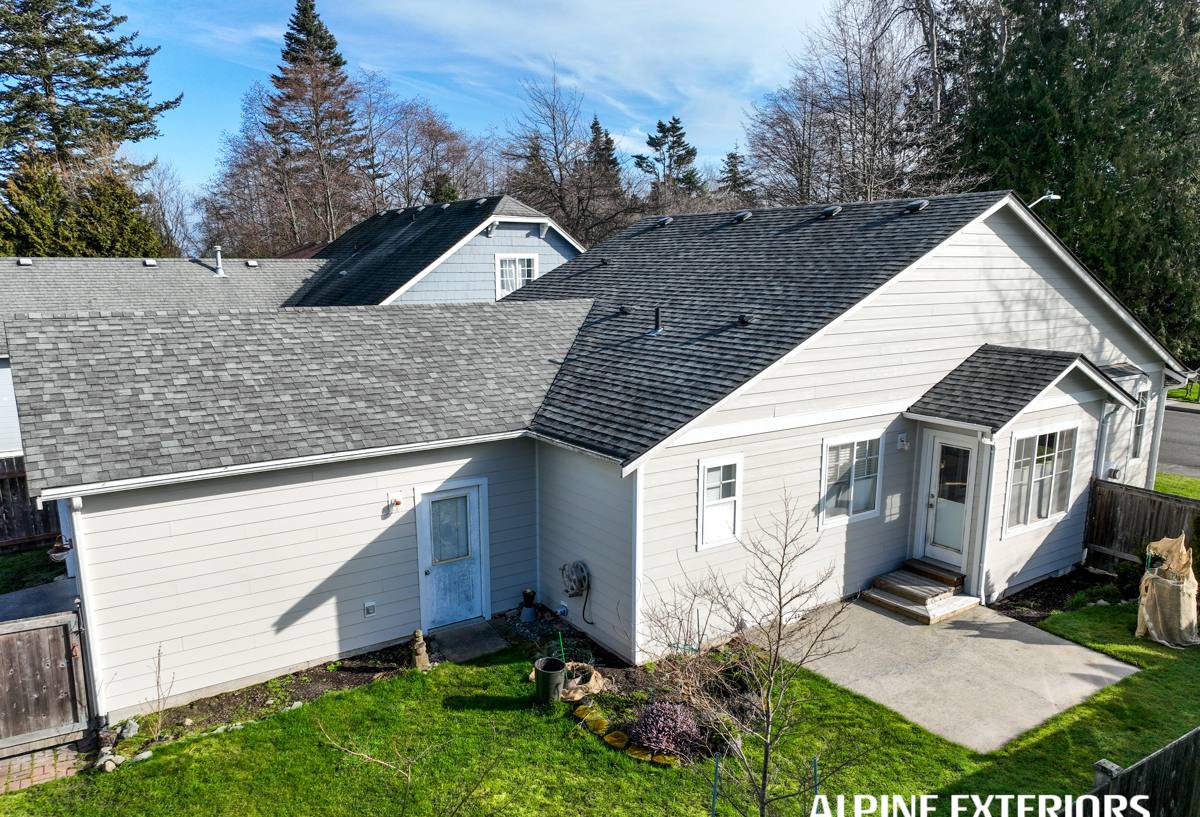
What Whatcom County Weather Actually Does to Siding
Moisture That Doesn't Leave
In a lot of the country, siding gets wet, then gets several hours of direct sun and low humidity to dry back out. In Lynden, especially from late fall through early spring, that drying window can be short or nonexistent for weeks at a stretch. Any siding material that absorbs moisture, or that relies on a paint film to keep water out, is working against the clock here. Wood-based products swell, siding seams can telegraph moisture intrusion behind the cladding, and paint films that would last a decade in a drier climate start failing years sooner.
Moss and Organic Growth
Shaded siding, north walls, and areas under trees or roof overhangs in Lynden are prone to moss and algae growth for a good part of the year. This isn't just cosmetic — organic growth holds moisture against the siding surface, which accelerates whatever degradation process is already happening underneath. Siding that's more porous or that has a softer painted surface gives moss more to grip onto and more material to feed on over time.
UV and Temperature Swings
Summers here aren't extreme, but they do bring stretches of strong, direct sun that bake south- and west-facing walls after months of damp conditions. That expansion-and-contraction cycle, repeated year after year, is hard on any material that isn't dimensionally stable — it's a major reason caulk joints crack, panels warp, and finishes chalk out prematurely on lower-grade siding.
Why We Only Install James Hardie
Before Birch Bay Siding Company standardized on James Hardie, we installed and repaired a wide range of siding products across Whatcom County homes. What we kept seeing, especially in damp, low-sun areas like parts of Lynden, was a pattern: materials that looked fine on install day but developed moisture problems, finish failure, or structural softening within a decade — well short of what a homeowner should expect from a full siding investment.
James Hardie fiber cement is made from cement, sand, and cellulose fiber. It doesn't absorb water the way wood-based products do, it won't rot, and it's non-combustible — a meaningful consideration for homeowners thinking about wildfire risk during the region's drier months. Hardie also factory-applies its ColorPlus finish under controlled conditions, which gives a more consistent, longer-lasting bond than field-applied paint ever can. That matters enormously in a climate where a siding product spends more time wet than dry for a good portion of the year.
What We Chose Not to Install, and Why
| Product | Where it falls short in this climate |
|---|---|
| Vinyl siding | Can warp or distort with temperature swings; seams and J-channels give moisture a path behind the panel; color fades over time with no way to refinish it |
| LP SmartSide | Engineered wood product — edges and cut ends are vulnerable to moisture intrusion if not sealed and maintained precisely, which is a hard standard to hold for the life of a house |
| Primed spruce / cedar | Natural wood movement, and ongoing repainting and caulk maintenance needed to keep moisture out — a heavy burden in a climate that rarely gives siding time to dry |
| Cemplank / Allura | Other fiber cement brands with similar core material to Hardie, but without the same factory finish warranty structure and regional engineering we've come to rely on |
None of these are bad products in every application. They're just products we've watched underperform in exactly the kind of damp, low-sun, moss-prone conditions Lynden homes deal with, and we'd rather tell a homeowner that upfront than sell something we don't believe will hold up.
James Hardie Product Lines for This Area
James Hardie makes climate-engineered product lines, and for Whatcom County we work almost exclusively with the HZ10 line, formulated for the cooler, wetter climate zones of the Pacific Northwest. Within that, homeowners typically choose between:
- HardiePlank lap siding — the most common choice, available in several exposure widths and smooth or cedar-textured finishes
- HardiePanel vertical siding — often used for accent walls, gables, or a more modern look
- HardieShingle siding — a good match for homes wanting a traditional or craftsman look without the maintenance burden of real wood shingles
- HardieTrim — used around windows, corners, and fascia to give a finished, consistent look that matches the siding's durability
ColorPlus finishes come in a range of regionally popular colors, and Hardie's factory finish carries its own finish warranty separate from the substrate warranty — worth understanding when you're comparing quotes, since not every "Hardie install" is finished or warrantied the same way.
Installation Quality Matters As Much As the Product
Fiber cement siding is only as good as its installation. Even the right product, installed wrong, will fail early in a climate like Lynden's. A few things we hold ourselves to on every job:
- Proper clearance between siding and grade, decks, and roof lines to avoid wicking moisture
- Correct fastener spacing and placement per Hardie's published specifications
- Rain screen or drainage plane installation appropriate to the wall assembly
- Properly flashed and sealed penetrations at windows, doors, and utility fixtures
- Factory-cut edges kept intact wherever possible, with cut ends properly sealed when field cuts are unavoidable
These details rarely show up in a driveway walkthrough after the job's done, but they're the difference between siding that performs for its full warranty period and siding that develops moisture problems behind the wall a few years in.
Why a Local Crew Matters Here
A crew that's done this work across Whatcom County knows which walls in a Lynden neighborhood tend to stay shaded and damp longest, how local wind and rain patterns hit a given elevation, and where moss and mildew problems tend to start first. That's not something a crew from outside the region reliably knows walking onto a job site for the first time. It shapes decisions on ventilation, drainage detailing, and even where we'd recommend trim versus flat panel on a given elevation.
Being local also means we're not disappearing after the install. If a question comes up two years down the road about a caulk line or a trim detail, we're still in the area and still standing behind the work.
Roofing, Windows, and Decks Alongside Your Siding
Siding doesn't work in isolation — it's part of a building envelope that includes your roof, windows, and any attached decks. Beyond siding, we also handle roofing, window replacement, and deck work, which matters when problems overlap. Deteriorating roof flashing can send water behind siding at a wall-roof intersection; an old window can leak at the flange and damage the siding around it; a deck ledger attached without proper flashing can rot the wall behind it. When we're on-site for a siding project, we look at the whole envelope, not just the cladding, so problems don't get patched over instead of fixed.
What a Siding Project Typically Involves
- An on-site assessment of your current siding, sheathing, and any moisture or rot found during removal
- A product and color plan, including trim and accent decisions
- Confirmation of drainage plane and flashing details specific to your home's construction
- Installation to Hardie's fastening and clearance specifications
- A final walkthrough covering warranty paperwork for both the substrate and the ColorPlus finish
Cost Factors Homeowners Should Understand
| Factor | Why it affects your project |
|---|---|
| Home size and wall complexity | More corners, gables, and elevation changes mean more cutting, trim, and labor time |
| Condition of existing sheathing | Rot or moisture damage found during tear-off adds repair scope before new siding goes on |
| Siding profile and texture chosen | Lap width, smooth vs. textured finish, and panel vs. shingle style all affect material cost |
| Trim and accent detailing | Vertical accent panels, extra trim boards, and custom color combinations add labor and material |
| Site access | Tight lots, landscaping, or multi-story walls can affect equipment needs and labor time |
We won't quote a broad number without seeing the home, but these are the factors that move a bid up or down, and worth asking about when you're comparing estimates from different contractors.
Get a Straight Answer for Your Home
If your siding is aging, showing moss buildup that won't go away, or you're just planning ahead for a project in the next year or two, we're happy to take a look and give you an honest read on where things stand — no pressure, no hard sell. Fill out the form below to schedule a free estimate for your Lynden home.