 Birch Bay Siding
 Two Very Different Materials, One Big Decision
When a homeowner in Birch Bay starts pricing out new siding, the conversation almost always comes down to two materials: vinyl and James Hardie fiber cement. Both are common in Whatcom County. Both show up on countless bids. But they are built differently, they age differently, and they behave differently once they're facing the specific mix of salt air, driving rain, and long moss season that defines this stretch of the Washington coast.
We install James Hardie fiber cement exclusively. We don't install vinyl, and we think homeowners deserve a straight answer about why — not a sales pitch, and not a takedown of a product that millions of homes use successfully. This page lays out what each material actually does well, where each one runs into trouble, and why our crews standardized on one over the other.
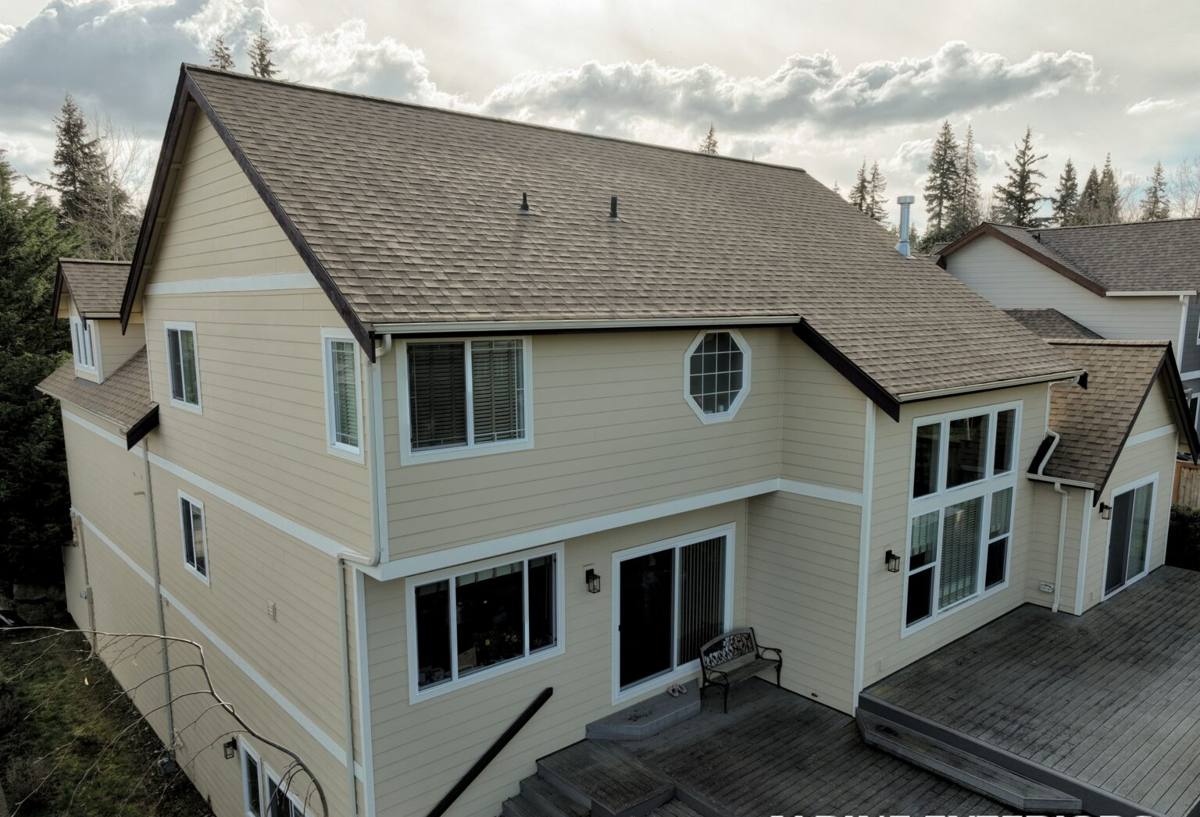
What Vinyl Siding Gets Right
Vinyl earned its place in the market honestly. It deserves credit for what it does well:
- Lower upfront cost. Material and installation costs are typically less than fiber cement, which matters on a tight budget or an investment property.
- Fast installation. Vinyl panels are light and quick to hang, which shortens labor time and can lower the total bill further.
- No painting required. Color is mixed into the panel itself, so there's no factory or field finish to maintain in the way a painted surface needs upkeep.
- Wide availability. Product, parts, and installers are easy to find almost anywhere, including here in Whatcom County.
For a lot of homes in drier, more moderate climates, vinyl performs adequately for years with minimal fuss. The trouble starts when you put it up against the specific conditions Birch Bay throws at a house.
Where Vinyl Struggles in a Salt-Air, High-Rain Climate
Moisture Management Behind the Panels
Vinyl siding is installed as an overlapping shell, not a sealed skin — it's designed to let some water in and drain it back out behind the panels. That works fine as a system when everything behind it is detailed correctly. But it means the house's water-resistive barrier and flashing are doing almost all of the real work, and vinyl offers very little backup if that layer is ever compromised. In a location that sees sustained, wind-driven rain off the Salish Sea for much of the year, that's a thinner margin for error than we're comfortable with.
UV Fading and Heat Distortion
Even under the Pacific Northwest's frequently overcast skies, UV exposure on south- and west-facing walls fades vinyl unevenly over time, and there's no practical way to repaint or refinish it to match — replacement is usually the only fix. Vinyl can also warp or ripple when it absorbs heat unevenly, particularly near reflective surfaces like windows or dark-colored neighboring materials.
Wind, Rattle, and Fastener Movement
Vinyl panels are intentionally installed with loose-nailing so they can expand and contract with temperature swings. That same looseness is what lets sustained coastal wind work panels over time, and it's a common source of the rattling and occasional panel loss homeowners report after a hard storm blowing in off the water.
Moss, Algae, and the Seams
Whatcom County's long wet season is exactly the environment moss and algae thrive in. Vinyl's overlapping seams and slightly textured surface give organic growth plenty of places to take hold, especially on shaded north walls or under tree cover — both common around Birch Bay. Cleaning helps, but it's an ongoing maintenance task rather than a one-time fix.
Salt Air and Hardware
Being this close to the water means airborne salt reaches every exterior surface, including the fasteners and trim hardware behind and around vinyl siding. Lower-grade fasteners are more prone to corrosion in this environment, which can show up as staining or loosening well before the siding itself would otherwise need replacing.
What James Hardie Fiber Cement Delivers
A Different Material, Not Just a Different Look
James Hardie siding is made from cement, sand, and cellulose fiber, pressed and cured into dense, rigid boards. It doesn't rely on flexibility and drainage gaps the way vinyl does — it's a heavier, more stable material that resists warping, cracking from impact, and moisture intrusion at the board level. It's also non-combustible, which matters to insurers and to homeowners thinking about wildfire-adjacent risk even in a coastal, high-rainfall region.
Climate-Engineered Product Lines
James Hardie makes region-specific "HZ" formulations engineered for different climate zones, including the wetter, milder conditions found across the Pacific Northwest. That's a meaningful distinction from a one-size-fits-all product — the board itself is formulated with our rainfall and humidity in mind, not just styled to look good in a showroom.
ColorPlus Factory Finish
Most Hardie siding we install uses the ColorPlus finishing system — a baked-on, factory-applied finish that's more consistent and more fade- and moisture-resistant than field-applied paint. It also means less on-site painting exposure to weather during installation, which is a real advantage on a job site that has to work around Birch Bay's rain windows.
Density Resists Moss and Algae Better
Fiber cement's dense, smooth-finished surface gives moss and algae less to grip onto compared to more porous or seamed materials, and it holds up to occasional pressure washing without the risk of denting or cracking that thinner materials carry.
Cost and Long-Term Value, Side by Side
Cost comparisons get thrown around loosely in this industry, so we'll keep this to broad, honest ranges rather than pretending there's a fixed number — actual pricing depends on the home's size, siding removal, trim detail, and access.
| Factor | Vinyl Siding | James Hardie Fiber Cement |
|---|---|---|
| Upfront material + install cost | Lower | Moderate to higher |
| Typical lifespan with normal upkeep | Shorter | Longer |
| Repainting needed | No (but fades, can't be refinished to match) | Rare with ColorPlus; conventional finish repaints on a normal cycle |
| Moisture resilience in high-rain climate | Depends heavily on underlying barrier detailing | Higher — board itself resists moisture damage |
| Impact and wind resistance | Lower | Higher |
| Fire rating | Combustible | Non-combustible |
| Resale perception | Standard | Generally viewed as an upgrade |
The pattern that matters most for a coastal Whatcom County home: vinyl's advantage is almost entirely on day one, while Hardie's advantage compounds the longer the house is exposed to salt air, rain, and moss pressure.
Installation Sensitivity — Both Materials Demand It, Differently
Neither product is foolproof to install, and bad installation can undercut either one. The difference is what goes wrong when corners get cut.
Vinyl installed too tight — without room to expand and contract — will buckle and wave with temperature swings. Installed too loose, it rattles and can blow off in wind. Because the material itself offers little structural backup, mistakes in the water-resistive barrier or flashing behind it tend to show up as hidden moisture damage long before anyone sees a problem on the surface.
Hardie siding requires correct fastener spacing, proper clearances from grade, decks, and roof lines, and correctly sealed and caulked joints and butt seams — especially critical in a climate where those joints see sustained rain exposure. Cut edges need field-applied touch-up paint to maintain the finish warranty. It's less forgiving of a rushed crew, which is exactly why we treat installation training and manufacturer-spec detailing as non-negotiable rather than optional.
Warranty Structure: Read the Fine Print
Vinyl siding warranties are commonly prorated, meaning the coverage value declines as the product ages — a panel that fails in year 18 of a "lifetime" warranty may only be covered for a fraction of replacement cost, and labor is often excluded entirely.
James Hardie's warranty on the substrate itself is non-prorated and transferable to a new owner within the coverage period, and ColorPlus finishes carry a separate finish warranty. Warranty terms are set by the manufacturer and can change, so we always review current warranty documentation with homeowners directly rather than relying on marketing summaries — but the structural difference between prorated and non-prorated coverage is worth understanding regardless of which product a homeowner ultimately chooses.
Why We Standardized on Hardie for Birch Bay Homes
We made a decision, as a company, to install one siding system and install it well rather than offer several products and spread our crews thin across different installation standards. Given what this coastline does to a house — salt air working on hardware, driving rain testing every seam, and moss finding every shaded, damp surface — we concluded fiber cement gives homeowners a better match for the actual conditions their siding has to survive, not just the conditions on a sunny install day.
That's a professional standard we hold ourselves to, not a claim that vinyl is unusable everywhere. It simply isn't the product we're willing to put our name behind on this stretch of Whatcom County coastline.
Questions Worth Asking Before You Choose
- Is the quoted product engineered or rated for a high-rainfall, coastal climate zone?
- Is the warranty prorated, and does it cover labor as well as material?
- What's the manufacturer's specified fastening and clearance detail, and will the crew follow it?
- How is the water-resistive barrier and flashing detailed behind the siding?
- What's the plan for moss and algae exposure on shaded or tree-covered walls?
- Is the finish factory-applied or field-painted, and what does that mean for future maintenance?
If you're weighing siding options for a Birch Bay home, we're happy to walk the exterior with you, talk through what we're seeing, and give you a straightforward, no-pressure estimate for a Hardie installation done to spec.