 Birch Bay Siding
 Siding Built for Nooksack's Weather, Not Just Its Look
Nooksack sits inland from Birch Bay, but the weather doesn't respect that distance. Whatcom County homes from the shoreline to the Nooksack River valley deal with the same basic pattern all winter and spring: long stretches of driving rain, low clouds that don't burn off for days, and enough sustained moisture to keep north-facing walls and shaded siding damp for weeks at a time. Add in the salt-tinged air that rides inland off Birch Bay and the Strait of Georgia on a west wind, and you've got exterior conditions that punish anything less than a genuinely weather-resistant siding system.
We're a local exterior contractor working across Birch Bay and the surrounding Whatcom County communities, including Nooksack. We install siding, roofing, windows, and decks, and on siding specifically, we've made a deliberate choice: we only install James Hardie fiber cement. This page explains what Nooksack homes are up against and how we approach siding work here.
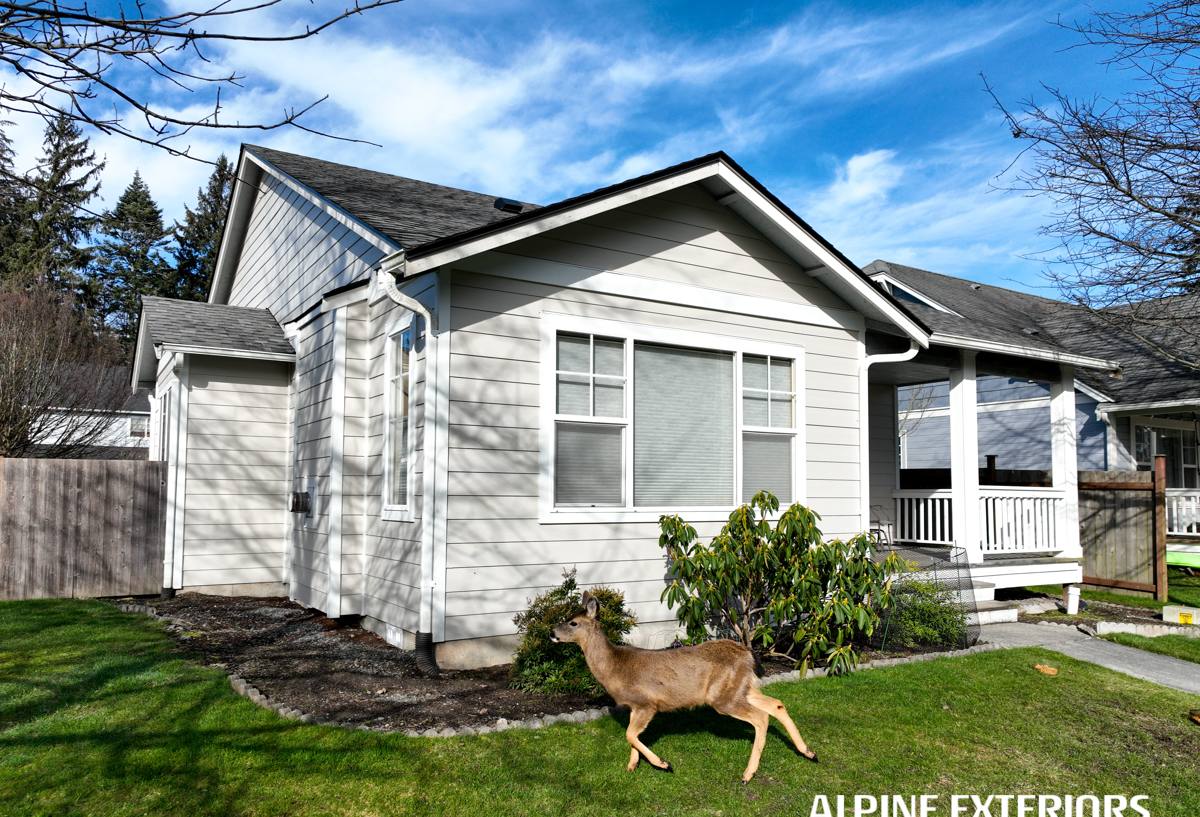
What This Climate Does to Siding Over Time
Moisture That Doesn't Let Up
Whatcom County's wet season isn't defined by hard downpours so much as by duration. Rain here tends to fall steadily, sideways when the wind picks up, and it can linger for days. Siding that isn't dimensionally stable, or that has weak points at seams and fastener locations, will eventually let water find its way behind the cladding. Once that happens, the damage is often happening out of sight, in sheathing and framing, long before it shows up as a visible problem.
Moss and Organic Growth
The long, mild, damp stretches from fall through spring create ideal conditions for moss, algae, and mildew on siding, trim, and roofing. Shaded walls, areas under trees, and north-facing elevations are the first to show green or black staining. Some siding materials absorb moisture into their surface and stay damp longer, which feeds that growth cycle year after year. Others shed water and dry faster, which slows it down considerably.
Salt Air and Corrosion
Homes closer to Birch Bay itself see salt air more directly, but the broader region, including inland communities, isn't immune to it during strong onshore weather. Salt exposure accelerates corrosion of fasteners and metal trim and can be tough on certain paint and coating systems over time, especially products that weren't engineered with coastal exposure in mind.
Temperature Swings and Wood Movement
Whatcom County doesn't see extreme heat, but the freeze-thaw cycles of a Pacific Northwest winter, combined with constant moisture, are hard on wood-based products. Repeated swelling and shrinking opens up joints, cracks paint film, and eventually lets water in at the exact spots that are hardest to inspect.
Why We Standardized on James Hardie Fiber Cement
We didn't start out refusing to install other siding products. Over years of exterior work in this climate, we saw a consistent pattern: the homes holding up best, decade after decade, were sided in fiber cement, and specifically James Hardie's engineered product lines. So we made it our standard rather than one option among several.
- Non-combustible material. Fiber cement doesn't burn, which matters for insurance considerations and long-term peace of mind, not just wildfire-prone regions.
- Dimensionally stable. It doesn't expand and contract with moisture the way wood-based sidings do, so joints and paint lines stay tighter longer in a climate that's wet more often than not.
- Factory-applied ColorPlus finish. The color is baked on in a controlled factory process rather than field-painted, which gives more consistent coverage and better resistance to fading and chipping than most site-applied paint jobs.
- Climate-engineered HZ product lines. Hardie manufactures regional HZ5 formulations specifically for wetter, harsher climates like the Pacific Northwest, rather than a single one-size-fits-all product for the whole country.
- Strong, transferable warranty. Hardie backs its products with a warranty that's meaningful in both length and structure, and it can transfer to a new owner if the home sells, which matters to buyers doing due diligence.
None of that means fiber cement is magic. It still has to be installed correctly, with proper clearances, fastening, and flashing, to perform the way it's designed to. That installation discipline is a big part of what we control as the contractor, and it's where a lot of siding failures actually originate, regardless of the material.
Why We Don't Install Vinyl, LP SmartSide, Cemplank, Allura, or Raw Wood Siding
Homeowners in Nooksack sometimes ask why we don't offer more options. It's a fair question, and the honest answer is that we looked at the trade-offs of each alternative in this specific climate and decided we'd rather not put our name on the installation.
| Product | What it does well | Why it's not our standard here |
|---|---|---|
| Vinyl siding | Low upfront cost, wide availability | Can warp or crack in temperature swings, seams and panels can allow water intrusion behind the wall, and it's a thinner, less rigid material overall |
| LP SmartSide | Engineered wood strand product, easier to cut than fiber cement | Wood-based core is more moisture-sensitive over time; long-term performance in a wet climate depends heavily on caulking and maintenance discipline |
| Cemplank / Allura | Also fiber cement, generally competent products | We standardized on one manufacturer's engineered systems, warranty structure, and factory finish rather than mixing suppliers |
| Primed spruce or cedar | Natural appearance, traditional look | Requires ongoing repainting and sealing to survive our moss and moisture season; the maintenance burden is real and recurring |
We're not saying every one of these products fails on every house. We're saying that after years of doing exterior work in this climate, we'd rather stand behind one system we trust completely than offer a menu of products with meaningfully different long-term maintenance demands.
How a Siding Project Works, Start to Finish
1. Assessment and Estimate
We look at the current siding, the condition of the sheathing and trim underneath where accessible, and any problem areas, moss buildup, staining, soft spots, that point to moisture already at work. You get a written estimate, not a verbal ballpark.
2. Tear-off and Inspection
Once old siding comes off, we can actually see the wall assembly. This is when hidden rot or water damage shows up, and it's better to find it now than to bury it under new siding.
3. Weather Barrier and Flashing
Correct water-resistive barrier installation and flashing detail at windows, doors, and penetrations matters as much as the siding itself. This is the layer that actually keeps a home dry in a climate like ours.
4. Hardie Installation to Spec
Proper fastener spacing, clearances from grade and roofing, and joint treatment, done to James Hardie's installation guidelines, not shortcuts.
5. Final Walkthrough
We walk the finished job with you before calling it done.
Roofing, Windows, and Decks Alongside Siding
Siding doesn't work in isolation. Roof flashing, window integration, and deck ledger connections all share the same wall system, and a failure in one often shows up as damage in another. Because we handle roofing, windows, and decks in addition to siding, we can look at a Nooksack home's exterior as one connected system rather than a series of separate trades that don't talk to each other. That's especially relevant on older homes where a roof replacement or window upgrade is happening around the same time as siding work.
Why a Local Crew Matters
Whatcom County's microclimates vary more than people expect. A house a mile from Birch Bay's shoreline sees different wind and salt exposure than a home further inland toward Nooksack, and both are different again from homes tucked into tree cover. A crew that works this region regularly understands those differences and details siding accordingly, rather than applying the same generic approach everywhere. Local also means faster response for follow-up questions and warranty support instead of chasing down a contractor who worked here once and moved on.
Signs Your Nooksack Home May Need New Siding
- Persistent moss, algae, or dark staining that comes back shortly after cleaning
- Soft spots, or a spongy feel, when pressing on the siding surface
- Paint that's peeling, bubbling, or chalking heavily
- Visible warping, cracking, or gaps at panel joints
- Rising heating bills without another clear explanation, which can point to a compromised wall assembly
- Siding that's original to a home built more than 20-25 years ago in wood or older vinyl products
What Affects the Cost of a Siding Project
| Factor | Why it matters |
|---|---|
| Home size and wall complexity | More square footage and more corners, gables, and dormers mean more material and labor |
| Current siding removal | Full tear-off costs more than installing over existing siding where that's an option, but it lets us inspect and fix what's underneath |
| Underlying damage | Rot or moisture damage found during tear-off adds repair scope before new siding goes on |
| Trim and detail work | Extensive trim, window casing, and accent details take more time than a simple flat elevation |
| Product line and profile | Hardie offers multiple plank widths, textures, and panel styles at different price points |
We give straightforward written estimates after seeing the home in person. We don't do high-pressure sales tactics or inflated "today only" pricing.
Get a Free, No-Pressure Estimate
If you're weighing a siding project on a home in Nooksack or anywhere else in the Birch Bay area, we're happy to take a look and walk you through what we see, what we'd recommend, and why. There's no obligation and no pressure. Use the form below to request a free estimate.