 Birch Bay Siding
 Siding Repair Built for Bellingham's Coastal Climate
Homes in and around Bellingham take a different kind of beating than siding fifty miles inland. You're close enough to Puget Sound and Birch Bay to get salt-laden air working on fasteners and finishes, you're in a corridor that sees driving, wind-pushed rain for months at a stretch, and you get a moss season that runs long and green thanks to shade, humidity, and mild temperatures. None of that is exotic weather. It's just Whatcom County. But it adds up faster than most homeowners expect, and it means a siding repair here isn't the same job as a siding repair in a dry inland climate.
We work Bellingham regularly as part of our normal Birch Bay service area, so we're not guessing at what the local climate does to a wall system over ten or twenty years — we're looking at it on siding calls every week. That matters more for repair work than for new installs, because a repair has to match the existing product, work with whatever's already going on behind the cladding, and hold up in the same conditions that caused the original damage.
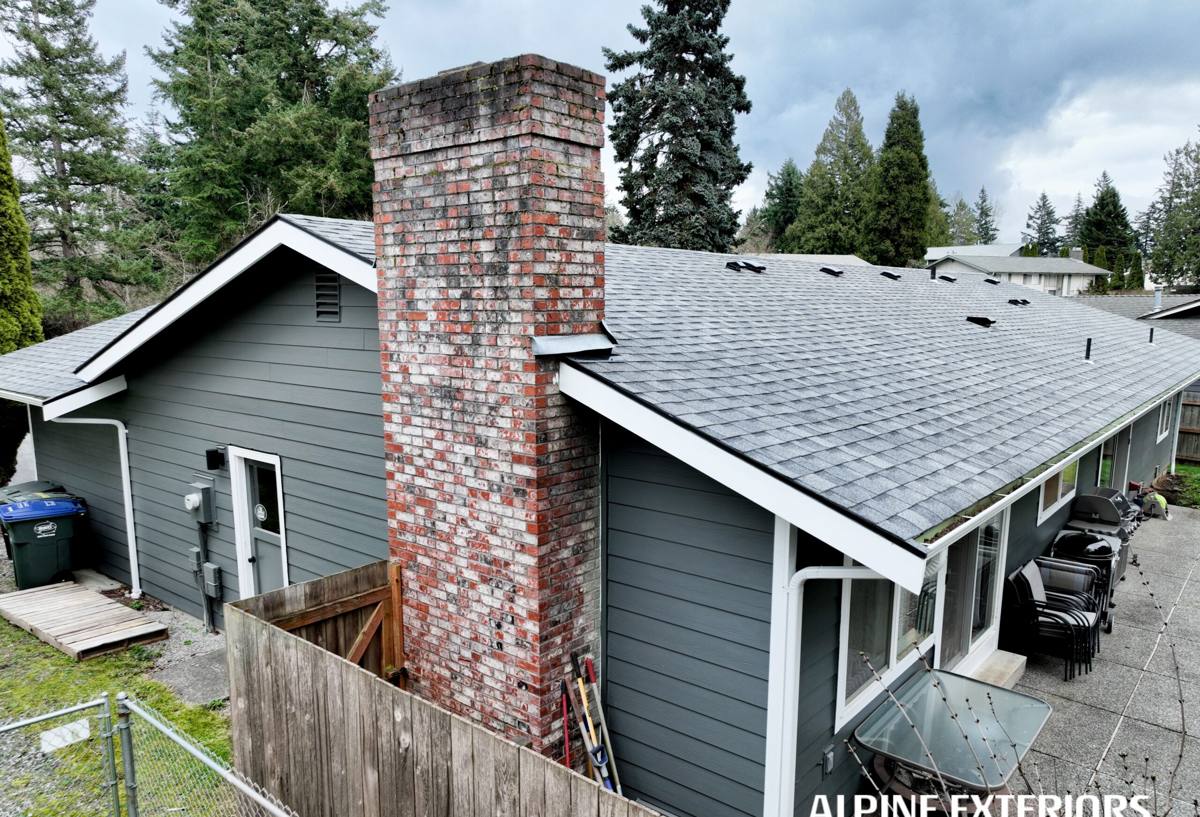
What Salt Air, Driving Rain, and Moss Season Actually Do to Siding
Three regional factors show up again and again on repair calls in this area:
Salt Air
Proximity to saltwater accelerates corrosion on any exposed metal — nail heads, flashing, trim fasteners, and hardware. Once a fastener starts to corrode, it stops holding as tightly, siding boards loosen slightly, and that tiny gap becomes an entry point for water. Salt air also breaks down some paint and coating systems faster than a factory-cured finish, which is one reason coating quality matters more here than in a dry climate.
Driving Rain
Wind-driven rain doesn't just fall on a wall, it gets pushed sideways into laps, seams, and any gap in the caulking or flashing. A siding system that's forgiving in calm rain can still fail in a wind event if the water-shedding details — lap spacing, flashing, sealant joints — weren't done right the first time.
Moss Season
Shaded, north-facing walls and anywhere siding stays damp longer than it should will grow moss and algae. Beyond the cosmetic issue, moss holds moisture against the siding surface far longer than open air would, which is exactly the condition that lets rot start underneath paint or coating that still looks fine from the ground.
Signs a Bellingham Home Needs Siding Repair
Most siding damage doesn't announce itself with a hole in the wall. It shows up as small changes that are easy to write off as cosmetic. Worth checking for:
- Soft or spongy spots when you press on siding near the bottom courses or under windows
- Visible gaps opening up at butt joints, corners, or where siding meets trim
- Persistent moss or dark streaking that comes back within a season of cleaning
- Paint or coating that's bubbling, peeling, or chalking heavily in one area but not others
- Nail heads that are rusting, popping, or backing out
- Warping, cupping, or visible swelling along board edges
- Water stains or discoloration on interior walls that share an exterior wall with a suspect area
- A musty smell in a room near an exterior wall, especially after a stretch of wind and rain
Any one of these on its own might be minor. Two or three in the same area, especially on a wall that faces prevailing wind and rain, usually means water has already gotten past the surface.
What a Correct Repair Actually Involves
A siding repair that just swaps a damaged board for a new one and calls it done is treating the symptom, not the cause. A repair worth doing includes:
Finding the Water Path, Not Just the Damaged Board
Damaged siding is a symptom. The actual problem is almost always a water path — a failed caulk joint, missing or corroded flashing, a gap where two materials meet, or a spot where the original installation didn't account for wind-driven rain. Replacing the board without fixing the path just buys a few years before it happens again.
Checking What's Behind the Siding
Any time siding comes off for repair, the water-resistive barrier, sheathing, and framing behind it should get a real look. If there's rot in the sheathing or framing, that has to be addressed before new siding goes back on — patching over compromised wood just hides the problem for the next owner or the next repair crew to find.
Matching Material and Finish
A repair that doesn't match the existing siding's profile, exposure, and color sticks out and can also create a performance mismatch — different materials expand, contract, and shed water differently. On factory-finished fiber cement, matching the ColorPlus finish matters both for appearance and because field-applied paint doesn't perform the same as the factory coating over time.
Correct Flashing and Fastening
New flashing at the repair area, proper fastener type and placement, and correct lap and joint sealing are what actually keep water out going forward. This is the part of the job that doesn't show once it's done, but it's the part that determines whether the repair lasts five years or twenty.
Patch, Section Replacement, or Full Re-Side: How to Decide
Not every repair call ends the same way. The right scope depends on how much damage there is and how much of it is hidden.
| Approach | Best For | What to Watch For |
|---|---|---|
| Spot patch / board replacement | Isolated damage — one impact spot, one section with a caulk failure, no hidden rot | Only appropriate if what's behind the siding checks out sound; otherwise it's a temporary fix |
| Section replacement | Damage concentrated on one wall or elevation, often the side that takes the most wind-driven rain | Worth checking whether the underlying water barrier and flashing need updating across the whole section, not just at the visible damage |
| Full re-side | Widespread failure, siding near the end of its service life, or damage found in multiple unrelated areas | Often the more cost-effective long-term choice once repair costs start adding up across several sections |
We'll always tell you honestly which category your home falls into rather than defaulting to the biggest job. A lot of Bellingham repair calls genuinely are isolated and don't need more than a section addressed.
Why the Siding Product Behind the Repair Matters
We install and repair James Hardie fiber cement exclusively, and it's worth explaining why that matters specifically for repair work in this climate. Fiber cement doesn't absorb and swell with moisture the way wood-based products can, and it's non-combustible, which matters as a durability factor independent of fire risk. When we're patching into existing Hardie siding, the material behaves consistently with what's already on the wall — same moisture response, same expansion behavior, same finish system.
We don't repair into or install LP SmartSide, vinyl, Cemplank, Allura, primed spruce, or cedar siding as a matter of company standard. That's not a knock on every homeowner who has one of those products — plenty of these systems perform reasonably well when installed and maintained correctly. But we've standardized on Hardie because of how it holds up specifically to the conditions this region delivers: sustained damp seasons, salt-adjacent air, and driving rain that finds every weak seam. If your home currently has a different siding product and needs a larger repair or a full re-side, we'll talk through why we'd recommend transitioning to Hardie rather than repairing in kind — with the real trade-offs, not a sales pitch.
Our Repair Process
- On-site assessment. We look at the damaged area and the surrounding wall, not just the spot you called about, since related issues often show up nearby.
- Diagnosis of the water path. Before quoting a fix, we identify why the damage happened, not just what the damage is.
- Honest scope recommendation. Spot patch, section replacement, or a conversation about full re-siding if that's genuinely the better long-term value.
- Repair or replacement. Matching material and finish where a patch is appropriate, correct flashing and fastening in every case.
- Final check. We verify the repair sheds water correctly at every joint before we consider the job done.
Why a Crew That Already Works Bellingham Matters
Siding repair is diagnostic work as much as it's carpentry. A crew that works Bellingham and greater Whatcom County regularly has already seen how salt air corrodes fasteners on this side of the county, which elevations take the worst of the wind-driven rain in a given neighborhood's typical orientation, and which shaded, damp spots grow moss fastest. That local pattern recognition is what keeps a repair from becoming a repeat call in two years. We're not traveling in from out of the area for a one-off job — Bellingham is part of our regular service area alongside Birch Bay, so we're accountable to the work we do here.
Get a Straight Answer on Your Siding Repair
If you're seeing soft spots, gaps, recurring moss, or peeling paint on your Bellingham home, it's worth getting an honest look before the damage spreads further behind the wall. We offer free, no-pressure estimates — we'll tell you plainly whether you're looking at a simple patch, a section replacement, or something bigger, and why.