 Birch Bay Siding
 Birch Bay Village's Climate Is Rougher on Siding Than It Looks
Birch Bay Village sits close enough to the water that salt-laden air, wind-driven rain, and long stretches of gray, damp weather are just part of owning a home here. Whatcom County doesn't get hurricanes, but it gets something siding actually struggles with more: months on end of low sun, high humidity, and moisture that never fully dries out between storms. That combination is what drives moss growth up north-facing walls, softens poor-quality trim, and slowly breaks down siding products that weren't engineered for a marine environment.
Homes in Birch Bay Village also tend to sit close together or back up to tree lines and greenbelt, which means less direct sun and airflow on at least one or two exposures of most houses. Less sun and airflow means slower drying after rain, which means more time for moisture to work into seams, end cuts, and fastener holes. Siding that isn't dimensionally stable, or that relies on paint film alone to keep water out, tends to show problems here years before it would somewhere drier.
Why We Install Only James Hardie Fiber Cement
We made a deliberate choice to install James Hardie fiber cement siding exclusively — not vinyl, not LP SmartSide, not Cemplank or Allura, not primed spruce or cedar. Each of those products has legitimate uses somewhere, but they each carry trade-offs we don't want to put our name behind on a Birch Bay Village project:
- Vinyl expands and contracts with temperature swings and can warp or crack under impact; it also isn't a great match for the tight reveals and clean lines many Birch Bay Village homes are built with.
- LP SmartSide is engineered wood — treated to resist moisture, but still wood at its core, meaning any breach in the coating or a missed caulking detail gives moisture a path into a material that can swell and rot.
- Cemplank and Allura are also fiber cement, but we've standardized on one manufacturer, one warranty structure, and one factory finish system so every job we do is consistent and every warranty claim is straightforward.
- Primed spruce or cedar looks great on day one, but it's a maintenance commitment — repainting, caulking, and moisture monitoring on a schedule most homeowners don't want to keep up with in a climate this damp.
James Hardie fiber cement is cement, sand, and cellulose fibers — non-combustible, dimensionally stable, and manufactured with a factory-applied finish that doesn't depend on a contractor's paint crew to get right. For a neighborhood dealing with salt air and a long wet season, that stability matters more than it does in a drier climate.
Choosing the Right Hardie Product Line for This Neighborhood
James Hardie makes climate-specific formulations under its HZ5 and HZ10 designations, engineered for different moisture and freeze-thaw conditions across the country. Western Washington, including Birch Bay Village, falls into the HZ5 zone — a formulation built around consistent moisture exposure rather than deep freeze cycles. We spec HZ5 product as the baseline here and don't substitute a formulation meant for a different climate zone just because it might be cheaper or easier to source.
Beyond the climate zone, most Birch Bay Village projects come down to a choice between a few product lines:
HardiePlank Lap Siding
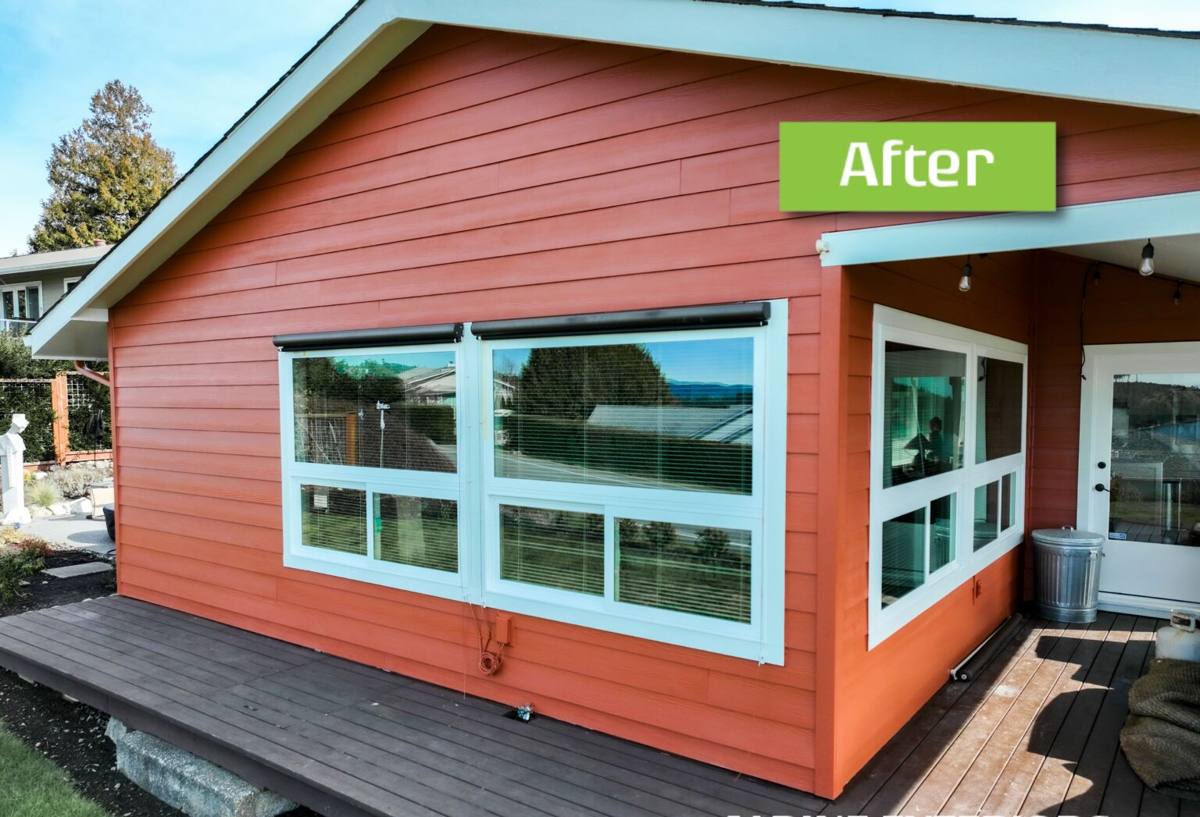
The most common choice — horizontal lap siding available in several exposures and textures (smooth or cedar-textured). It reads as a classic Pacific Northwest look and holds up well against the driving rain that comes in off the water during winter storms.
HardiePanel Vertical Siding
Often used as an accent on gables, dormers, or as a full vertical treatment for a more modern look. Vertical panel seams need to be detailed carefully — more on that below.
HardieShingle
Used selectively for gable accents or a shingled-style upper story. It costs more per square foot than lap siding and is usually reserved for architectural detail rather than whole-house coverage.
ColorPlus Factory Finish: Why It's Worth the Difference
Every James Hardie product we install can be ordered with a ColorPlus factory-applied finish — a baked-on coating applied and cured under controlled conditions, backed by its own finish warranty separate from the product warranty. In a salt-air environment, this matters for a specific reason: factory finishes cure more evenly and bond more consistently than field-applied paint, which is applied on-site in whatever weather and temperature happen to show up that week.
Field-painting Hardie siding after installation is still possible and sometimes necessary for touch-ups or trim matching, but for full elevations exposed to weather and salt air, ColorPlus gives you a more even, longer-lasting finish without depending on ideal painting conditions that a Birch Bay winter rarely provides.
What a Correct Installation Actually Involves
Fiber cement siding fails less often because of the material and more often because of how it was installed. This is where a lot of the real risk in a siding job actually lives:
- Weather-resistive barrier and flashing installed and lapped correctly behind the siding — this is the layer that actually keeps bulk water out, not the siding itself.
- Proper clearances at grade, roof lines, and decks — Hardie's own installation instructions specify minimum clearances, and skipping them is one of the most common warranty-voiding mistakes we see on older installs.
- Correct fastening pattern — nailing too close to panel edges, over-driving fasteners, or using the wrong fastener type all shorten the life of an installation regardless of the product behind it.
- Sealed and caulked joints at panel seams, trim, and penetrations — done with a quality sealant rated for the exposure, not whatever was on the truck.
- Rainscreen or drainage gap where conditions call for it, giving any moisture that does get behind the siding a way to drain and dry out instead of sitting against the wall sheathing.
On vertical panel applications especially, seam detailing needs extra attention — vertical seams collect and channel water differently than horizontal lap joints, and a rushed or under-detailed vertical installation is one of the more common callback issues in this trade.
Our Process for a Birch Bay Village Project
Every project follows the same sequence, whether it's a single wall repair or a full re-side:
- On-site assessment — we walk the exterior, check current siding and sheathing condition, note moss and moisture patterns on each exposure, and measure for material takeoff.
- Product and color selection — walking through HZ5 product lines, profiles, and ColorPlus color options based on the home's exposure and your preferences.
- Written estimate — a clear scope covering removal, any sheathing repair, weather barrier and flashing work, siding installation, and trim.
- Removal and inspection — once old siding comes off, we inspect sheathing for hidden moisture damage before anything new goes up, since covering a problem is worse than finding it.
- Installation to manufacturer spec — barrier, flashing, clearances, fastening, and sealant done to James Hardie's published installation requirements, not shortcuts.
- Final walkthrough — reviewing the finished work with you before we consider the job done.
Cost Factors on a Birch Bay Village Home
Every home is different, but the same variables drive most of the cost swing on a fiber cement project in this area:
| Factor | Why It Moves the Price |
|---|---|
| Sheathing condition | Hidden moisture damage found during removal requires repair before new siding goes on |
| Product line | Lap siding, vertical panel, and shingle accents carry different material and labor costs |
| Finish choice | ColorPlus factory finish vs. field-painting changes both material cost and finish longevity |
| Home complexity | Dormers, multiple gables, and cut-up elevations take more trim and labor time than simple wall runs |
| Accessibility | Tree cover, tight property lines, or multi-story walls affect staging and labor time |
| Drainage detailing | Adding a rainscreen gap on moisture-prone exposures adds labor but reduces long-term risk |
We give a written, itemized estimate before any work starts, so you know what's driving the number rather than a single lump figure.
Keeping Hardie Siding Looking Right Through Moss Season
Correctly installed James Hardie siding is low-maintenance, not no-maintenance. A short annual routine keeps it performing the way it's designed to in this climate:
- Rinse siding annually, focusing on north-facing and shaded walls where moss and algae take hold first
- Keep gutters clear so overflow doesn't run down the face of the siding
- Trim back vegetation and tree limbs that shade walls and slow drying after rain
- Check and refresh exterior caulking at trim and penetrations every few years
- Watch for chalking or fading on unpainted or older field-painted sections and address early
Why Local Experience in Birch Bay Village Matters
A crew that already works this stretch of Whatcom County knows which exposures on a given lot layout tend to hold moisture, how local wind patterns drive rain into specific wall sections, and what the salt air does to fasteners and trim over time. That's knowledge you don't get from a general contractor passing through the area once. It shows up in small decisions — where to add extra flashing, which exposure gets a drainage gap, which product line actually holds up on a shaded gable — that a spec sheet alone won't tell you.
If you're weighing a re-side or repair on your Birch Bay Village home, we're happy to take a look and walk you through what your specific home needs. There's no pressure and no cost to get an honest assessment and a written estimate — just fill out the form below to get started.