 Birch Bay Siding
 Fiber Cement Siding, Done Right, for Custer Homes
Custer sits in the part of Whatcom County where salt-laden air off the water, wind-driven rain, and a moss season that runs most of the year all show up on the same wall. Fiber cement siding, specifically James Hardie's, is the product we install here because its inorganic core and factory finish are built to take that kind of exposure without the maintenance burden that wood-based or vinyl siding carries in this climate. This page isn't about that broader argument, though. It's about what a fiber cement job actually looks like when it's done correctly on a home in Custer: what the install needs to get right, what we typically find once the old siding comes off, and why a crew that already works this specific stretch of coastline handles it differently than a crew driving in from somewhere drier.
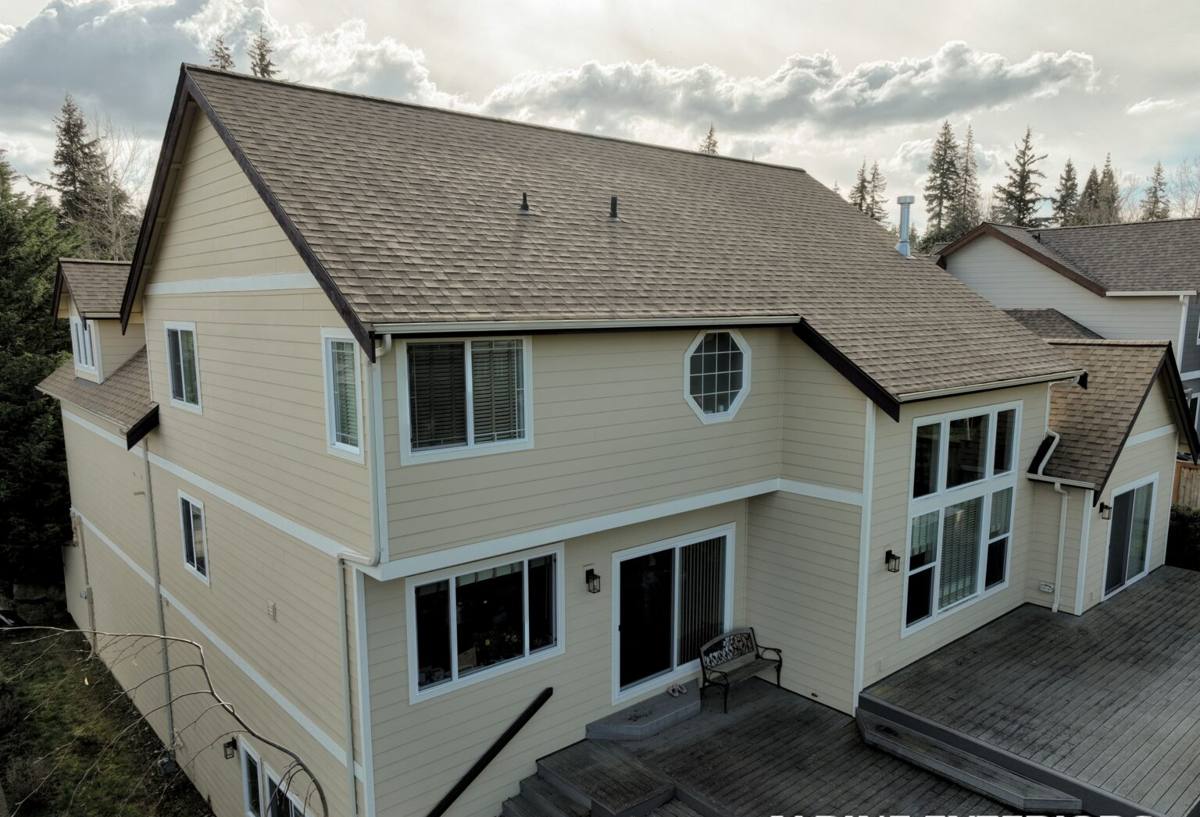
The Conditions Shaping This Job
Three things make Custer siding work different from a generic install: salt air that reaches most properties in town, not just the waterfront lots; rain that comes in sideways more often than straight down; and mild, damp weather that keeps moss and mildew active across most of the calendar. None of that is unusual for this part of Birch Bay, but it does change which details on a fiber cement install actually matter. A board that's rated for the material isn't the same as an install that accounts for how water and organic growth behave on a wall in this specific location, and that's the gap we're trying to close on every job.
Getting the Installation Details Right
Fiber cement's long-term performance depends more on installation quality than almost any other siding material on the market. The board itself is inert and stable; the failures we see in the field almost always trace back to a detail around the board, not the board itself.
Clearances and the Drainage Plane
Manufacturer-specified clearances at grade, roofline, and decks keep splash-back and standing water away from the bottom edge of the siding, which is the most vulnerable point on any lap system. Behind the siding, a proper rain screen or drainage plane gives any moisture that does get past the surface a way to drain and dry instead of sitting against the sheathing. In a climate where it rains sideways for a good part of the year, skipping or shortcutting this layer is the single most common reason a fiber cement job underperforms its material.
Flashing, Fasteners, and Field Cuts
Every window, door, and penetration needs flashing detailed to shed wind-driven rain rather than funnel it into a seam. Fasteners need to be the correct type, placement, and depth for the board thickness and framing behind it, since over- or under-driven fasteners are a common source of cracking. Wherever a board has to be field-cut, that cut edge needs to be sealed per the manufacturer's spec, because a factory edge and a raw field cut don't behave the same way once they're exposed to years of damp weather.
Matching the Product Line and Finish to This Site
James Hardie makes different siding lines engineered for different climate zones, and the HZ5 line, built for regions with sustained moisture and freeze-thaw cycles, is the right fit for Whatcom County rather than a line engineered primarily for hot, dry markets. That's a decision we make at the estimate, not an afterthought.
Color and the ColorPlus Finish
Hardie's ColorPlus finish is baked on in multiple coats at the factory rather than applied on site, and it's backed by its own finish warranty separate from the substrate warranty. For a coastal property, that matters because salt air and UV exposure are exactly the conditions that break down a lower-quality or field-applied finish fastest. Darker colors absorb more heat and can show fade differently over time than lighter tones, which is worth talking through during the estimate if color retention on a shaded or sun-exposed elevation is a priority for you.
What We Typically Find on Older Homes in This Area
Every tear-off is different, and we're not going to claim we know what's behind your specific walls before we look. But after years of working on older homes in this part of the county, a few patterns show up often enough to mention.
| What We Often Find | What It Usually Means |
|---|---|
| Moisture staining or soft sheathing near the base of walls | Long-term splash-back or a missing/failed drainage plane behind the old siding |
| Caulk-dependent joints that have dried and cracked | A water management system that relied on sealant instead of physical detailing, which fails over time in this climate |
| Moss or dark staining concentrated on shaded, tree-lined elevations | Sustained moisture exposure in exactly the spots where organic growth takes hold fastest |
| Corroded or discolored fasteners and trim hardware | Salt air accelerating the breakdown of hardware that wasn't rated for coastal exposure |
None of these are unusual or a sign of a bad original build, they're just the predictable result of time and this climate. What matters is catching them at tear-off, before new siding goes over the top of a problem instead of fixing it.
Our Process From First Look to Final Walkthrough
The steps themselves aren't unique to Custer, but the judgment calls at each one are shaped by having done this here before.
- Walk-through and estimate. We look at current siding condition, site exposure, and elevation-specific factors like shade, tree cover, and wind direction before quoting a scope.
- Tear-off and sheathing inspection. Old siding comes off and we inspect the sheathing underneath for rot, moisture damage, or prior repairs that need to be addressed before anything new goes on.
- Moisture barrier and drainage plane installation. This layer goes on correctly the first time, since it's the part of the system you won't see again once the siding is up.
- Fiber cement installation to manufacturer spec. Clearances, fastening, and flashing are installed to James Hardie's published requirements, not adjusted on the fly to save time.
- Trim, accessories, and finish details. Trim boards, corners, and any color-matched accessories are installed and sealed at every transition point.
- Final walkthrough. We go over the finished job with you directly and cover warranty registration and what maintenance, if any, to expect going forward.
Cost Factors Worth Understanding Upfront
Every property is different, but the factors that actually move a fiber cement quote are consistent enough to lay out honestly before you're staring at a number.
| Factor | Why It Affects Cost |
|---|---|
| Condition of the sheathing underneath | Rot or moisture damage found at tear-off adds repair scope that can't be known until the old siding is off |
| Home size, elevation count, and architectural detail | More corners, trim, and roofline transitions mean more labor-intensive flashing and cutting |
| Product line and finish selection | HZ5 boards and ColorPlus finishes are engineered products, and pricing reflects that over a generic fiber cement board |
| Site access and exposure | Waterfront or bluff-adjacent lots can add scaffolding, access, or weather-scheduling considerations |
Why a Crew That Already Works This Area Matters
A contractor who's worked in Custer and around Birch Bay repeatedly has already made the mistakes worth learning from on someone else's job, not yours. That shows up in practical ways: knowing which elevations on a typical local lot take the worst of the wind-driven rain before the walk-through even starts, having an established supply line for Hardie's HZ5 boards and matching trim instead of scrambling to source them, and understanding Whatcom County's permitting and inspection process well enough that it doesn't add delay to your project. It also means warranty registration gets handled correctly the first time, which matters more than homeowners often realize when it comes time to sell.
Before You Hire: A Quick Checklist
- Ask whether the crew is manufacturer-certified for James Hardie installation specifically, not just experienced with siding generally.
- Ask which HZ product line they're proposing and whether it's the one engineered for this climate zone.
- Ask how they handle sheathing repair if rot or moisture damage turns up at tear-off, and get that answer in writing.
- Ask what the drainage plane or rain screen detail looks like on your specific home, not just in general terms.
- Ask how warranty registration works and whether it transfers to a future buyer if you sell.
Ready for a Free Estimate in Custer
If your siding is showing its age or you're planning ahead for a re-side, we're glad to walk the property, take a real look at what's on the walls now, and give you a straight answer about scope and cost. Reach out using the form below to schedule a free, no-pressure estimate.