 Birch Bay Siding
 Decks in Cottonwood Beach Take a Different Kind of Beating
A deck in Cottonwood Beach doesn't age the same way a deck ten miles inland does. Homes here sit close enough to the water that salt-laden air is a constant presence, working its way into every exposed nail head, hinge, and joist hanger. Add in the driving rain that blows sideways off Birch Bay during winter storms, and a moss season that can stretch from October well into spring, and you've got three separate forces all working against the same structure at once. None of them are dramatic on their own, but together they wear a deck out years ahead of schedule if it isn't built and maintained with that exposure in mind.
Most of the deck repair calls we get in this stretch of Whatcom County aren't from decks that were poorly built. They're from decks that were built to a general standard, not a coastal one. The framing lumber, the fastener grade, the finish schedule — all of it needs to be a notch tougher here than it would in a drier, more sheltered part of the county. That's the gap we're fixing when we work on a Cottonwood Beach deck.
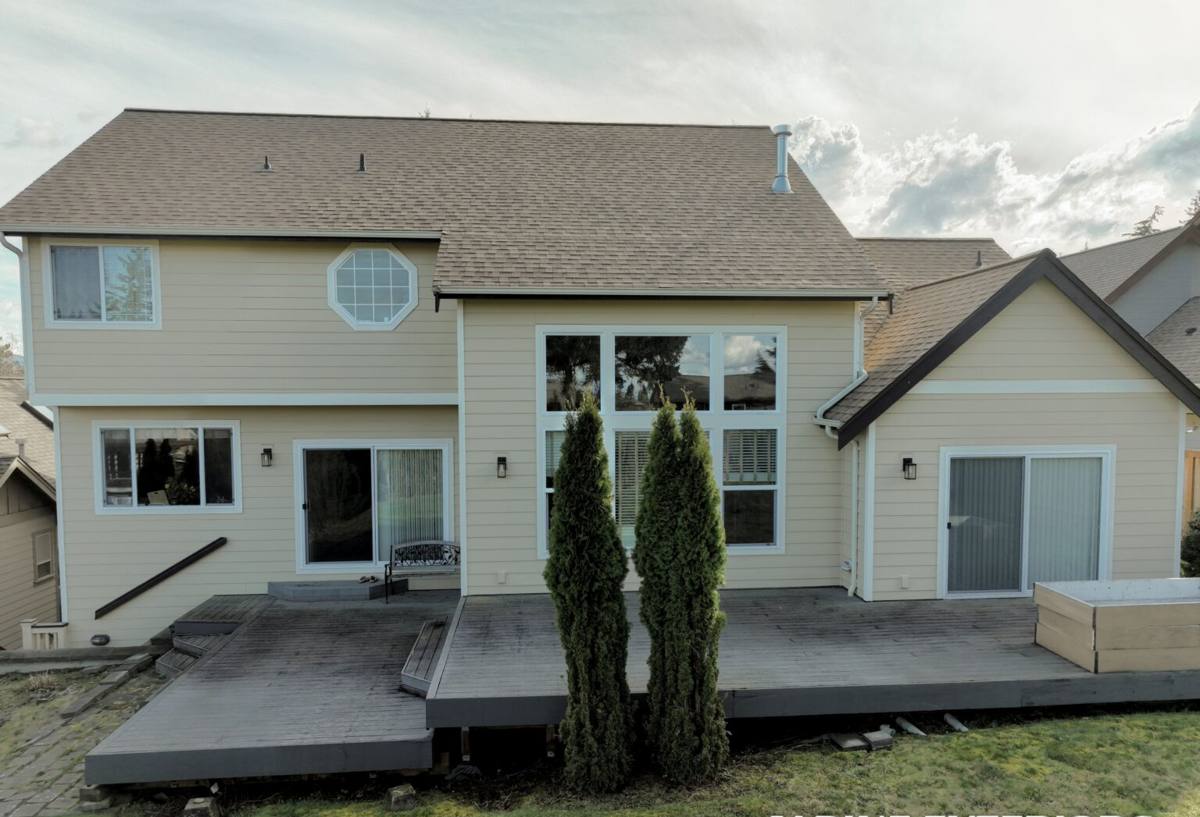
Signs Your Deck Needs Repair, Not a Full Rebuild
Most decks don't fail all at once — they give you warning signs first, usually in the framing or the fasteners before the surface boards show much wear. Catching these early is what keeps a repair a repair, instead of turning it into a full tear-off.
- Boards that feel spongy, bounce, or flex more than they used to underfoot
- Rust streaks bleeding out from screw heads, joist hangers, or post bases
- Gaps opening up where the deck ledger meets the house
- Railings or stair stringers that wiggle when you grab them
- Persistent green or black staining that comes right back after cleaning
- Soft or crumbling wood at post bottoms, stair stringers, or anywhere wood sits close to grade
- Fasteners that have backed out or snapped off flush with the board
If you're only seeing one or two of these, especially on the surface boards, a targeted repair is usually enough. Once you start seeing multiple issues in the framing itself — the ledger, the joists, the posts — it's worth a closer structural look before deciding what to fix and what to replace.
What a Proper Deck Repair Actually Involves
A repair that only addresses what's visible from the top often misses the parts of the deck doing the real work. We start every repair by getting underneath and behind the deck, not just walking the surface.
Framing and Ledger Board
The ledger board — where the deck attaches to the house — is the single most important connection on the whole structure, and it's also the piece most exposed to whatever water runs down the siding during a storm. We check the flashing above it, the fasteners holding it, and the condition of the wood itself. A ledger that's held on with the wrong fasteners or has no flashing behind it is a problem that surface repairs won't touch.
Fasteners and Hardware
This is where salt air does its quiet damage. Standard fasteners that would last decades inland can start rusting and losing grip strength much faster this close to the water. When we open up a deck for repair, replacing corroded fasteners and hardware with a coastal-rated option is usually part of the job, even if it wasn't the reason for the call.
Decking Boards and Surface Repairs
Individual board replacement, re-securing loose boards, and addressing cupping or splitting are the most visible part of a repair — but they're only worth doing well if the framing underneath is sound. We don't put new boards on questionable joists.
Railings and Stairs
Railings and stair stringers take a lot of direct weather exposure and a lot of physical load. Loose railing posts are one of the more common safety issues we find, and they're often a quick, affordable fix once caught.
Moss, Algae, and Moisture: Managing a Long Wet Season
Whatcom County's moss season is long, and Cottonwood Beach's mix of tree cover and marine humidity gives moss and algae plenty of time to establish themselves on shaded deck surfaces. Moss isn't just a cosmetic problem — it holds moisture against the wood, which accelerates rot in exactly the areas that already get the least sun to dry out.
Cleaning vs. a Structural Fix
A one-time cleaning will lift moss off the surface, but if the underlying issue is poor drainage, inadequate board spacing, or a shaded layout that never fully dries, the moss comes back within a season. Part of a proper repair is looking at why moss is establishing where it is — sometimes the fix is as simple as adjusting board gapping or clearing debris from between boards so water and air can move through, rather than just treating the symptom over and over.
Repair or Replace? What Actually Drives That Decision
Homeowners often assume any deck showing damage needs full replacement. In our experience, most decks we're called out to in this area can be repaired — but the right call depends on where the damage is and how far it's spread.
| Factor | Leans Toward Repair | Leans Toward Replacement |
|---|---|---|
| Framing condition | Joists and posts are solid, damage is isolated | Widespread rot or corrosion in structural members |
| Age of deck | Under 15-20 years, built with decent materials | Original construction is old or was low-grade to start |
| Ledger connection | Sound, properly flashed | Undersized, unflashed, or showing water damage behind siding |
| Extent of damage | A few boards, some hardware, one section | Damage across multiple boards, framing, and railings at once |
| Design fit | Layout still works for how the home is used | Deck no longer fits the space or the household's needs |
We'll always tell you honestly which side of that table your deck falls on. There's no benefit to us in talking a homeowner into a full rebuild when a solid repair will get them another decade of use.
Our Deck Repair Process
The process is straightforward, but the inspection step is where most of the value is — it's what determines whether we're doing a small repair or flagging something bigger before it becomes expensive.
- Full inspection — top surface, framing, ledger connection, hardware, and posts, not just the obvious problem area
- Written scope — a clear explanation of what needs fixing, why, and what it will cost, before any work starts
- Repair work — framing and hardware first, then decking boards, then railings and stairs
- Finish and protect — sealing or finishing exposed wood so the repair holds up through the next wet season, not just the summer
- Walkthrough — we show you what was done and what to keep an eye on going forward
Materials: What We Use and Why
Material choice matters more on a deck this close to the water than almost anywhere else in the county. We lean toward stainless or high-grade coated hardware for fasteners and connectors, because the labor to replace a board is far cheaper than the labor to replace a board twice because the fasteners holding it failed first. For decking and framing lumber, we look at how the specific area of the deck is exposed — full sun and open air dry out faster and tolerate standard treated lumber well, while shaded, low-airflow sections benefit from either a more rot-resistant species or careful attention to spacing and drainage so moisture doesn't sit.
Composite decking is a reasonable option for surface boards in some situations — it doesn't need refinishing, and it resists the kind of surface wear that wood shows first. It's not automatically the right call for every repair, though. Composite still needs solid, well-fastened framing underneath, and matching a repaired section to existing composite boards can be harder than matching wood, since colors and profiles change between product runs. We'll walk you through the honest trade-offs for your specific deck rather than defaulting to one material for every job.
Why It Matters That We Work Cottonwood Beach Regularly
A contractor who only sees a handful of coastal decks a year tends to treat every repair like a standard inland job — same fasteners, same finish schedule, same assumptions about how fast wood dries out. Working in Cottonwood Beach and the rest of the Birch Bay area regularly means we already know which parts of a deck fail first out here, what hardware actually holds up, and where moisture tends to collect on a shaded, marine-exposed lot. That translates into fewer surprises once we open up the structure, and repairs that are built for the conditions your deck actually faces rather than a generic standard.
It also means straightforward, local accountability — we're not a crew passing through the area for one job. If a repair doesn't hold up the way it should, we're easy to reach and close by.
Keeping Your Deck in Good Shape After the Repair
A repaired deck still needs some seasonal attention to get the most life out of it, especially in a climate like this one.
- Clear leaves and debris from between boards before the wet season sets in, so water and air can keep moving through
- Rinse off salt residue and grime a few times a year, particularly after storms
- Check railings and stair connections for looseness once or twice a year
- Re-seal or refinish exposed wood on the schedule appropriate for the product used, not just "when it looks faded"
- Address small issues — a loose board, a rusting screw — before the next wet season, not after
If your deck in Cottonwood Beach is showing any of the signs above, or it's just been a while since anyone looked underneath it, we're happy to come take a look. The estimate is free, there's no pressure attached to it, and you'll walk away knowing exactly what your deck needs and why — use the form below to get started.