 Birch Bay Siding
 Why Ferndale Homes Need Siding Built for This Climate
Ferndale sits in a stretch of Whatcom County where marine air off the water meets steady inland rainfall, and the result is a siding environment that's tougher than it looks from the curb. Salt-laden air works on fasteners and trim edges year-round, driving rain finds every gap in a wall assembly that wasn't detailed correctly, and a long moss and algae season — stretching from fall through spring — keeps siding damp for weeks at a stretch on shaded and north-facing walls. None of this is dramatic. It's slow, cumulative wear, and it's exactly the kind of wear that separates siding that lasts twenty-plus years from siding that starts failing at year eight.
Homeowners in this part of Washington usually don't have one big problem to solve. They have three small ones happening at once: corrosion at the fastener line, moisture intrusion behind the cladding, and organic growth on the surface. A siding system has to answer all three, not just one.
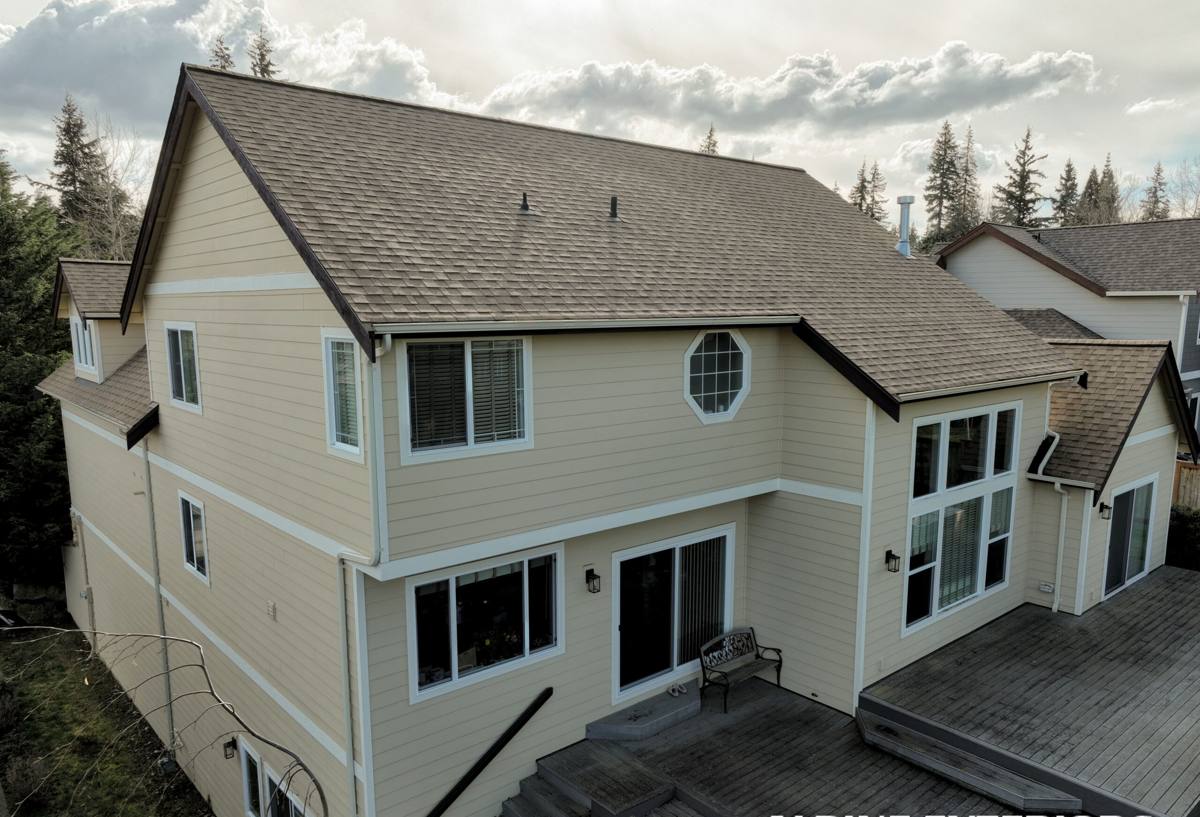
What James Hardie Brings to This Kind of Weather
Fiber Cement That Doesn't Feed Moisture Problems
James Hardie siding is fiber cement — sand, cement, and cellulose fiber — not wood and not vinyl. It doesn't rot, it doesn't swell or delaminate when it takes on repeated wetting, and it doesn't give moss and mildew the organic food source that wood-based products do. In a climate where siding stays damp for long stretches, that's the difference between a surface that self-cleans with normal rain and sun exposure and one that needs regular pressure-washing and treatment to stay ahead of green staining.
Engineered for This Specific Region
Hardie manufactures its HZ5 product line specifically for climates like ours — the Pacific Northwest's freeze-thaw cycling combined with sustained moisture exposure. It's not a generic national product; it's a regional engineering spec, and it matters for a coastal Whatcom County property the same way the right roofing underlayment matters here.
A Factory Finish That Handles Salt Air
ColorPlus finish is baked on at the factory under controlled conditions, which gives it more consistent adhesion and UV resistance than field-applied paint. That matters near the water, where salt exposure accelerates finish breakdown on lesser coatings. Homeowners get a finish warranted against fading and chipping, and they don't inherit a repaint cycle every five to seven years the way they would with site-painted wood or fiber cement trim.
The Right Hardie Products for a Ferndale Home
| Product | Where It's Used | Why It Fits This Climate |
|---|---|---|
| HardiePlank lap siding | Main wall cladding | Primary defense against driving rain; HZ5 formulation resists moisture cycling |
| HardiePanel vertical siding | Accent walls, gables, shop/garage faces | Clean modern look with the same moisture and fire performance |
| HardieTrim boards | Corners, window and door casing, fascia | Won't absorb water at end grain like wood trim does — a common failure point in wet climates |
| HardieSoffit panels | Eaves and overhangs | Resists the trapped, humid air that soffits see under long overhangs common in this region |
What a Correct Installation Actually Involves
Hardie's own warranty is conditional on installation to its published specifications — this is where a lot of the real-world performance difference between a good job and a problem job actually comes from, and it's rarely visible once the wall is closed up.
- A drainable weather-resistive barrier installed behind the siding, not just a flat wrap, so any water that gets past the cladding has somewhere to go
- Correct starter strip and first-course height off finished grade, keeping the bottom edge of siding clear of splash-back and standing moisture
- Rain screen or furring strips where wall assembly and exposure call for it, so the siding can dry on both faces instead of trapping moisture against the sheathing
- Stainless steel or hot-dip galvanized fasteners driven to Hardie's specified pattern and depth — critical near salt air, where lesser fasteners corrode and streak the finish
- Proper flashing at every window, door, and roofline penetration, plus kick-out flashing at roof-to-wall intersections so water is directed away from the wall, not into it
- Correct joint treatment and caulking at butt joints and trim, using products compatible with ColorPlus finish
- Manufacturer-specified clearances at decks, patios, and grade so the siding never sits in standing water or snow
Skip any one of these and the product itself isn't the weak point — the installation is. That's true of any siding brand, but it's especially unforgiving with fiber cement, where a poorly cut or unsealed edge can telegraph moisture damage over a few wet seasons.
How We Approach a Ferndale Project
Assessment First
We start by walking the exterior and identifying the specific exposure each wall faces — which sides take the worst of the driving rain, which stay shaded and damp longer, and where the existing siding or trim is already showing moisture or moss issues. That assessment drives product choices (lap versus panel, trim detailing) and where extra flashing attention is warranted.
Tear-Off and Sheathing Check
Old siding comes off down to the sheathing so we can actually see the wall — not guess at what's behind it. Any soft or water-damaged sheathing gets addressed before anything new goes on; covering a hidden problem with new siding just delays a much bigger repair.
Barrier and Drainage Plane
We install the weather-resistive barrier and drainage plane to spec, with particular attention to window and door flashing integration — this is the step that determines whether the wall actually sheds water the way it's supposed to for the next few decades.
Installation to Manufacturer Spec
Fastener pattern, exposure, clearances, and joint treatment all follow Hardie's published requirements, which is also what keeps the manufacturer's warranty intact for the homeowner.
Final Walkthrough
We review the finished work with the homeowner, including maintenance basics specific to a coastal Whatcom County property, before calling the job complete.
James Hardie Compared to Other Options Homeowners Ask About
We only install James Hardie, and it's worth being straightforward about why, since most homeowners have heard of at least one alternative.
| Factor | James Hardie Fiber Cement | Vinyl | Wood / Cedar |
|---|---|---|---|
| Moisture behavior | Doesn't rot or swell; engineered for wet climates | Doesn't absorb water, but can warp and gap, letting water behind it | Absorbs moisture; prone to rot without diligent upkeep |
| Finish durability near salt air | Factory-baked ColorPlus, warranted against fading/chipping | Color molded in but fades and chalks with UV/salt exposure over time | Requires repainting or staining on a recurring cycle |
| Moss/algae resistance | Non-organic material won't feed growth; still needs normal cleaning | Resists growth but can trap moisture behind panels | Organic surface is a food source for moss and mildew |
| Fire resistance | Non-combustible | Combustible; can melt or deform near heat | Combustible |
| Typical service life when installed correctly | Multiple decades, backed by transferable warranty | Variable; shorter in high-UV or high-wind exposure | Shorter without consistent maintenance |
Vinyl and cedar both have legitimate uses elsewhere, and we're not here to disparage them. But for the specific combination of salt air, driving rain, and a long damp season that Ferndale homes deal with, we standardized on Hardie because it's the product we can install once, back with a strong warranty, and not have to explain away a maintenance schedule five years later.
Maintenance That Actually Matters Here
- Rinse siding annually, and check shaded or tree-covered walls more often since they hold moisture longest
- Keep gutters clear so overflow doesn't run down the wall face and concentrate moisture at one section of siding
- Trim back vegetation and tree limbs that keep any wall in constant shade — this is usually where moss shows up first
- Check caulking at trim and joints every year or two, and have any cracked or missing sealant addressed promptly
- Watch for streaking near fastener heads, which can signal a fastener issue worth having looked at early
Why a Crew That Already Works in Ferndale Matters
Fiber cement installation isn't complicated in theory, but it's unforgiving of shortcuts, and every region has its own pattern of where jobs go wrong. A crew that's already worked on homes throughout Whatcom County knows which wall orientations here take the worst weather, where flashing tends to get skipped on rushed jobs, and how the local moss season actually behaves on real houses — not just in a training manual. That local pattern recognition is what keeps a Ferndale installation from being a generic, one-size-fits-all job.
It also means a shorter feedback loop if anything ever needs a look after the fact — a crew rooted in this area isn't driving in from three counties over for a five-minute warranty check.
If you're weighing a siding replacement or new siding for a Ferndale property, we're happy to walk the exterior with you, point out what your home's specific exposure needs, and put together a straightforward, no-pressure estimate. There's a form just below this article — reach out and we'll get you scheduled.