 Birch Bay Siding
 Ferndale's Climate Is Harder on Siding Than It Looks
Ferndale sits close enough to the Salish Sea and the Birch Bay shoreline that homes here deal with a combination most siding materials weren't designed for: salt-laden marine air, long stretches of driving rain pushed in by winter storm systems, and a moss season that can run most of the year on shaded or north-facing walls. None of these factors is dramatic on its own. Together, over years, they're what separates siding that still looks sharp at year fifteen from siding that's chalking, cupping, or hiding rot behind a coat of fresh paint.
Salt air is corrosive to fasteners and hardware, and it accelerates the breakdown of finishes that aren't formulated to handle it. Driving rain — rain that comes in sideways during a windstorm instead of falling straight down — finds every gap in flashing, every under-caulked joint, and every seam that wasn't detailed correctly. And moss doesn't just look bad; it holds moisture against the siding surface for weeks at a time, which is exactly the condition that causes slower-drying materials to swell, warp, or rot from the back side out, often before a homeowner sees anything wrong from the street.
Any siding job in Ferndale has to be evaluated against those three conditions specifically, not against a generic national spec sheet. That's the lens we use on every estimate.
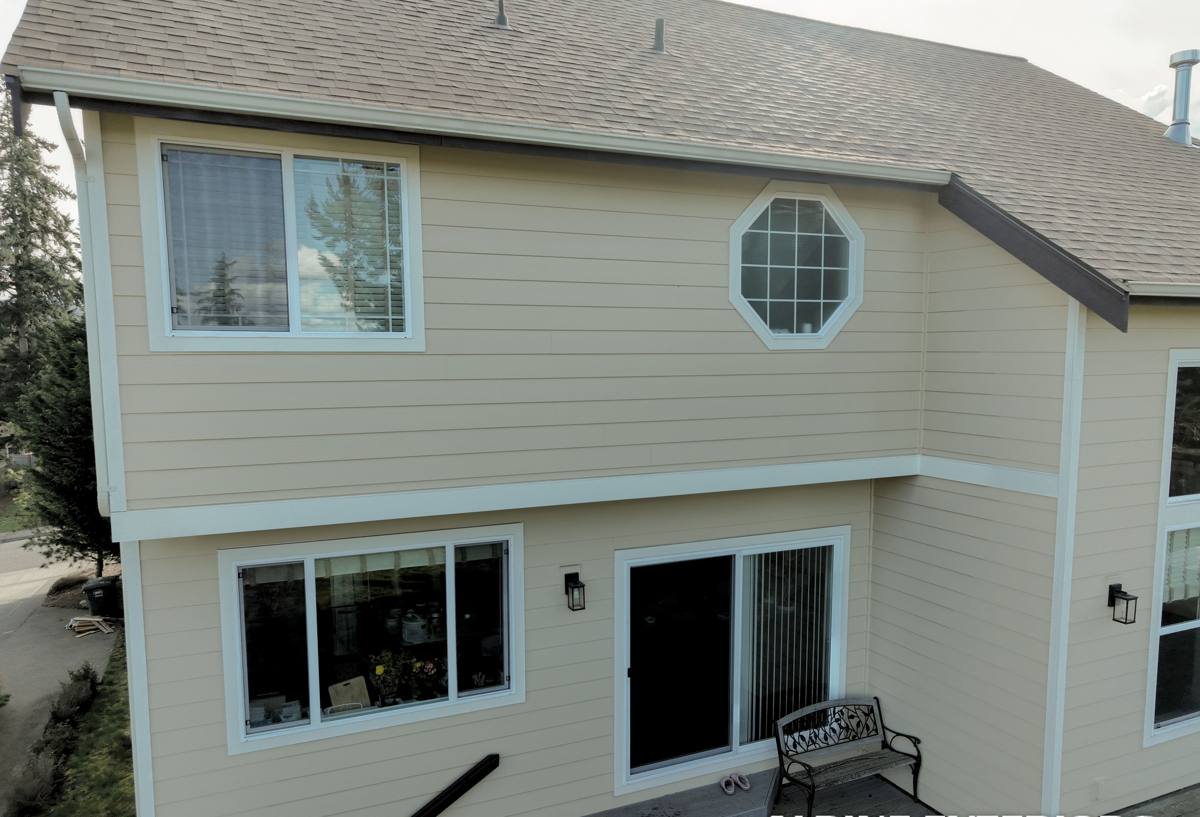
Why Fiber Cement Is the Right Answer for This Climate
It Doesn't Rely on the Wood Behaving Itself
Fiber cement is made from cement, sand, and cellulose fiber, not wood. That matters directly in a climate like this one because it doesn't absorb and release moisture the way wood-based products do, and it doesn't provide the organic material that moss and mildew feed on the way raw or engineered wood siding can. It also won't ignite, which matters in a region that has seen wildfire smoke and dry-season fire risk increase in recent years even this far north.
A Factory Finish That Isn't Betting on Field Conditions
We install James Hardie fiber cement with a factory-applied ColorPlus finish, which is baked on and cured under controlled conditions rather than brushed on outdoors during a narrow weather window. That's a meaningful difference in a place where you might not get five consecutive dry days between October and April. A field-applied paint job depends on the weather cooperating during installation; a factory finish already has that problem solved before the material reaches the site.
Built for the Pacific Northwest Specifically
James Hardie engineers its siding in regional formulations, and the HZ5 product line is built for climates like ours — places with sustained moisture exposure and freeze-thaw cycling. That's the line we use on Ferndale and Birch Bay projects. It's not a generic board pulled from a national warehouse; it's a version of the product designed around the conditions this siding will actually face.
What a Correct Fiber Cement Installation Actually Involves
Fiber cement is only as good as the installation behind it. It's a forgiving material in terms of durability, but it's not forgiving of shortcuts in flashing, fastening, or clearances — and in a driving-rain climate, those shortcuts show up as moisture problems, sometimes years later and behind the wall where no one's looking until it's expensive.
A correct installation in this area should include:
- A continuous, code-compliant weather-resistive barrier installed and lapped correctly before the first course goes up
- Proper clearance from grade, roofline, decks, and patios so the bottom edge of the siding never sits in standing water or wicks moisture from below
- Corrosion-resistant fasteners suited to a marine-influenced climate, driven flush — not overdriven, which cracks the board's outer face and opens a path for water
- Factory-cut and field-cut edges primed or sealed before they go on the wall, since a raw cut edge is the most vulnerable point on the board
- Correctly integrated flashing at every window, door, and roof-to-wall intersection, since these are the spots driving rain actually gets in
- A fastening pattern that follows the James Hardie installation manual for our wind and exposure zone, not just "close enough"
None of this is exotic. It's the manufacturer's own spec, followed completely rather than partially. The difference between a siding job that lasts and one that fails early almost always comes down to whether these details were actually done, not whether the material itself was any good.
Fiber Cement Compared to Other Siding Options
Homeowners in Ferndale usually cross paths with four main options. Here's an honest side-by-side for a climate defined by salt air, driving rain, and moss:
| Material | Rain & Moisture Resistance | Salt Air Durability | Moss/Mildew Resistance | Typical Maintenance |
|---|---|---|---|---|
| James Hardie Fiber Cement | High — doesn't swell or rot | High with correct fasteners | High — non-organic surface | Occasional wash, no repainting under warranty |
| Vinyl Siding | Sheds water but seams and edges can allow moisture behind it | Can become brittle and fade faster in coastal exposure | Moderate — moss grows on the surface, not into it | Low, but limited lifespan and repair options |
| Cedar (Wood) Siding | Moderate — needs finish maintained to stay ahead of moisture | Moderate; finish breaks down faster near salt air | Low — organic surface feeds moss and mildew | Regular refinishing, caulking, and spot repair |
| LP SmartSide (Engineered Wood) | Moderate — engineered against swelling but still wood-based | Moderate; coating and edge sealing are critical | Moderate — still an organic substrate | Watching edges and cut ends closely for years |
We don't install vinyl, cedar, or engineered wood siding — that's a deliberate standard, not a lack of options. Each of those products can perform reasonably well when installed and maintained correctly, but in this specific climate, fiber cement gives homeowners the best combination of moisture behavior, low maintenance, and long-term performance without asking them to stay on top of a maintenance schedule to keep it that way.
What Drives the Cost of a Fiber Cement Project in Ferndale
Every home is different, so we don't quote broad averages until we've actually looked at the house. The factors that move the number are consistent, though:
| Factor | Why It Matters |
|---|---|
| Home size and total wall area | More square footage means more material and labor hours |
| Number of stories and access | Second-story and steep-lot work require more staging and time |
| Removal of existing siding | Tear-off, disposal, and any hidden sheathing repair add scope |
| Moisture or rot damage found underneath | Common on older homes in this climate; sheathing repair is priced once it's actually visible |
| Siding profile and trim detail | Lap width, board-and-batten, and detailed trim take more time than a plain elevation |
| Color selection | Standard ColorPlus finishes are typically less than custom or specialty colors |
We'd rather walk your home and give you real numbers than throw out a range that doesn't mean anything for your specific project.
Our Process for a Ferndale Siding Project
- On-site assessment. We look at wall condition, existing siding, drainage around the foundation, and any areas showing early signs of moisture or moss buildup.
- Tear-off and sheathing check. Once the old siding is off, we inspect the sheathing underneath — this is where hidden moisture damage from years of driving rain typically shows up, and it needs to be addressed before anything new goes on.
- Weather barrier installation. A continuous, correctly lapped weather-resistive barrier goes on before a single piece of siding.
- Fiber cement installation to spec. Clearances, flashing, fastening pattern, and joint treatment are all done to the James Hardie installation manual for our region.
- Trim, caulking, and finish work. Every seam and penetration is sealed with a product rated for this climate, not just whatever's on the truck.
- Final walk-through. We go over the finished work with you before we consider the job done.
Living With Fiber Cement: Moss, Mildew, and Long-Term Care Here
Fiber cement isn't maintenance-free in the sense that nothing ever needs attention — it's maintenance-light compared to the alternatives. Because the surface is non-organic, moss and algae that land on it in a shaded, damp yard tend to sit on top of the material rather than feeding into it the way they do with wood. A periodic gentle wash (not a high-pressure blast, which can force water behind trim and joints) keeps north-facing and tree-shaded walls looking clean.
The other piece of long-term care is simple vigilance around caulked joints, trim intersections, and anywhere a deck, porch roof, or addition meets the main wall. These are the spots where movement, settling, or age can open a small gap over time, and in a climate with this much annual rainfall, small gaps are worth catching early rather than letting them sit for a few seasons.
Why a Crew That Already Works Ferndale and Birch Bay Matters
Installation instructions on paper don't account for the specific conditions of a given lot — which walls get shaded and stay wet longest, which exposures take the worst of a southwest storm, where moss tends to establish first on a given roofline. A crew that's worked houses throughout Whatcom County has already seen those patterns repeat across dozens of homes, and that shows up in small decisions on your project: where extra flashing attention gets paid, which walls get flagged for a closer look at the sheathing, and how the job gets sequenced around actual weather instead of a generic calendar.
It also matters for accountability. A local crew is easy to reach if a question comes up two years after the job, and their reputation in this specific area depends on the work holding up under exactly the conditions your home faces — not conditions three states away.
If you're considering fiber cement siding for a home in Ferndale or the wider Birch Bay area, we're glad to take a look and walk you through what your specific house needs. There's no pressure and no obligation — just a straightforward assessment and an honest estimate based on what we actually find on your walls.