 Birch Bay Siding
 Why Nooksack Needs Siding Built for This Climate
Homes in the Nooksack area, on the inland edge of the Birch Bay service area, deal with a version of Whatcom County weather that's easy to underestimate. It doesn't get the direct wind-driven spray of a waterfront lot, but the same marine air moves through the lowlands off the Strait of Georgia and Puget Sound, carrying salt-laden moisture that settles on exterior surfaces day after day. Add in long stretches of driving rain through fall and winter, and a moss season that can run from late autumn well into spring, and you have an environment that punishes any siding product with a weak point.
That combination — salt exposure, sustained rain, and moss growth — is exactly why we install only James Hardie fiber cement siding. Wood-based products swell, rot, or delaminate under repeated wetting and drying. Vinyl can hold moisture behind it in ways that aren't visible until there's a problem. Hardie's fiber cement doesn't feed mold or moss the way organic materials do, and it's engineered specifically for the wet, moderate Pacific Northwest climate this part of Whatcom County sits in.
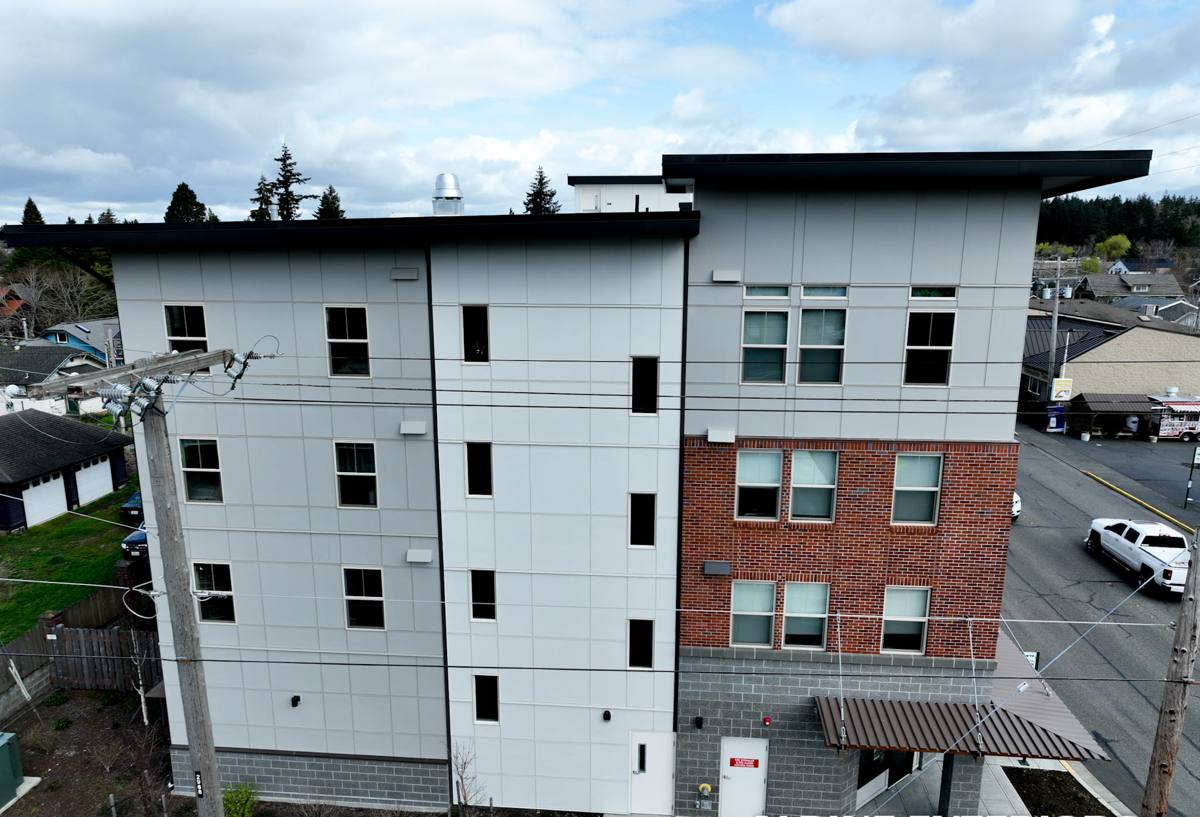
What Moss Season Actually Does to a Home's Exterior
Moss doesn't just grow on roofs. Given shade, moisture, and an organic surface to cling to, it spreads across siding, trim, and fascia boards too. On wood or wood-composite siding, moss holds water against the substrate for months at a time, which accelerates rot from the outside in — often in places a homeowner can't see without getting up close with a ladder.
Fiber cement doesn't give moss the same foothold. It's an inorganic material, so moss and mildew sit on the surface rather than feeding into it. Combined with James Hardie's factory-applied ColorPlus finish, which resists the kind of surface staining that makes moss and mildew harder to clean off, siding stays lower-maintenance through the wet months than most alternatives.
Where Moss Problems Start
In our experience working this area, moss and rot issues on older homes cluster in a few predictable spots: under overhangs with poor airflow, along ground-level siding courses that stay damp longer, and behind gutters that shed water onto the wall below instead of away from it. A correct siding installation addresses all three, not just the visible surface.
What a Correct James Hardie Installation Involves
James Hardie makes a good product, but the siding is only as good as the installation behind it. A lot of the failures we get called out to inspect on other contractors' work trace back to shortcuts taken during install, not a flaw in the material itself.
Water Management Comes First
Before a single plank goes up, the wall needs a properly lapped weather-resistive barrier, correctly flashed windows and doors, and rainscreen or drainage detailing where the wall assembly calls for it. This is the layer that actually keeps water out — the siding is the second line of defense, not the first.
Fastening and Clearances
James Hardie specifies exact nailing patterns, fastener types, and minimum clearances from grade, roof lines, and other flashing details. Skipping the required clearance above a deck or patio, for example, is a common shortcut that lets water wick into the bottom of the siding for years before it shows.
Cut Edges and Field Painting
Every field-cut edge of a Hardie plank needs to be sealed with the manufacturer-approved touch-up product before it's installed. This step gets skipped more often than homeowners realize, and it's one of the fastest ways to void a warranty or create a slow leak point at every cut.
Our Process From Estimate to Finished Job
- On-site assessment — we look at the current siding, water damage, moss patterns, and any structural or moisture issues underneath before quoting anything.
- Tear-off and inspection — old siding comes off so we can check sheathing and framing for rot, especially at corners, window openings, and the lowest courses near grade.
- Repair and water barrier — any compromised sheathing gets replaced, then a new weather-resistive barrier and flashing system goes on correctly, including drainage detailing suited to this climate.
- James Hardie installation — planks, trim, and accessories go up to manufacturer spec: proper fastening, clearances, and sealed cut edges throughout.
- Final walkthrough — we go over the finished exterior with the homeowner and flag anything that needs attention before we consider the job done.
Comparing Siding Materials for a Wet, Salt-Influenced Climate
Homeowners in the Nooksack and Birch Bay area often ask why we don't offer alternatives to Hardie. The honest answer is in how these materials perform over time in exactly this kind of weather.
| Material | Moisture Behavior | Moss/Organic Growth | Long-Term Maintenance |
|---|---|---|---|
| James Hardie fiber cement | Dimensionally stable when installed to spec; does not swell or rot | Inorganic surface resists growth; ColorPlus finish sheds grime | Occasional wash; repaint only if not ColorPlus finish |
| Vinyl siding | Can trap moisture behind panels; prone to warping in heat/cold swings | Growth sits on surface but panel seams collect debris | Low upkeep but limited repair options once damaged |
| Primed wood or cedar | Absorbs and releases moisture; swells and checks over seasons | Organic material feeds moss and mildew directly | Regular repainting/staining and moss treatment required |
| LP SmartSide (engineered wood) | Better than raw wood but still wood-based; edge sealing critical | Organic substrate can support growth if coating fails | Ongoing edge and seam maintenance to prevent moisture entry |
This isn't about any one product being poorly made — it's about which material holds up with the least ongoing risk in a climate defined by sustained damp and a long moss season. That's the standard we hold our own work to, and it's why we standardized on James Hardie rather than offering several options side by side.
James Hardie Product Lines and Colors
James Hardie builds its siding in HardieZone formulations matched to regional climate demands, and homes in this part of Washington fall under the HZ5 specification, engineered for wetter, more moderate climates rather than extreme heat or freeze cycles. Within that, homeowners typically choose from lap siding, shingle-style panels, or board-and-batten looks, all available with the factory-applied ColorPlus finish, which is baked on rather than field-painted and carries its own finish warranty separate from the substrate warranty.
Color and texture selection matters more in a wet climate than people expect. Darker, more saturated colors on a lower-quality finish can show water staining and mildew streaking faster than a properly finished product. ColorPlus is formulated to resist that kind of surface staining, which matters through a Whatcom County winter.
Warranty Structure
James Hardie's non-combustible fiber cement carries a strong transferable limited warranty on the substrate, and ColorPlus finishes carry a separate finish warranty covering fading and flaking. Warranty coverage depends on installation meeting manufacturer specifications — another reason correct installation isn't optional, it's what keeps the coverage intact if something does go wrong down the road.
What Affects the Cost of a Nooksack Siding Project
Every home is different, but a few factors consistently move the price on jobs in this area:
- How much of the existing wall assembly needs repair once old siding comes off
- Home size, number of stories, and roofline complexity around windows, dormers, and corners
- Whether trim, fascia, and soffit work is bundled into the same project
- Product selection — lap versus shingle-style panels, and standard versus premium ColorPlus colors
- Site access and staging, particularly on wooded or sloped lots common around Birch Bay and Nooksack
We give straightforward, itemized estimates rather than a single lump number, so homeowners can see what they're actually paying for.
Maintaining James Hardie Siding in a Moss-Prone Climate
Correctly installed Hardie siding is genuinely low-maintenance, but "low-maintenance" isn't "no-maintenance." A short seasonal routine keeps it performing the way it's designed to:
- Rinse siding down once or twice a year, focusing on shaded, north-facing walls where moss takes hold first
- Keep gutters clear so water sheds away from the wall instead of running down the face of the siding
- Trim back landscaping and tree cover that keeps siding damp and shaded longer than necessary
- Check caulking at trim joints and penetrations annually, and re-seal if it's cracking or pulling away
- Have any impact damage or cracked planks repaired promptly rather than waiting, since a compromised plank is where moisture gets behind the material
Why Hiring a Crew That Already Works This Area Matters
A siding installer who works regularly in Birch Bay and the surrounding Nooksack area already knows which details matter here: how far moisture drives inland with the weather patterns off the Strait, how long moss season actually runs, and which parts of a wall assembly fail first under those conditions. That local pattern recognition shows up in the flashing details, the clearances, and the water management choices made during installation — the parts of the job a homeowner won't see again once the siding is up, but will absolutely feel if they were done wrong.
We install one product because we've seen what correct, climate-appropriate installation does for a home's exterior over the long run, and we'd rather do one thing at the standard it deserves than offer several options and let quality vary.
If you're planning a siding project in the Nooksack or greater Birch Bay area, we're happy to take a look and put together a free, no-pressure estimate — just fill out the form below.