 Birch Bay Siding
 Siding That Has to Work Year-Round in Whatcom County
Lynden sits inland from Birch Bay, but it shares the same marine-influenced weather pattern that moves off the Strait of Georgia and Puget Sound and settles over Whatcom County for much of the year. That means long stretches of steady, driving rain rather than short downpours, humidity that lingers on north-facing walls and under eaves, and a moss season that can run from fall through spring on anything that stays damp too long. Salt-laden air off Birch Bay's shoreline also travels with the prevailing winds, which is part of why we don't treat siding here the same way a contractor in a dry inland climate would.
Siding in this region isn't just a cosmetic layer. It's the first line of defense against moisture intrusion, wood rot in the sheathing behind it, and the slow paint failure that shows up on homes with the wrong product or a rushed installation. When we go out to a home in Lynden, we're not just matching a color — we're evaluating how that specific wall assembly will handle water, wind-driven rain, and prolonged dampness over the next 30-50 years.
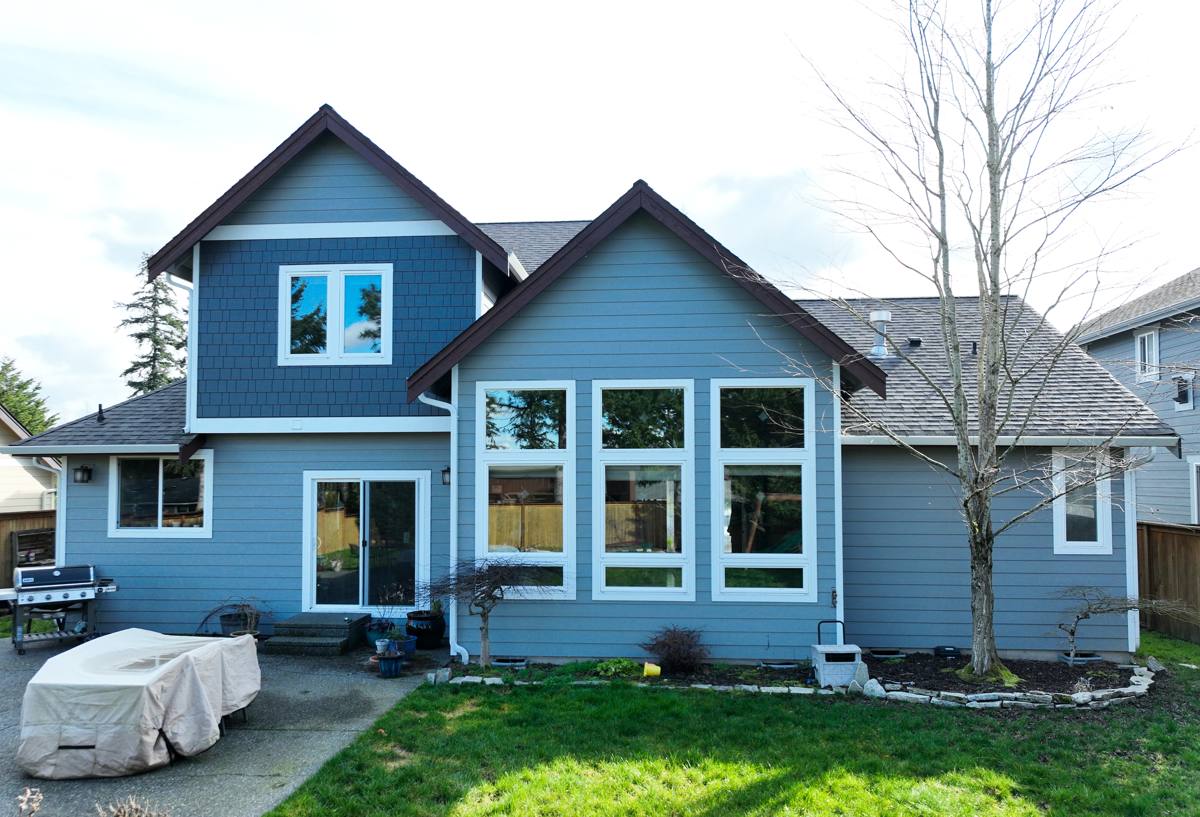
Why We Only Install James Hardie
Birch Bay Siding Company installs James Hardie fiber cement siding exclusively. We don't install vinyl, LP SmartSide, Cemplank, Allura, primed spruce, or cedar. That's not a marketing position — it's a standard we hold because of what we've seen happen to other materials in this exact climate over time.
Vinyl siding can warp and gap as temperatures swing, and its seams give water a path inward if it's not installed with real precision. Wood-based composite siding like LP SmartSide performs well when it's kept dry, but any climate with this much sustained moisture puts extra pressure on the OSB core and the factory treatment protecting it — a single missed caulk joint or damaged edge becomes a slow, hidden problem. Cedar and primed spruce are beautiful materials, but they require an ongoing maintenance commitment — refinishing, caulking, and moisture monitoring — that most homeowners don't sign up for when they picture "new siding."
James Hardie fiber cement is non-combustible, dimensionally stable across our temperature range, and its ColorPlus factory finish is baked on and warrantied against fading and peeling — it doesn't rely on a field-applied paint job holding up against Whatcom County rain the way wood and some composite products do. That combination is why it's the only product we put our name behind.
What Other Fiber Cement Brands Get Right — and Where We Draw the Line
Other fiber cement brands, including Allura and Cemplank, use similar core technology and aren't inherently bad products. Our decision to standardize on James Hardie comes down to three practical factors: the depth and consistency of the HZ5 climate-engineered product line for our region, the strength and transferability of Hardie's warranty coverage, and the level of manufacturer-backed installer training we've built our process around. Consistency matters more to us than having more brand options on the table.
The Right Hardie Product Line for a Lynden Home
James Hardie engineers its siding by climate zone, and homes in Whatcom County fall into the HZ5 category — the line built for regions with sustained moisture, freeze-thaw cycling, and wind-driven rain. HZ5 products are formulated and tested specifically for this kind of exposure, which is different from what gets installed in a dry or mild climate elsewhere in the country.
Within HZ5, most Lynden homes use one of these Hardie product types, often combined for visual interest:
- HardiePlank lap siding — the most common choice, available in several exposure widths and textures (smooth or cedar-grain)
- HardiePanel vertical siding — used for board-and-batten looks or accent sections
- HardieShingle siding — for a shingle-style appearance on gables or full elevations
- HardieTrim boards — for corners, fascia, and window/door casing that matches the siding's durability
All of these come pre-finished in ColorPlus Technology colors, which matters here specifically because it removes the weak point that hurts field-painted siding in wet climates: a factory-cured finish bonds more consistently than paint applied on-site in variable weather, and it's backed by its own finish warranty.
What Correct Installation Actually Involves
Fiber cement siding is only as good as its installation. The material itself resists moisture and rot, but the assembly around it — flashing, gaps, fastening, and caulking — determines whether water actually stays out of the wall. This is where we see the biggest gap between a correct Hardie install and a rushed one, and it's the reason installer experience matters as much as the product choice.
| Installation Detail | Done Correctly | Common Shortcut |
|---|---|---|
| Bottom clearance | Minimum clearance maintained above grade, decks, and roof lines per Hardie spec | Siding installed too close to grade, wicking moisture from splashback |
| Butt joints | Flashed or gapped and caulked per manufacturer detail | Butted tight with no flashing, becomes a water entry point over time |
| Fastening | Correct nail type, spacing, and depth into framing | Overdriven or underdriven fasteners that crack the board or leave gaps |
| Window and door flashing | Integrated with housewrap using proper flashing tape sequencing | Siding butted to trim with caulk relied on as the only barrier |
| Panel gaps | 1/8" gaps maintained at joints for expansion, sealed per spec | No gap left, causing buckling or forced cracking over seasons |
Every one of these details is inspectable, and every one of them is easy to skip on a job that's being rushed. In a climate that gets as much sustained rain as Whatcom County, a shortcut here doesn't show up as a problem in year one — it shows up as rot behind the siding in year five or six, usually after the damage is already done.
Our Process for a Lynden Project
We run the same disciplined process on every home, whether it's a full re-side or a single-elevation repair job:
- On-site assessment — we look at existing siding condition, sheathing access points, moisture staining, and any problem areas around windows, decks, or roof intersections before quoting anything
- Tear-off and sheathing check — old siding comes off and we inspect the sheathing underneath for soft spots or hidden rot before anything new goes up
- Weather barrier and flashing — housewrap and flashing are installed or repaired to current best practice, not just patched over what was there
- Hardie installation — panels, planks, or shingles installed to manufacturer fastening and clearance specs, with trim and joint detailing done to the same standard
- Final walkthrough — we go over the finished job with the homeowner and point out anything worth knowing for future maintenance
Cost Factors for a James Hardie Project in Lynden
Every home is different, but the same handful of factors drive most of the cost variation we see on Whatcom County projects:
| Factor | Why It Matters |
|---|---|
| Existing siding removal | Tear-off adds labor, and hidden sheathing repair sometimes only becomes visible once old siding is off |
| Product selection | Plank width, texture, and whether shingle or panel accents are included changes material cost |
| Home complexity | Roof lines, dormers, and elevation count affect labor time and trim detailing |
| Trim and accent work | Corner boards, window casing, and accent siding areas add both material and install time |
| Access and site conditions | Steep lots, tight setbacks, and staging space affect scaffolding and equipment needs |
We give homeowners a real, itemized number after an in-person assessment rather than a rough phone estimate — too many of these factors are only accurate once we've actually looked at the house.
Maintenance and Long-Term Care in This Climate
James Hardie siding needs far less upkeep than wood or composite alternatives, but "low maintenance" doesn't mean "no maintenance" — especially with the moss and moisture exposure common around Lynden and Birch Bay. A short annual checklist keeps siding performing the way it's designed to:
- Rinse siding annually to clear pollen, dirt, and early moss growth before it takes hold
- Keep gutters clear so overflow doesn't run down the wall face repeatedly
- Trim back vegetation and tree limbs that keep siding shaded and damp longer than necessary
- Check caulked joints at trim, windows, and butt joints every year or two for cracking or separation
- Address any impact damage (from debris, equipment, or ladders) promptly rather than letting a small chip become a moisture entry point
None of this is heavy work, but skipping it is exactly how moss gets a foothold and how small caulk failures turn into bigger problems during the wetter months.
Why a Crew That Already Works in Lynden Makes a Difference
Siding installation isn't generic across climates, and it isn't generic within Whatcom County either. A crew that regularly works Lynden and the surrounding Birch Bay area already knows how local wind exposure and rain patterns affect flashing details, understands the permitting expectations for this jurisdiction, and has already worked through the practical realities of staging equipment on the lot sizes and layouts common in this area. That familiarity shows up in fewer surprises during the job and a finished install that's detailed for how this specific climate actually behaves, not a generic specification sheet.
If you're weighing a siding replacement or repair in Lynden, we're happy to walk the property, answer questions honestly — including where James Hardie isn't the cheapest option on paper — and put together a free, no-pressure estimate using the form below.