 Birch Bay Siding
 Roof Repair in Lynden: What Whatcom County Weather Actually Does to a Roof
Lynden sits inland from the coast, but it doesn't escape the weather pattern that defines this whole corner of Washington. Marine air moves in off the Salish Sea and settles over Whatcom County for days at a time, bringing long stretches of low clouds, steady drizzle, and the kind of driving rain that finds every weak seam in a roof system. Add mature tree cover and farmland humidity to that mix, and you get a climate that's genuinely hard on roofing — not because of any one dramatic storm, but because of how many wet months a roof has to survive every single year.
A roof repair here has to account for that. Patching a leak on a dry August afternoon is easy. Making that patch actually hold through a wet Whatcom County winter is the part that separates a real repair from a temporary fix.
Moss Season and What It Really Does
Moss isn't just cosmetic. On asphalt composition shingles, moss holds moisture against the granule surface far longer than the shingle was ever designed to handle, which accelerates granule loss and lets water work its way under shingle edges and tabs. On any roof with shaded, north-facing slopes — common on lots with good tree cover, which describes a lot of Lynden properties — moss can establish itself in just a season or two if it isn't kept in check. By the time it's visibly thick, it's usually already lifted shingles enough to let water underneath.
Driving Rain and Wind-Driven Leaks
Wind-driven rain doesn't behave like a garden hose pointed straight down. It gets pushed sideways and upward under flashing, into vent boots, and along valleys where two roof planes meet. Most of the "mystery leaks" we get called out for in this area aren't failures in the open field of the roof at all — they're flashing, valley, or penetration failures that only show themselves when rain comes in at an angle for hours at a stretch.
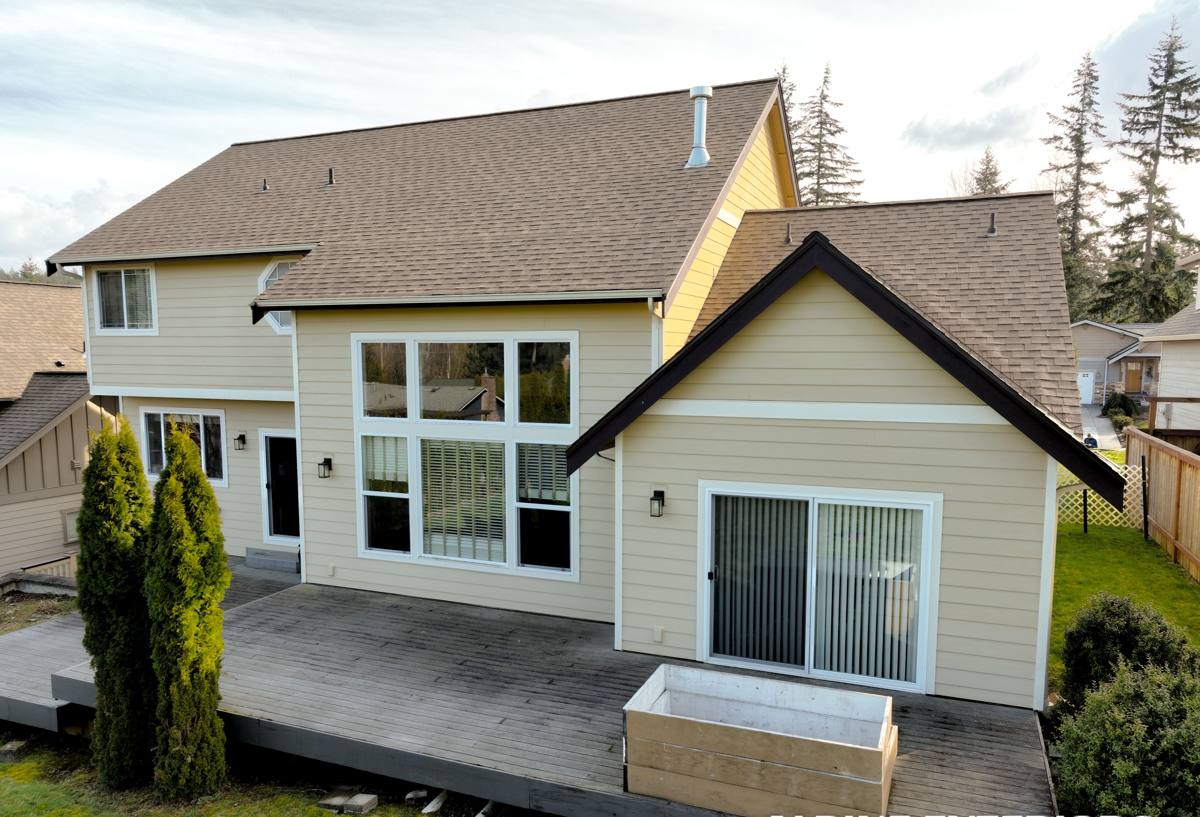
Common Roof Repair Needs We See in Lynden Homes
The repair calls we handle in this area tend to fall into a handful of recurring categories:
- Moss-lifted shingles along shaded slopes, especially on roofs that haven't had a moss treatment or gentle cleaning in several years
- Flashing failures around chimneys, skylights, and roof-to-wall transitions, where the metal has pulled away, corroded, or was never sealed correctly to begin with
- Valley leaks where debris and moss build up and hold water against the roof deck longer than it should sit
- Deteriorated pipe boots and vent seals — usually rubber components that crack and shrink years before the shingles around them are due for replacement
- Gutter and fascia-related rot where clogged or undersized gutters overflow and saturate the roof edge and fascia board over time
- Wind-lifted or missing shingles after a stretch of stronger fall or winter weather
Here's a simple checklist for knowing when it's time to call someone rather than wait:
- Water stains on an interior ceiling or upper wall, even if they aren't actively dripping right now
- Visible moss patches thicker than a light green film, especially on north-facing slopes
- Shingles that look cupped, curled, or are missing granules in patches
- Daylight visible through the roof deck from inside the attic
- Sagging in the roofline or soft spots you can feel when walking the attic
- Debris consistently collecting in one valley or corner instead of washing through
What a Correct Roof Repair Actually Involves
Diagnosing the Real Source of a Leak
Water travels. A stain on a bedroom ceiling might have nothing to do with the roof directly above it — it could be tracking down a rafter from a flashing gap several feet away. A repair that just seals the spot where the stain shows up, without tracing the actual entry point, tends to come back within a season or two. A correct repair starts with getting on the roof (and often into the attic) to trace the path of the water, not just treat the symptom.
Matching Materials and Doing Flashing Right
Repairs also need to match what's already on the roof — shingle profile, color, and weight — so the patched section sheds water the same way the surrounding roof does. Flashing work is where a lot of shortcuts happen: flashing that's just caulked over instead of properly integrated under the shingle courses will fail again, usually faster than the original problem did. Correct flashing repair means removing and replacing the metal in the right sequence with the surrounding shingles, not layering sealant over a bad detail and hoping it holds.
Roof Repair or Roof Replacement? How We Help Lynden Homeowners Decide
Not every roof problem needs a full replacement, and not every leak can be fixed with a patch. The honest answer usually comes down to the roof's age, how widespread the damage is, and what condition the decking underneath is in once we actually get eyes on it.
| Situation | Usually Points To |
|---|---|
| Isolated leak, roof under 12-15 years old, decking solid | Targeted repair |
| Moss coverage on part of the roof, shingles otherwise intact | Cleaning/treatment plus spot repair |
| Multiple leak locations, roof nearing or past expected lifespan | Replacement likely more cost-effective long term |
| Soft or rotted decking discovered during repair | Repair scope expands; replacement of that section required regardless of overall roof age |
| Granule loss widespread across most slopes | Roof is aging out; repairs become short-term fixes |
Several other factors shape what a given repair actually costs, and we walk through these with every homeowner before any work starts:
| Cost Factor | Why It Matters |
|---|---|
| Size of the damaged area | More square footage means more materials and labor time |
| Roof pitch and accessibility | Steep or hard-to-reach sections take longer and require more safety setup |
| Number of penetrations involved | Chimneys, skylights, and multiple vents each add flashing work |
| Decking condition once opened up | Rotted plywood or sheathing found mid-repair adds material and labor |
| Material match availability | Older or discontinued shingle lines can take more work to blend in |
We won't quote a firm number over the phone for anything beyond the simplest jobs — a roof repair estimate that's worth anything has to be based on what we actually find up there, not a guess.
Our Roof Repair Process
- Inspection. We get on the roof (and into the attic where relevant) to trace the actual source of the problem, not just the visible symptom.
- Written estimate. You get a clear explanation of what we found, what needs to happen, and what it costs — no vague scope, no pressure to decide on the spot.
- The repair itself. Matched materials, correct flashing sequencing, and attention to the details that determine whether a repair lasts one season or many.
- Cleanup. Old materials and debris hauled off; we don't leave a job site looking worse than we found it.
- Follow-up. If something isn't right after the next round of weather, we want to hear about it and make it right.
Why a Crew That Already Works in Lynden Matters
Roofing crews who only pass through an area once end up guessing at things a local crew already knows — how tree cover and shade patterns in a given part of the county tend to accelerate moss growth, what roof ages and materials are common on homes of a certain era, and how to sequence exterior work around the wetter stretches of the Whatcom County calendar instead of fighting them. That kind of familiarity doesn't replace a proper inspection, but it does mean fewer surprises and a repair plan that accounts for how the area actually behaves over a full year, not just how it looks on the day we show up.
It also means accountability. A crew that plans to keep working in Lynden and the surrounding area has every reason to make sure a repair holds — reputation and repeat business depend on it far more than a one-time job ever would.
Maintaining Your Roof Between Repairs
A few habits go a long way toward stretching the years between repair calls in this climate:
- Have gutters cleaned at least twice a year — more often if you're under conifers or deciduous trees that shed heavily
- Address moss while it's still thin, before it has a chance to lift shingle edges
- Walk the exterior after any significant windstorm and look for shingles that have shifted or gone missing
- Check attic insulation and ventilation periodically — poor attic airflow contributes to both moisture problems and ice-related issues during cold snaps
- Get a roof looked at professionally every few years even without an obvious problem, since small issues are far cheaper to fix than the water damage they eventually cause
If you're dealing with a leak, visible moss, or just want an honest opinion on what your roof actually needs, we're happy to take a look. Reach out for a free, no-pressure estimate using the form below.