 Birch Bay Siding
 Why Cherry Point Roofs Wear Differently Than Roofs Inland
Cherry Point sits out on the edge of Whatcom County, exposed to open water and weather that homes further inland simply don't deal with. A roof out here isn't fighting one problem — it's fighting three at once, year-round: salt-laden air off the Salish Sea, wind-driven rain that comes in sideways during fall and winter storms, and a moss season that runs longer than most homeowners realize. Any one of these will shorten a roof's life if it's not accounted for. Together, they're why a roof that would last 25+ years in a dry inland climate can start failing early out here if it wasn't built for this specific stretch of coastline.
Salt Air and Metal Fasteners
Airborne salt doesn't just sit on the surface — it works into exposed metal over time. Nails, staples, drip edge, and flashing that aren't rated for coastal exposure corrode faster than they would a few miles inland, and once fasteners start failing, shingles lift, flashing gaps open, and water finds its way underneath. A roof built for Cherry Point needs corrosion-resistant fasteners and flashing from day one, not as an upgrade after the first repair.
Wind-Driven Rain
Storms coming off the water push rain sideways, not straight down. That matters because a roof can be watertight against normal rainfall and still leak under wind-driven conditions if the underlayment, flashing laps, and seal-down strips weren't installed with that in mind. Eaves, valleys, and anywhere the roofline changes direction are where wind-driven rain finds its way in first.
The Long Moss Season
Whatcom County's wet season stretches long, and shaded, tree-covered lots around Cherry Point stay damp well after the rain stops. Moss doesn't just look bad — it holds moisture against the roofing material, works its way under shingle tabs, and can lift edges enough to let water underneath. Left unchecked over a few seasons, moss growth alone can take years off a roof's usable life.
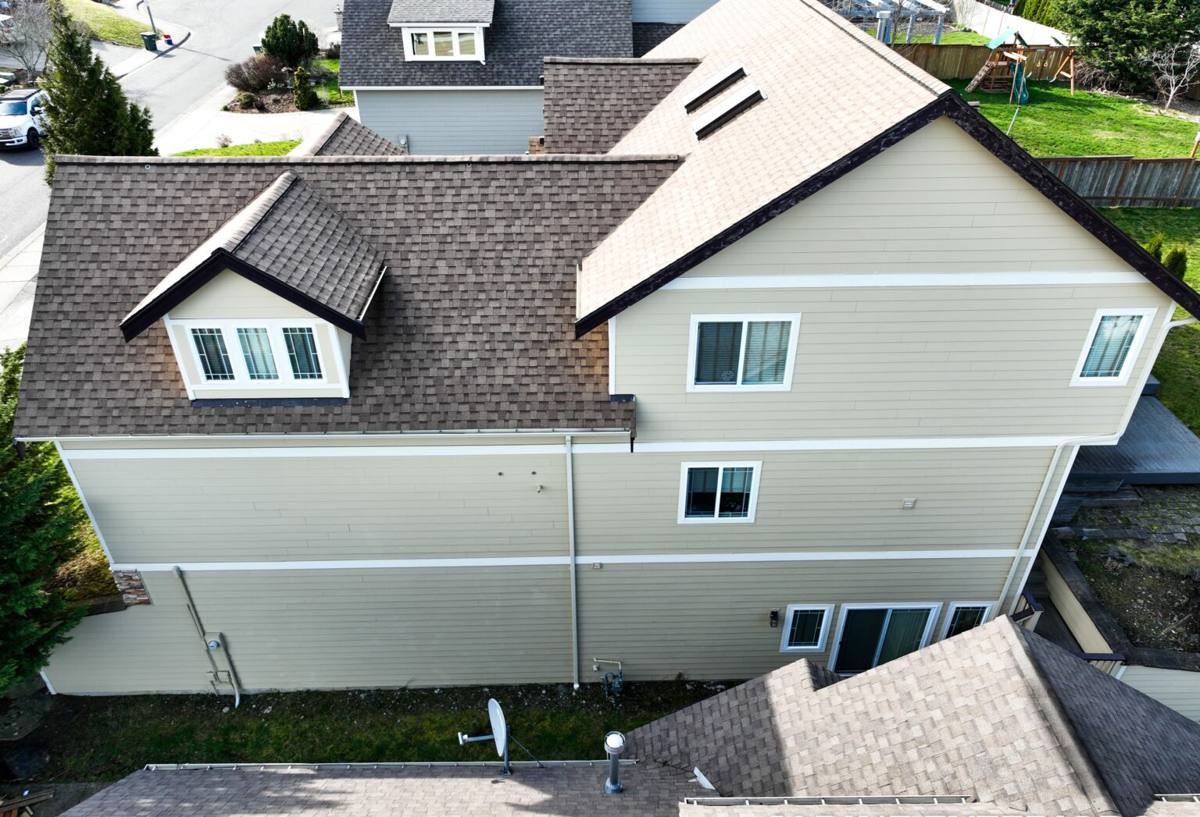
Signs a Cherry Point Home Needs a New Roof, Not Another Repair
Repairs make sense when the damage is isolated. A new roof makes sense when the whole system is aging out or the damage is spread across the roof rather than confined to one spot. Some signs point clearly toward replacement:
- Granules collecting in gutters or at downspouts, or shingles that look bald in patches
- Shingle edges curling, cupping, or lifting, especially on south- and west-facing slopes
- Moss or dark streaking covering large sections rather than a small patch
- Daylight visible through the roof deck from inside the attic
- Soft, spongy spots underfoot when walking the roof, or sagging along the ridge or eaves
- A pattern of repeated repairs to the same sections over the last few years
- A roof that's at or past its material's expected service life, regardless of visible damage
- Water stains on ceilings or in the attic that show up after wind-driven rain specifically
If you're seeing two or more of these, it's usually more cost-effective over time to replace than to keep patching.
Choosing a Roofing Material for This Microclimate
There's no single "best" roofing material — there's a best material for this specific site, this roof pitch, this tree cover, and this budget. Here's how the common options actually perform in a salt-air, high-moisture environment like Cherry Point:
| Material | Typical Lifespan Here | Moss & Algae Resistance | Wind Performance | Maintenance |
|---|---|---|---|---|
| Architectural asphalt (algae-resistant) | 20–30 years | Good, with copper/zinc granule technology | Strong with proper nailing and sealant strips | Periodic moss treatment on shaded slopes |
| Standard three-tab asphalt | 15–20 years | Fair — more prone to early moss growth | Adequate, lower wind rating than architectural | More frequent moss and algae attention |
| Standing seam metal | 40–50+ years | Excellent — moss struggles to hold on smooth panels | Excellent | Very low; occasional fastener check |
| Synthetic/composite shake | 30–40 years | Good to excellent depending on product | Strong | Low; periodic debris clearing |
Most Cherry Point homes we work on land on algae-resistant architectural asphalt for the balance of cost and performance, or standing seam metal on homes with heavier tree cover or waterfront exposure where the upfront cost buys decades of low maintenance. There's no wrong answer as long as the choice matches the site — a bargain three-tab shingle on a shaded, moss-prone slope is a false economy.
What a Correctly Installed New Roof Actually Includes
The roofing material is what you see. What actually determines whether the roof performs in this climate is everything underneath and around it.
Tear-Off and Deck Inspection
A full tear-off, rather than a layover, lets us actually see the roof deck — sheathing, rafters, and any hidden rot or soft spots from past leaks. In a wet climate like this, skipping that step means building a new roof over a problem that's already there.
Underlayment System
Synthetic underlayment across the full deck, with self-adhering ice-and-water shield at eaves, valleys, and around every penetration — chimneys, vents, skylights — is what actually stops wind-driven rain from reaching the deck if a shingle ever gets compromised. This is the layer most homeowners never see and most corner-cutting jobs skip.
Flashing Details
Step flashing at sidewalls, counterflashing at chimneys, valley metal, and drip edge all need to be installed in the correct order and lapped correctly — not just caulked over gaps. Caulk is a temporary fix; correct flashing is a permanent one.
Ventilation
Balanced intake at the soffits and exhaust at the ridge keeps the attic temperature closer to outside air, which reduces condensation buildup and helps prevent the kind of trapped moisture that feeds rot and mold from the inside. Poor ventilation is also one of the fastest ways to void a shingle manufacturer's warranty, even on a well-installed roof.
Our Cherry Point Installation Process
Every roof is different, but the sequence stays consistent so nothing gets missed:
- On-site inspection and honest assessment — repair, partial replacement, or full replacement
- Written estimate walking through material options and what each one means for this specific roof
- Permit pulled through Whatcom County before any work begins
- Full tear-off and haul-away of the old roofing material
- Deck inspection, with any rotted or soft sheathing replaced before moving forward
- Underlayment and ice-and-water shield installed at all vulnerable points
- Flashing installed at every wall, valley, and penetration
- Roofing material installed to manufacturer spec and local wind requirements
- Ventilation checked and corrected if intake or exhaust is inadequate
- Full site cleanup, including a magnetic sweep for stray nails
- Final walkthrough and warranty paperwork handed over
What Drives the Cost of a New Roof Here
Two roofs of the same square footage can cost very different amounts depending on a handful of real factors — not because one contractor is padding the price. Here's what actually moves the number:
| Factor | Why It Matters |
|---|---|
| Roof size and pitch | Steeper roofs take longer to work safely and use more material per square foot of coverage |
| Number of existing layers | Tearing off two layers of old roofing costs more in labor and disposal than one |
| Decking condition | Rotted sheathing found during tear-off has to be replaced before anything else happens |
| Material choice | Standard asphalt, algae-resistant asphalt, and metal all sit at different price points |
| Roof complexity | Valleys, dormers, chimneys, and skylights all add flashing work and time |
| Site access | Tree cover, steep driveways, and tight lot lines around Cherry Point can affect equipment and staging |
We walk through these factors on-site rather than quoting off a phone call, because guessing at any of them leads to a number that doesn't hold up once the tear-off actually starts.
Why Hire a Crew That Already Works Cherry Point
A roofing crew that only occasionally works this stretch of Whatcom County is guessing at how much moss buildup is normal for a shaded lot here, how far up a slope wind-driven rain actually pushes water, and which fastener and flashing choices hold up against salt air versus which ones look fine on paper but corrode within a few years. A crew that works Cherry Point regularly has already seen which details matter on homes just like yours, and builds for that from the start instead of learning it through a warranty claim later. That local familiarity also means faster response if a storm causes damage and you need someone out quickly, not a callback queue from a contractor working three counties over.
Permits, Timeline, and Warranty
Whatcom County requires a permit for a full roof replacement, and we handle that as part of the job rather than leaving it on the homeowner. Timeline depends on roof size and weather — a straightforward tear-off and re-roof on an average home typically runs a few days of on-site work, though we schedule around forecasted rain windows since roofing in the middle of a storm isn't good practice for anyone. On warranty, it's worth understanding there are two separate pieces: the manufacturer's warranty on the material itself, and our workmanship warranty covering the installation. Both matter, and we make sure you have the paperwork for each before we consider the job finished.
Get a Straightforward Estimate
If your roof is showing its age, or you just want an honest read on whether repair or replacement makes more sense for a Cherry Point home, we're glad to come take a look. The estimate is free, there's no pressure attached to it, and you'll get a straight answer either way — use the form below to get started.