 Birch Bay Siding
 Point Whitehorn Roofs Work Harder Than Most
Point Whitehorn sits close enough to the water that homes here take on a different kind of weather load than a roof five or ten miles inland. Salt-laden air off the Strait of Georgia settles on shingles, flashing, and fasteners day after day. Wind-driven rain comes in sideways during winter storms, testing every seam and lap in a roof system rather than just the field of the shingles. And the tree cover that gives so many Point Whitehorn properties their privacy also means shade, damp air, and the kind of moss and algae growth that shortens a roof's working life if it's never addressed. None of this is unusual for a home near the Whatcom County coastline, but it does mean a "standard" roof installation, done without those conditions in mind, tends to underperform here.
A roof that's built for Point Whitehorn isn't a special product line — it's ordinary materials installed with extra attention paid to the details that salt air, wind-driven rain, and prolonged moisture actually attack: fastener choice, flashing, underlayment, ventilation, and moss prevention. That's the difference between a roof that looks fine going up and one that's still performing well in fifteen or twenty years.
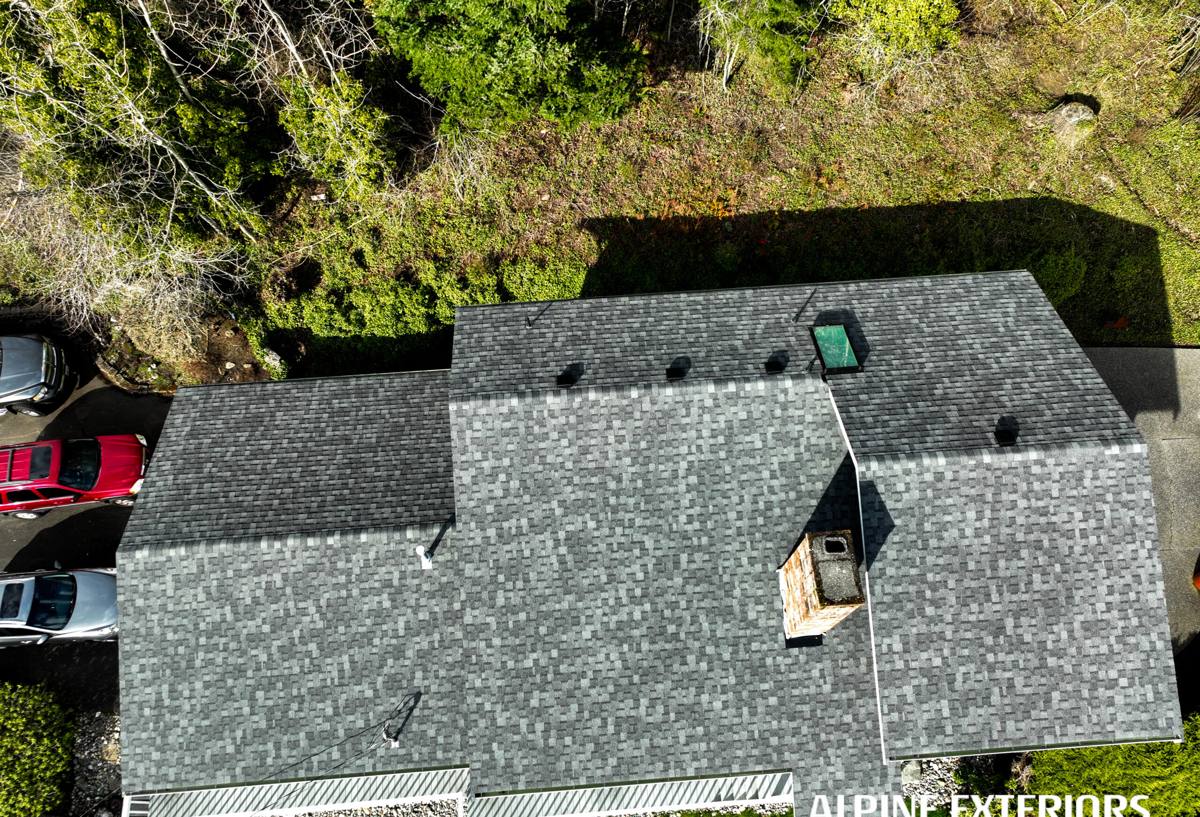
What a Correct New Roof Installation Actually Involves
A new roof is more than shingles nailed to plywood. Every layer underneath the visible surface does a specific job, and skipping or shortcutting any of them is where premature leaks and moss problems start.
Tear-Off and Deck Inspection
We remove the old roofing down to the deck rather than installing over existing layers. That lets us actually see the plywood or plank decking underneath — which matters a lot in a marine climate, because trapped moisture under old shingles is exactly how rot gets started and stays hidden. Any soft, delaminated, or water-stained decking gets replaced before anything new goes down. Skipping this step to save time is one of the most common shortcuts in the trade, and it's the one that causes the most expensive problems later.
Underlayment
Underlayment is the roof's backup layer, and in a home exposed to driving rain off the water, it earns its keep. We use synthetic or self-adhered underlayment products rated for high wind and moisture exposure, with ice-and-water shield style membrane at the eaves, valleys, and any roof-to-wall transitions where wind-driven rain is most likely to find a way in.
Flashing
Flashing around chimneys, skylights, dormers, and roof-to-wall intersections is where the majority of roof leaks actually originate — not in the open field of shingles. We install new flashing rather than reusing old pieces, and we pay particular attention to any galvanic corrosion risk where dissimilar metals meet, since salt air accelerates that kind of corrosion significantly faster than it would inland.
Fasteners
Standard fasteners can start showing surface corrosion within a few years this close to the water. We use corrosion-resistant fastener grades appropriate to coastal exposure, because a roof is only as good as the nails holding it down, and a fastener failure decades before the shingles wear out defeats the purpose of the rest of the job.
Choosing a Roofing Material for a Salt-Air, High-Moss Property
There isn't one "correct" roofing material for Point Whitehorn — the right choice depends on the home's exposure, its roof pitch, tree cover, and the owner's maintenance expectations. Here's how the common options actually compare under these specific conditions.
| Material | Salt Air / Corrosion Resistance | Moss & Algae Resistance | Maintenance Expectations |
|---|---|---|---|
| Architectural Asphalt Shingles | Good, with corrosion-resistant fasteners and flashing | Moderate — algae-resistant (AR) shingle options help; still benefits from periodic cleaning in shaded areas | Occasional moss/debris removal, especially on north-facing or tree-covered slopes |
| Standing Seam Metal | Excellent when properly coated and fastened; avoid dissimilar-metal contact | Very good — moss struggles to hold on smooth metal panels | Low; periodic rinsing and gutter checks |
| Composite / Synthetic Shingle | Good; check manufacturer coastal warranty terms | Moderate to good depending on product | Similar to architectural asphalt |
We'll talk through these trade-offs honestly during an estimate rather than pushing whichever product carries the best margin. A heavily shaded, north-facing roof under mature trees has different needs than an open, wind-exposed roof closer to the bluff, even on the same street.
Moss and the Long Wet Season
Whatcom County's overcast, damp stretch of the year is long, and Point Whitehorn's tree cover means some roof slopes rarely get direct sun to dry out between rains. That combination is exactly what moss and algae need to establish. Left unaddressed, moss does more than look bad — it lifts shingle edges, holds moisture against the roofing surface, and works its way into granule loss over time, all of which shortens the roof's service life.
A correct new installation reduces future moss pressure in a few concrete ways: proper shingle selection for shaded slopes, zinc or copper control strips at ridge lines where appropriate, and making sure the roof has enough airflow underneath it to actually dry out between rain events. None of this eliminates the need for occasional moss removal on a heavily shaded roof, but it changes how often that maintenance is needed and how much damage moss can do in between cleanings.
Ventilation: The Detail Most Homeowners Never See
A roof deck that can't breathe traps moisture, and trapped moisture is bad news in a climate this damp — it can lead to sheathing rot, reduced insulation performance, and premature shingle failure from the underside, which no amount of surface-level maintenance will catch in time. Balanced ventilation, intake at the eaves paired with exhaust at the ridge, keeps air moving through the attic space so moisture has somewhere to go instead of condensing against the deck. On a lot of older Point Whitehorn homes, ventilation was undersized or mismatched by the time the original roof went in decades ago. A new roof installation is the right moment to correct that, since the deck is already exposed and accessible.
Our Process, Start to Finish
- On-site inspection and estimate. We look at the existing roof, decking condition where visible, ventilation, and exposure to wind and shade before quoting anything.
- Written scope and material selection. You get a clear breakdown of materials, underlayment, flashing, and any deck repair contingencies — no vague allowances.
- Tear-off and deck inspection. Old roofing comes off, decking is inspected, and any needed repairs are addressed before new material goes down.
- Underlayment, flashing, and fastening. Installed to the standard described above, with attention to coastal exposure at every step.
- Final walkthrough. We review the completed roof with you, including ventilation and any moss-prevention measures installed.
- Site cleanup. Magnetic sweep for stray nails and full debris removal before we consider the job done.
What Affects the Cost of a New Roof
Every roof is priced on its own specifics, but the factors that move the number are consistent. Knowing them ahead of time makes it easier to compare estimates honestly.
| Cost Factor | Why It Matters |
|---|---|
| Roof size and pitch | Steeper roofs take longer to work safely and use more material per square |
| Number of existing layers | Tear-off of multiple old layers adds labor and disposal cost |
| Decking condition | Rotted or delaminated sheathing found during tear-off requires replacement |
| Material selection | Asphalt, metal, and composite options carry different material costs and labor time |
| Flashing and penetrations | Chimneys, skylights, and multiple roof planes add detail work |
| Access and site conditions | Tree cover, tight lots, and staging space affect labor time |
We're upfront about broad cost ranges during the estimate once we've actually looked at your roof — we don't quote sight unseen, and we don't pad estimates with vague "contingency" line items that leave you guessing.
Signs a Point Whitehorn Roof May Need Replacement
Some of these show up from the ground; others need a closer look. If you're seeing more than one of these, it's worth having the roof evaluated before a small problem becomes a deck-replacement problem.
- Shingles that are curling, cupping, or losing granules faster on one slope than others
- Heavy moss growth, especially on shaded or north-facing sections
- Rusted or corroded flashing around chimneys, vents, or skylights
- Daylight visible through the roof deck from inside the attic
- Soft spots or sagging when walked on (a red flag for compromised decking)
- Water stains on interior ceilings, especially after wind-driven rain events
- Missing, cracked, or lifted shingles after winter storms
- A roof that's approaching or past the expected service life of its material
Why Local, Point Whitehorn-Familiar Experience Matters
A crew that regularly works Point Whitehorn and the Birch Bay coastline already knows which slopes tend to hold moss, how far wind-driven rain can travel under poorly lapped flashing, and which fastener and flashing choices actually hold up against salt air over time — because they've seen the roofs that didn't get those details right. That's not something a crew based well inland, working mostly on dry-side roofs, necessarily has front of mind. Hiring locally isn't about hometown loyalty for its own sake; it's about hiring a crew whose default installation habits already account for the conditions your roof actually faces.
Ready to Talk About Your Roof?
If your Point Whitehorn home's roof is showing its age, or you just want an honest read on how many years it has left, we're happy to take a look. We'll walk the roof, explain what we find in plain terms, and put together a written estimate with no pressure to decide on the spot. The form below is the easiest way to get started.