 Birch Bay Siding
 Composite Decking Built for Sandy Point's Waterfront Climate
Sandy Point sits right on the water, and that changes what a deck has to survive year after year. Homes here take a steadier dose of salt-laden air than properties even a mile or two inland, and that air settles on every exposed surface: railings, fasteners, joist hangers, and the decking boards themselves. Add Whatcom County's long wet season, near-constant driving rain off the Strait, and the shaded, moisture-holding conditions that let moss and algae take hold on north-facing and low-clearance decks, and you've got a set of demands that a lot of standard deck builds simply weren't designed for.
Composite decking, installed correctly, holds up well against this combination. But "composite decking" isn't one product or one installation method — the difference between a deck that looks good in year twelve and one that's cupping, staining, or working loose at the fasteners almost always comes down to the substructure, the flashing, and the hardware choices made before a single board goes down. This page covers what a Sandy Point composite deck actually needs, what our process looks like, and what to watch for whether you hire us or someone else.
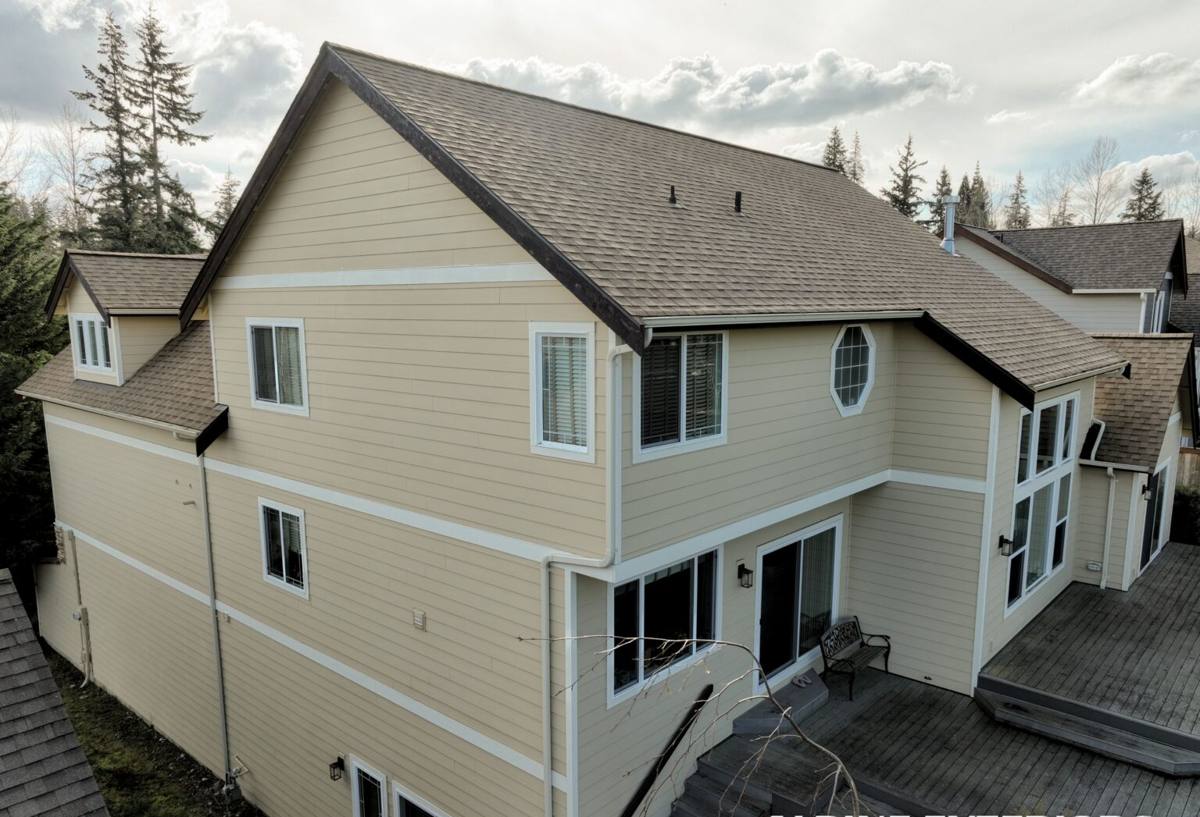
What Sandy Point's Climate Actually Does to a Deck
Salt Air and Metal Hardware
Salt air accelerates corrosion on anything ferrous. Standard galvanized fasteners, joist hangers, and screws that would last decades a few miles inland can start showing rust streaks and pitting in half that time on a waterfront lot. Once a fastener corrodes, it loses holding strength long before it looks obviously bad — which is a problem specifically because composite decking hides its substructure. You won't see a weakening hanger; you'll just eventually feel a soft spot or hear a squeak.
Driving Rain and Water Path
Wind-driven rain off the water doesn't fall straight down — it gets pushed sideways into ledger connections, under rail post bases, and into any gap where flashing was skipped or done half right. On a deck attached to the house, the ledger board-to-house connection is the single most common point of long-term water damage on the whole structure, composite decking or not. If that flashing detail is wrong, moisture gets behind the decking entirely and starts working on the framing, siding, and sheathing where nobody sees it until there's a real problem.
Moss, Algae, and a Long Wet Season
Composite boards don't rot, but that doesn't mean they're maintenance-free in this climate. Shaded areas, decks under tree cover, and boards with poor airflow underneath collect moisture and organic debris through the long Whatcom County wet season, and that's exactly what moss and algae need to establish. Some composite surfaces resist this better than others depending on the cap technology and surface texture — a detail worth understanding before you pick a board, not after.
Composite vs. the Alternatives for This Location
| Material | Salt air / moisture behavior | Moss & algae resistance | Ongoing maintenance |
|---|---|---|---|
| Capped composite | Strong — won't rot, resists staining and swelling when properly ventilated | Good with textured, capped surfaces; still needs periodic cleaning in shaded spots | Occasional wash; no sealing or staining |
| Uncapped composite | Weaker — exposed core can absorb moisture at cut ends and edges over time | Fair; more prone to surface mold in shaded, damp areas | More frequent cleaning; watch cut edges |
| Pressure-treated wood | Vulnerable — repeated wet/dry cycling and salt exposure accelerates checking and fastener corrosion | Poor without regular treatment | Annual sealing/staining recommended |
| PVC decking | Very strong — fully synthetic, doesn't absorb moisture | Good, similar to capped composite | Low; can look more plastic underfoot |
For most Sandy Point homes, capped composite hits the right balance: it holds up to the salt and rain exposure, resists the moss and algae issues that plague shaded coastal decks, and doesn't demand a yearly maintenance ritual homeowners are already juggling for the rest of a saltwater property.
What a Correct Composite Deck Build Involves Here
Substructure and Fasteners
This is where we don't cut corners, and it's the part that's invisible once the deck is finished. On a waterfront or near-waterfront lot, we spec stainless steel or high-grade corrosion-resistant fasteners and joist hangers rather than standard galvanized hardware — the upfront cost difference is small compared to what it costs to fix a failed connection under a finished deck later. Joists get properly sized and spaced for composite's specific span ratings, which differ from lumber decking and vary by brand.
Ledger Flashing and Water Management
Where the deck attaches to the house, we install proper flashing — not just caulk — to keep driving rain from working behind the ledger board over time. Composite decking itself sheds water fine; the vulnerable point is always the connections and the framing underneath, so that's where the real waterproofing work happens.
Ventilation Under the Deck
Composite boards need airflow underneath to dry out between rain events. Decks built too close to grade, or with insufficient joist height, trap moisture underneath and create exactly the damp, shaded environment moss and algae thrive in. We plan clearance and airflow as part of the substructure design, not as an afterthought.
Board Selection and Layout
Hidden fastener systems keep the surface clean and reduce the number of exposed screw points where water and salt can concentrate. Board direction and picture-framing (trim boards run perpendicular to the field boards) both affect how water sheds off the surface and how the edges hold up over time — details we walk through with you before ordering material.
Our Process for a Sandy Point Deck Project
- On-site assessment. We look at sun/shade exposure, proximity to water, existing drainage, and the condition of any structure the new deck ties into.
- Design and material selection. Board brand, color, and rail system chosen based on your home, budget, and how much surface glare or heat retention matters to you.
- Permitting. Deck projects in Whatcom County typically require a permit depending on size, height, and attachment to the structure — we handle that process rather than leaving you to sort it out.
- Substructure build. Corrosion-resistant framing hardware, correct joist spacing for the specified composite span rating, and ledger flashing done right the first time.
- Decking and rail installation. Hidden fastener systems where specified, proper board spacing for expansion, and clean, code-compliant railing.
- Final walkthrough. We go over basic care and what to expect from the material in this environment before we consider the job done.
Cost Factors for a Sandy Point Composite Deck
| Factor | Why it moves the price |
|---|---|
| Deck size and shape | More square footage and multiple angles/levels increase material and labor |
| Height off grade | Elevated decks need engineered footings, stairs, and additional railing |
| Board tier | Entry-level capped composite vs. premium multi-layer or PVC boards |
| Hardware spec | Stainless or marine-grade fasteners cost more than standard galvanized but matter here |
| Access to the site | Waterfront lots and tight side-yard access can add labor time |
| Demolition | Removing an existing wood deck adds cost but is often bundled efficiently |
We give straightforward, itemized estimates rather than a single lump number, so you can see exactly where the cost is going and where there's room to adjust the scope.
Maintenance That Actually Matters Here
- Rinse or sweep debris off the deck regularly, especially in fall when leaves and organic matter collect and hold moisture against the boards
- Clean shaded or low-airflow sections a bit more often — this is where moss and algae get a foothold first
- Check railing post connections annually for any looseness, since these take direct wind load off the water
- Keep gutters and downspouts near the deck clear so runoff isn't dumping extra water onto the structure
- Inspect the ledger flashing area during a normal walk-around; catching a small gap early is far cheaper than repairing hidden rot later
- Avoid pressure-washing at close range or high pressure directly into board seams — it can drive water where it shouldn't go
What to Check Before Hiring Anyone for This Job
- Do they spec corrosion-resistant hardware for waterfront and near-waterfront properties, or use standard galvanized everywhere?
- Can they explain their ledger flashing detail without hand-waving?
- Do they account for under-deck ventilation in the design, or just match joist height to whatever's convenient?
- Are they familiar with Whatcom County permitting requirements for deck construction?
- Will they give you span and fastening specs matched to the actual composite brand you're buying, not generic lumber numbers?
- Do they have experience with other decks in Birch Bay, Sandy Point, or similar coastal Whatcom County properties?
Why a Crew That Already Works Sandy Point Matters
A lot of deck problems on the water aren't material failures — they're the result of a build that was done to a generic spec instead of the conditions actually present on site. A crew that already works Sandy Point and the surrounding Birch Bay area knows which hardware corrodes too fast here, which board surfaces actually shed moss in a shaded yard, and how the wind off the water behaves against a railing system. That's not something you can fully substitute with a product spec sheet. It comes from having built and, just as importantly, having gone back to check on decks in this exact environment over time.
We're not going to tell you every composite deck failure in this area is dramatic — most problems show up slowly, as a soft spot, a rust stain bleeding through a board, or a corner that's started to hold water. The point of getting the substructure, flashing, and hardware right the first time is that you never have to deal with any of that.
If you're considering composite decking for a home in Sandy Point, we're happy to walk the property, look at your sun and water exposure, and put together a straightforward, no-pressure estimate using the form below.