 Birch Bay Siding
 Siding Replacement in Point Roberts: Built for an Exposed Peninsula
Point Roberts sits on a small peninsula at the far northwest corner of Whatcom County, cut off from the rest of Washington by a stretch of Canadian soil — the only way to drive here is through Delta, British Columbia, crossing the border twice along the way. That geography does more than make Point Roberts an interesting spot on the map. It puts homes here on a piece of land with water close on more than one side, which means more sustained salt air, more direct wind, and more driving rain than most Whatcom County properties see even a few miles inland. Siding on a Point Roberts home works harder than siding almost anywhere else in the county, and when it's time to replace it, the material and the installation both need to match that exposure.
We serve Point Roberts as part of our regular coastal Whatcom County territory alongside Birch Bay, and siding replacement here is a job we've done enough times to know what actually holds up. We install James Hardie fiber cement exclusively — not as a sales pitch, but as a professional standard shaped by what we've seen fail, and what's held up, on homes exposed to exactly this kind of marine climate.
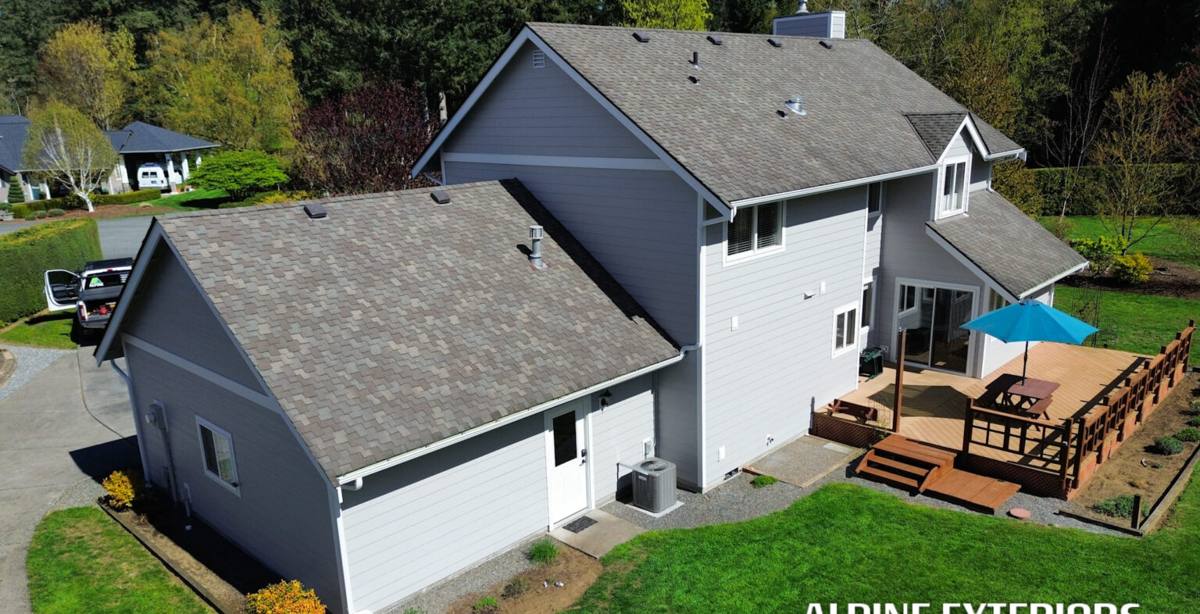
What This Climate Does to Siding
Salt Air From More Than One Direction
Most coastal towns in Whatcom County face salt exposure from one direction — the bay or the strait they sit on. Point Roberts' peninsula shape means salt-laden air can reach a house from multiple sides depending on wind direction, not just the side that faces open water. That accelerates corrosion on fasteners, flashing, and trim hardware, and it wears down lower-quality finishes faster than a single-exposure coastal property would see. Siding material and hardware choices carry more weight here, not less.
Driving Rain and Open Wind
With little inland terrain to break the wind, storms coming off the water arrive with real force and push rain sideways into wall assemblies, window flashing, and roof-to-wall joints. That sideways load is harder on a house than the same total rainfall would be in a more sheltered location, and it's exactly the kind of moisture that finds any gap a rushed installation left behind. A siding system that isn't detailed for wind-driven rain specifically shows it here faster than in more sheltered parts of the county.
A Long Moss Season
Mild temperatures and near-constant moisture add up to a moss and mildew season that can run most of the year on shaded or north-facing walls. Any siding material with even a little surface porosity becomes a growth surface over time, and on a peninsula with this much ambient moisture, that clock starts sooner and runs longer than it does on drier, inland Whatcom County properties.
Signs a Point Roberts Home Needs Siding Replacement, Not Just Repair
Repair makes sense when damage is limited to a small, isolated area and the wall behind it is still sound. Full replacement becomes the more honest recommendation once damage is spread across multiple walls or the sheathing underneath has been compromised. A few signs worth taking seriously:
- Soft or spongy siding in more than one location, especially near the bottom of walls or around window trim
- Persistent moss or dark staining that returns quickly after cleaning, beyond a single weathered patch
- Visible warping, cupping, or separation at seams and butt joints
- Paint or finish failing broadly rather than in one worn spot
- Rust staining around fasteners or trim, which points to hardware that was never rated for this exposure
- A musty smell or soft drywall on interior walls that back up to exterior siding
One or two of these in isolation might mean a repair is enough. Several of them together, especially across more than one exposure of the house, usually mean the siding system as a whole has reached the end of its useful life.
Why We Only Install James Hardie Fiber Cement
We used to install a broader range of siding products. What changed our mind wasn't a supplier relationship — it was what we kept finding on tear-offs in exactly this kind of exposed, high-moisture, salt-air environment.
- Non-combustible core: Fiber cement doesn't feed a fire the way wood-based siding products can, which matters for both safety and insurance considerations.
- Factory-applied ColorPlus finish: The color is baked on under controlled factory conditions instead of brushed on in the field, so it holds up longer against fading, chalking, and salt-driven wear.
- Climate-engineered HZ5 formulation: Built for regions with sustained moisture exposure and freeze-thaw cycling, which describes exposed Whatcom County coastline well.
- Dimensional stability: Fiber cement doesn't swell, cup, or warp the way engineered wood products can after repeated wetting in a place that rarely dries out completely.
- Strong transferable warranty: Hardie backs the product with one of the stronger warranty structures in the industry, provided the installation follows their spec.
We won't install LP SmartSide, vinyl siding, Cemplank, Allura, primed spruce, or cedar. Each has a place in the market and homeowners elsewhere who are happy with them. But on a peninsula this exposed, we'd rather replace a home's siding once with a system we fully stand behind than install something cheaper that quietly shifts maintenance risk back onto a homeowner who can't always get a crew back out here on short notice.
What a Correct Replacement Involves
Tear-Off and Sheathing Inspection
Replacement starts with removing the old siding entirely and inspecting the sheathing underneath before anything new goes up. In a climate this wet, it's common to find soft spots or moisture damage behind siding that looked fine from the outside — installing new siding over compromised sheathing just buries the problem for later.
Weather Barrier and Flashing
The water-resistive barrier goes on with proper overlap and taped seams before any flashing or siding covers it. Every window, door, vent, and penetration gets flashed to shed water downward and outward, which matters more on a property that takes wind-driven rain from multiple directions instead of one prevailing side.
Fastening, Clearance, and Sealed Edges
James Hardie publishes exact fastener type, spacing, and clearance requirements, and following that spec — not a shortened version of it — is what keeps the warranty valid and the panels secure through open wind exposure. Any field-cut edge gets sealed before it goes up, since an unsealed cut is one of the more common places fiber cement actually takes on water.
- Corrosion-resistant fasteners rated for marine exposure, not standard-grade hardware
- Documented clearance between the bottom of the siding and grade, decks, or roofing
- A continuous, properly lapped water-resistive barrier under the new siding
- Flashing visible and correctly lapped at every penetration before siding closes it in
- All field-cut panel edges sealed or primed, not left raw
Our Replacement Process, Step by Step
On-Site Assessment
We walk the property and look at how each wall is exposed — which faces take direct wind and salt air, which sit in shade, and where existing damage suggests a chronic moisture issue rather than a one-time problem. That shapes the actual scope, since two homes that look similar from the street can need very different amounts of sheathing repair once the old siding comes off.
Written Scope and Timeline
Before work begins, we put together a clear, written scope and a realistic timeline that accounts for Point Roberts' logistics as well as the weather. We'd rather set an honest expectation up front than promise a date a supply delay or storm system is likely to break.
Tear-Off, Repair, and Installation
Old siding comes off, damaged sheathing gets repaired or replaced, and the new weather barrier and James Hardie siding go up to manufacturer spec. Field cuts are sealed as they're made, not left for later.
Final Walkthrough
We walk the finished job with the homeowner, confirm the work matches what was scoped, and go over the basic maintenance that makes sense for a home in this kind of exposure.
The Point Roberts Access Factor
Because Point Roberts is reachable only by a drive through Canada, or by boat or small aircraft, scheduling and material delivery here take more planning than a typical Whatcom County job. Crews, tools, and full truckloads of siding material all need to clear the border in both directions, and that adds a layer of coordination a contractor unfamiliar with the crossing can easily underestimate. We build that factor into our scheduling from the start rather than treating it as a surprise partway through a project, and we batch material deliveries and crew days to minimize how many crossings a job actually requires.
Cost Factors for a Point Roberts Siding Replacement
| Factor | Why It Matters |
|---|---|
| Home size and number of stories | More wall area and height mean more material, labor, and staging |
| Sheathing condition underneath old siding | Rot or moisture damage found during tear-off adds repair scope before new siding can go up |
| Trim and window complexity | More openings and roofline transitions mean more flashing and cutting work |
| Exposure and wind direction | Walls facing open water or prevailing wind often warrant closer flashing and drainage attention |
| Border crossing and delivery logistics | Material and crew scheduling need to account for crossing time, which affects timeline more than price directly |
| Product line and finish selection | James Hardie offers multiple panel styles, textures, and ColorPlus finishes at different price points |
These are general drivers, not a quote — every home's actual scope depends on what we find once the old siding comes off, which is why we walk the property in person before putting a number on the work.
Timing a Replacement Around Local Weather
Whatcom County's wettest, windiest stretch typically runs from late fall through winter, and Point Roberts' open exposure makes that stretch harder on both the house and the installation than it is in more sheltered towns. Spring and summer generally offer the driest, most stable conditions for tear-off and installation, since fiber cement and the weather barrier underneath it perform best when they can be installed and allowed to set up without a storm system moving through mid-project. Combined with the extra lead time border logistics can add, it's worth starting the planning conversation earlier than you might for a similar job elsewhere in the county.
A Checklist Before Hiring for a Point Roberts Siding Job
- Ask whether the contractor has actually worked in Point Roberts before, not just nearby on the mainland
- Confirm current Washington contractor licensing and insurance
- Ask how they plan material delivery and crew scheduling around the border crossing
- Ask what siding material they install and why, and whether they stand behind it with a written warranty
- Get a clear, written scope of work, including what happens if sheathing damage turns up during tear-off
Why a Crew That Already Works Point Roberts Matters
A contractor who's done this drive before, who already knows how to time material orders around the crossing and how this specific exposure behaves on real houses, makes different decisions than one working here for the first time. That shows up in the details — how flashing gets lapped on a wall that catches wind from more than one direction, which fastener grade is worth the extra cost, and how a schedule gets built so a delay at the border doesn't turn into a half-finished house sitting open to the weather. On a property this exposed and this logistically distinct from the rest of Whatcom County, that experience is worth as much as the material itself.
If your Point Roberts home needs new siding, we're glad to come take a look and give you a straightforward, honest read on what it needs. Reach out using the form below to schedule a free, no-pressure estimate.