 Birch Bay Siding
 Custom Decks Built for Blaine's Waterfront Climate
Blaine sits close enough to the water that every deck we build here has to answer to salt air, wind-driven rain, and a moss season that runs longer than most homeowners expect. A deck design that works fine twenty miles inland in a dry, sheltered yard can fail early in Blaine if it's built the same way. We've built and repaired decks throughout Birch Bay and the surrounding Whatcom County waterfront long enough to know which shortcuts show up as problems in year two, not year twenty.
This page covers what actually matters for a custom deck project in Blaine: the materials that hold up, the structural details that keep water out of places it shouldn't be, and the process we use from first walk-through to final walk-off.
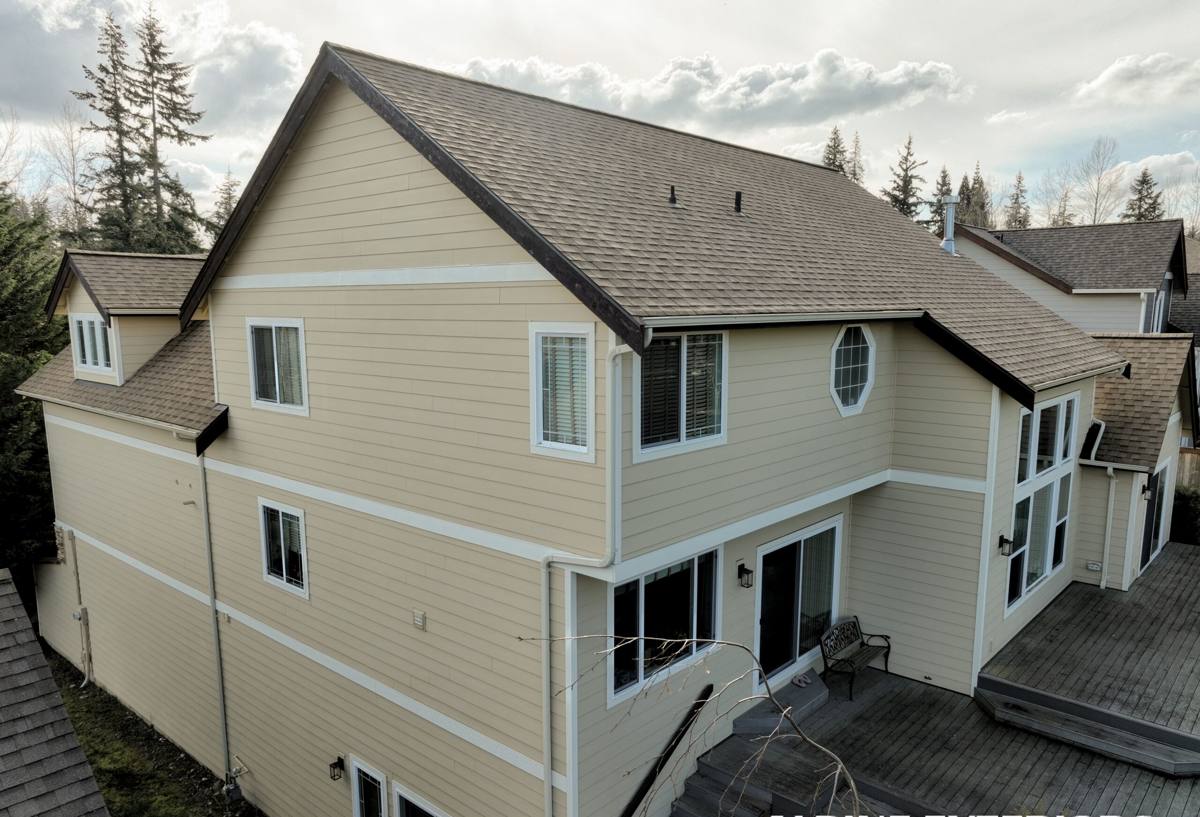
What This Climate Actually Does to a Deck
A deck is one of the more exposed structures on a property. Unlike siding, which sheds water vertically, a deck surface takes rain, sun, and salt spray head-on and holds moisture longer. In Blaine's climate, that shows up in a few predictable ways.
Salt Air and Metal Corrosion
Proximity to the Salish Sea means airborne salt settles on everything, including deck hardware. Standard zinc-coated fasteners and connectors that would be fine further inland can start showing rust and pitting within a few seasons this close to the water. Once a fastener corrodes, it loses holding strength long before it looks obviously bad, which is why hardware grade matters more here than the spec sheet default.
Driving Rain and Trapped Moisture
Storms off the water tend to come in sideways rather than straight down. That drives moisture into ledger connections, under railing posts, and into any gap where flashing was skipped or done halfway. Wood that stays damp longer than it stays dry is wood that rots from the inside before it shows on the surface.
Moss and Algae Season
Between the rainfall and the shade many Birch Bay lots have from mature trees, moss and algae have a long growing window here — often close to eight or nine months of the year with the right conditions. On a deck surface, that's not just cosmetic. Moss holds moisture against the boards and makes the surface slick and dangerous underfoot, especially on stairs.
Choosing Decking Material for a Blaine Property
There's no single "best" decking material — the right call depends on how exposed the site is, how much maintenance the homeowner wants to do, and budget. Here's how the common options actually perform in this climate.
| Material | Salt Air / Moisture Performance | Moss Resistance | Maintenance |
|---|---|---|---|
| Cedar | Naturally rot-resistant if sealed and maintained; fasteners are the weak point | Needs regular cleaning; moss takes hold if neglected | Annual cleaning and re-sealing recommended |
| Pressure-treated fir/pine | Good structural durability when properly fastened; surface checks and cups over time | Prone to moss without cleaning | Periodic cleaning, occasional staining |
| Composite decking | Doesn't rot or absorb water into the board itself | Still needs washing — moss and algae will grow on any surface, composite included | Low — occasional wash, no sealing/staining |
| PVC/capped composite | Fully sealed surface, best moisture resistance of the group | Same as composite — surface cleaning still needed | Lowest — wash only |
We're honest with clients that composite and capped composite cost more up front but usually make more sense for full-sun-to-shade transitions and lots with heavy moss exposure, simply because they remove the "did I seal it this year" variable. Cedar and treated wood are still good choices when the homeowner wants a natural look and is willing to keep up with maintenance — we just make sure the fastening and flashing underneath is built to a standard that doesn't depend on the surface finish to keep water out.
Railings and Trim
Railing posts and horizontal trim take the brunt of driving rain because they're vertical and exposed on all sides. We steer clients toward materials and cap details that shed water off the top of posts and rail caps rather than letting it pool, and we're careful about which wood species we'll use for anything that sits in standing contact with moisture — some are simply a poor match for this exposure regardless of how they're finished.
The Structural Work That Doesn't Show
The visible decking board is maybe a third of what makes a deck last in this climate. The rest is underneath.
Ledger Attachment and Flashing
Where a deck attaches to the house is the single most common failure point we find on older decks in this area. If the ledger board isn't properly flashed — with flashing that actually directs water out and away from the house band board, not just tucked in loosely — water tracks behind it every time it rains sideways. On a repair or rebuild, this is usually the first thing we check, and it's non-negotiable on new builds.
Joist Protection
Exposed joist tops are where standing moisture does slow, quiet damage over years. We use joist tape or an equivalent moisture barrier on the tops of joists and beams so screws seal into protected wood rather than bare, repeatedly wetted lumber.
Footings and Post Bases
Footings need to sit below frost depth and be sized for the soil conditions on the specific lot — waterfront and low-lying Birch Bay properties don't always have the same soil behavior as sites a mile inland. Post bases should hold the post up off the concrete, not let it sit in a puddle after every storm.
Fasteners and Hardware: Why We Don't Cut Corners Here
Given the salt air, we default to stainless steel or high-grade coated fasteners and connectors rated for coastal exposure, even when it costs more than the standard hardware most suppliers stock. The reasoning is simple: a corroded joist hanger or ledger bolt is a structural problem, not a cosmetic one, and it's expensive to diagnose after the deck surface is already down. Matching fastener metal to connector metal also matters — mixing metals can accelerate corrosion through galvanic reaction, which is an easy mistake to make if a crew isn't paying attention.
Drainage, Spacing, and Keeping Moss Off the Surface
Design choices at the framing stage make a real difference in how much moss and standing water a deck deals with later.
- Board spacing sized to let water drain through rather than pool on the surface
- Deck framed with a slight slope away from the house so water sheets off instead of collecting
- Under-deck airflow preserved — skirting or storage enclosures built with vents, not sealed boxes that trap humidity
- Shaded, low-airflow areas identified early so material choice or drainage gaps can be adjusted before it's a maintenance headache later
- Stair treads and any north-facing sections flagged for the homeowner as spots that will need more frequent cleaning
None of this eliminates moss entirely — nothing does in Whatcom County's climate — but it stretches the time between cleanings and keeps the deck safer underfoot in the meantime.
Our Custom Deck Process
Every deck we build in Blaine follows the same sequence, adjusted for the specific lot and house:
- Site walk and assessment — we look at sun exposure, wind direction relative to the water, drainage patterns, and the condition of the house wall where the deck will attach
- Design and material selection — sizing, layout, railing style, and material recommendations based on how exposed the site is and how much upkeep the homeowner wants
- Permitting — we handle the permit application and inspections through the appropriate local jurisdiction
- Framing and structural work — footings, ledger flashing, joist protection, and coastal-grade hardware, all built to hold up before a single deck board goes down
- Decking, railing, and finish work — installed to manufacturer spec, with attention to fastening patterns and expansion gaps appropriate to the material
- Final walk-through — we go over maintenance expectations specific to the material chosen, so there are no surprises a year in
Permits and Local Considerations
Deck projects in Blaine and the greater Birch Bay area typically require a building permit, and waterfront or near-shoreline properties can carry additional setback or shoreline review requirements depending on the specific lot and its distance from the water. We handle permit applications as part of the project and flag early if a property's location looks like it may need extra review, rather than surprising a homeowner with it mid-project.
Keeping a Deck Healthy in This Climate
Whatever material a deck is built from, a few habits go a long way in a climate like this one:
- Rinse or sweep the surface regularly through the wet season to keep organic debris from feeding moss growth
- Clean moss and algae off stairs and shaded areas as soon as it appears — it's easier to remove early than after it's established
- Check railing post bases and ledger flashing yearly for early signs of water staining or corrosion
- Keep gutters and downspouts near the deck clear so runoff isn't dumping directly onto or under it
- Re-seal or re-stain wood decking on the schedule the product actually calls for, not "whenever it looks dry" — appearance lags behind actual protection
Why Hiring a Crew That Already Works in Blaine Matters
A lot of deck problems we get called to fix started as a design or framing decision that made sense somewhere drier. Crews without regular experience on Whatcom County's waterfront tend to build to the general code minimum and stop there — technically compliant, but not necessarily built for what this specific stretch of coastline throws at a structure year-round. Working here regularly means we've already seen which details hold up and which ones come back as callbacks, and we build accordingly the first time.
If you're planning a new deck or replacing one that's showing its age, we're happy to walk the site with you and talk through material and design options honestly — no pressure, no obligation. The form below gets you a free estimate.