 Birch Bay Siding
 Decking Built for the Cherry Point Stretch of Coast
Cherry Point sits close enough to the water that every outdoor structure on a property feels the effects of it — salt-laden air, wind-driven rain that finds its way under loose boards, and a moss season that runs longer here than it does even a few miles inland. A deck built to a generic spec doesn't hold up the same way out here. We install composite decking specifically with this stretch of Whatcom County in mind, and that shows up in the fasteners we choose, how we frame the substructure, and how we finish the edges where moisture tends to collect.
This page covers composite decking as a standalone project for Cherry Point homes — what the local climate actually demands, what a correct installation looks like, and how we run the job from estimate to final walkthrough.
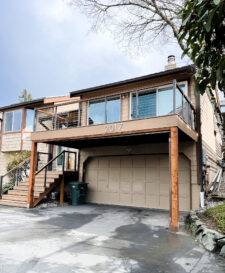
What Salt Air, Rain, and Moss Actually Do to a Deck
Salt Air
Airborne salt from the Strait doesn't just sit on the surface — it works into any exposed metal fastener, hinge, or bracket over time. On a wood deck this shows up as corroded nail heads and rust streaks; on composite, the boards themselves don't corrode, but the hardware holding them down absolutely can if it's not rated for a marine-adjacent environment. This is one of the most common corner-cutting mistakes we see on decks built by out-of-area crews — standard hardware store fasteners instead of coated or stainless options.
Driving Rain
Storms coming off the water tend to arrive at an angle, not straight down. That means rain gets pushed sideways under railings, into board end-cuts, and along any seam where two deck boards butt together. A deck that's only designed to shed water from directly overhead will show problems at these joints within a few wet seasons — swelling on the cut ends of composite boards that weren't capped, or staining where water pooled and couldn't drain.
Moss and Sustained Dampness
Whatcom County's moss season isn't a two-week nuisance — it's a stretch of months where anything shaded and slow to dry stays damp. Moss and algae need that sustained moisture to take hold, and they will grow on composite decking just as readily as on wood if the board surface stays wet and the area doesn't get airflow. The difference is that composite doesn't rot from it the way wood does, but a slick, moss-covered deck is still a slip hazard and still needs to be addressed in the design, not just cleaned after the fact.
Why a Standard Deck Spec Falls Short Here
A lot of decking failures we get called out to inspect weren't caused by a bad product — they were caused by a generic installation that didn't account for local conditions. Common issues we find on decks that weren't built with this coastline in mind:
- Under-spaced substructure joists that don't give composite boards enough support against moisture-driven expansion and contraction
- Standard carbon-steel fasteners instead of coated or stainless hardware, leading to rust bleed-through on the board surface
- No ventilation gap left under the deck, trapping moisture and speeding up moss growth on the underside and framing
- Cut board ends left uncapped or unsealed, letting water into the board core at the exact spots most exposed to wind-driven rain
- Railing posts and ledger connections without proper flashing, which lets water track back into the house framing
None of these are exotic problems. They're the result of building a deck to a one-size-fits-all standard instead of to what this specific coastline actually throws at it year-round.
What a Correct Cherry Point Composite Deck Install Involves
Substructure First
The framing underneath a composite deck matters as much as the boards on top, arguably more. We use pressure-treated or naturally resistant framing lumber, joist spacing tightened to the manufacturer's wet-climate spec rather than the minimum allowed, and joist tape or flashing on top of the framing to keep moisture from wicking up into the wood from below.
Fasteners and Hardware
Everything below the board line — screws, hidden fastener clips, structural brackets — gets specified for coastal exposure. This is a small line-item cost difference and a large difference in how the deck looks and performs five and ten years out.
Drainage and Airflow
We build in a ventilation gap under the deck surface and grade or slope the substructure so water has somewhere to go instead of sitting against the framing. Where a deck sits close to grade, that airflow gap is often the single biggest factor in whether moss becomes a chronic problem or a manageable one.
Board Layout and Finishing
Board ends are capped or fascia-covered rather than left raw, especially on any edge exposed to prevailing weather. Gapping between boards follows the manufacturer's spec for our humidity range, not a dry-climate default, so the deck doesn't buckle or gap unevenly as moisture levels swing through the seasons.
Comparing Composite to the Alternatives for This Location
| Decking Type | How It Handles This Climate | Maintenance Reality |
|---|---|---|
| Composite (capped) | Resists moisture absorption at the core; won't rot; still needs periodic cleaning to prevent surface moss/algae | Low — occasional wash, no staining or sealing |
| Pressure-treated wood | Absorbs moisture readily; prone to warping, splintering, and rot at fastener points near the coast | High — annual sealing/staining, ongoing repair of weathered boards |
| Cedar | Naturally rot-resistant but still an organic material that grays and softens faster in salt air and sustained damp | Moderate to high — regular sealing to hold color and resist moisture |
| Uncapped composite | Better than wood but more porous at cut ends and surface; more prone to staining and moisture uptake over time | Moderate — more surface care than capped composite |
We install capped composite as our standard recommendation for Cherry Point properties because it holds up to the specific combination of salt exposure and prolonged dampness better than the alternatives, without the recurring maintenance burden wood-based decking carries out here.
Cost Factors for a Cherry Point Deck Project
Every deck is different, so we won't quote a number without seeing the site, but the main factors that move the price are consistent:
| Factor | Why It Matters |
|---|---|
| Deck size and shape | More square footage and more corners/cuts increase material and labor |
| Height off grade | Taller decks need more substructure, railing, and sometimes stairs |
| Board tier | Composite lines range from base capped boards to premium multi-tone options |
| Substructure condition | Replacing an existing deck may require new or reinforced framing, not just new boards |
| Railing and fascia | Composite or aluminum railing systems add cost but reduce long-term upkeep |
| Site access | Waterfront and hillside lots around Cherry Point can add labor for material staging |
Our Process for a Cherry Point Deck Project
- On-site assessment. We look at existing framing, drainage, sun/shade exposure, and how the deck ties into the house.
- Written estimate. Clear scope, board selection, hardware spec, and timeline before any work starts.
- Substructure work. Framing, flashing, and ventilation gaps built to hold up to coastal moisture, not just a dry-season minimum.
- Composite installation. Boards, fasteners, and edge treatments installed to manufacturer spec and adjusted for our climate.
- Final walkthrough. We check railing, board spacing, drainage, and finish details with you before calling the job done.
Why Hire a Crew That Already Works This Area
A crew that only occasionally works near Whatcom County's shoreline often builds to the manufacturer's generic install guide and calls it done. A crew that works Cherry Point and Birch Bay regularly knows where the wind-driven rain hits hardest on a given lot orientation, which fastener specs actually hold up after a few winters of salt exposure, and where moss tends to establish first on a deck that doesn't have enough airflow underneath. That local pattern recognition is the difference between a deck that looks right on installation day and one that still looks right in year seven.
Maintaining a Composite Deck Near the Water
- Rinse or sweep debris off the surface regularly, especially in fall and winter when organic buildup accelerates moss growth
- Keep gutters and downspouts near the deck clear so runoff isn't dumping extra water onto the deck surface
- Trim back vegetation that shades the deck and slows drying time after rain
- Wash the deck surface periodically with a mild cleaner to prevent algae film before it becomes a slip hazard
- Inspect railing posts and ledger connections annually for any sign of water intrusion at the house connection
If you're planning a new deck or replacing an aging one in Cherry Point, we'll walk the site with you, talk through board and hardware options suited to this climate, and give you a straightforward estimate — no pressure, no obligation. Fill out the form below to get started.