 Birch Bay Siding
 Custer's Climate Is Hard on Decks — Here's Why
Custer sits close enough to the water that homes here deal with the same salt-laden air that hits Birch Bay proper, combined with the heavy, near-constant rainfall that defines this stretch of Whatcom County. That combination is rough on outdoor structures. Salt air accelerates corrosion on fasteners and hardware. Driving rain off Georgia Strait and Semiahmoo Bay finds every gap in flashing and framing. And the long gray stretch from fall through spring — often five or six months of damp, low-light conditions — is exactly what moss and algae need to take hold on any horizontal surface that doesn't drain and dry quickly.
A deck built without those three factors in mind — salt, driving rain, and moss — will show it within a few seasons: green film on the boards, soft spots where water sat too long, corroding screws, and a substructure that never fully dries out between storms. None of that is inevitable. It comes down to material choice and installation details that matter more here than they would in a drier inland climate.
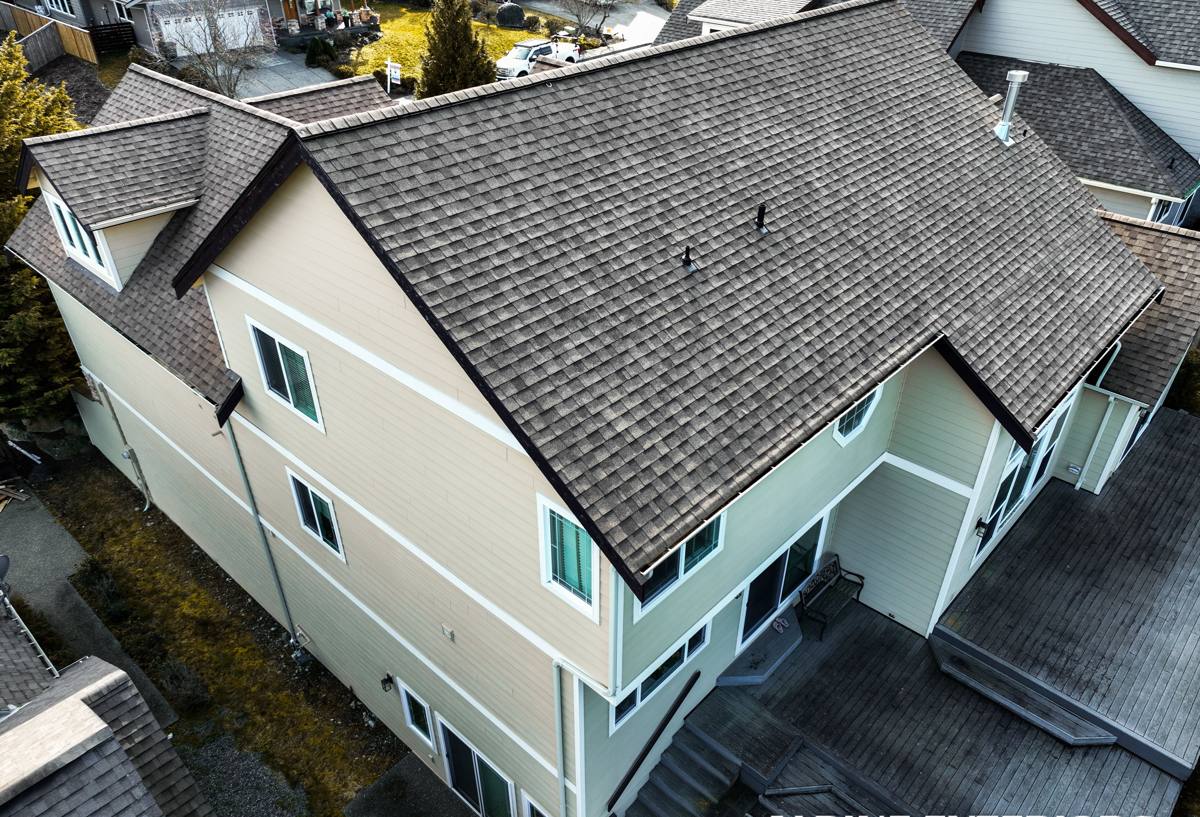
Why Composite Makes Sense for Custer's Climate
Composite decking — a blend of wood fiber and recycled plastic, usually with a protective outer cap — is a reasonable answer to Custer's specific conditions for a few concrete reasons:
- It doesn't absorb water the way wood does. Capped composite boards resist moisture penetration, which matters when a deck sits wet for days at a time during a typical Whatcom County winter.
- It doesn't need refinishing. No annual staining or sealing means one less maintenance window to try to catch between rain systems.
- It resists rot. Standard lumber decking, especially in shaded or low-airflow areas common on wooded Custer lots, is prone to soft rot within a decade in this climate. Composite doesn't rot the way wood does.
- Surface texture matters for moss. Boards with a slight texture and good drainage grooves shed water and debris faster than smooth, flat-profile boards, which reduces (though doesn't eliminate) the surface moss gets to grip.
Composite isn't maintenance-free, and we won't tell a Custer homeowner it is — more on that below. But for this climate, it's a material that holds up with less ongoing work than wood, and it doesn't have the moisture-sensitivity problems that make some other manufactured products a poor fit for a rainy, salt-air site.
A Note on Capped vs. Uncapped Composite
Not all composite decking is built the same. Capped composite has a plastic shell fully wrapping the board, which is what actually gives it its water and stain resistance. Uncapped or partially capped composite is cheaper but exposes wood fiber on some faces, which can wick moisture over time — a real liability in a climate this wet. We install fully capped composite on Custer projects for that reason. It costs more upfront, but in a driving-rain, high-humidity environment, the cap is doing the work that justifies the price difference.
What a Correct Composite Deck Install Actually Involves
Composite decking is often marketed as low-maintenance, and it is — but that reputation only holds if the deck underneath the boards is built right. Most composite deck problems we get called out to fix in this area trace back to the substructure or the details, not the decking material itself.
Substructure and Framing
Composite boards are heavier than wood and behave differently under load and temperature swings, so joist spacing needs to match the manufacturer's spec for composite specifically — not the wider spacing that's fine for solid lumber. Framing lumber should be properly rated for ground contact where it's close to grade, and all structural hardware should be stainless or heavily coated to handle the salt air rather than standard galvanized, which corrodes faster this close to the water.
Ledger Board and Flashing
Where the deck ties into the house, the ledger board connection is the single most common source of hidden water damage. Proper flashing — installed so water is directed out and away from the ledger, not just tucked behind siding — is non-negotiable in a climate with this much driving rain. This is also the detail most likely to get rushed on a fast install, and it's the one that causes rot in the rim joist and framing behind the wall years later.
Fasteners and Hidden Fixings
Hidden fastener systems keep the deck surface clean and reduce the number of exposed screw heads that can corrode or streak the boards with rust in salt air. Where screws are exposed, they should be coated or stainless specifically rated for coastal/marine exposure — standard exterior screws will show rust streaking on composite boards within a couple of seasons in this environment.
Ventilation and Drainage Underneath
A deck built low to the ground or over a spot with poor drainage traps moisture underneath, which keeps the whole structure damp longer after every rain event and speeds up moss growth on the surface above. Proper height off grade, gapping between boards, and grading beneath the deck so water doesn't pool are all part of doing this correctly the first time.
Material Comparison for This Climate
| Material | Upfront Cost | Maintenance in Salt Air / Rain | Moss Resistance | Typical Lifespan Here |
|---|---|---|---|---|
| Pressure-treated wood | Lowest | Annual staining/sealing needed | Low — needs regular cleaning | 10–15 years before major repair |
| Uncapped composite | Mid | Low, but can wick moisture at cut ends and exposed faces | Moderate | 15–20 years |
| Fully capped composite | Higher | Very low — occasional washing | Good, especially with textured/grooved boards | 20–30 years |
| Cedar | Mid-high | High — regular sealing to resist moisture and moss | Low without upkeep | 10–20 years with diligent care |
These are general ranges based on how each material behaves under coastal Whatcom County conditions, not manufacturer marketing numbers — actual lifespan always depends on installation quality and how consistently a deck is cleaned.
Our Process for Custer Composite Decking Projects
We keep the process straightforward and don't skip the parts that matter most in this climate:
- On-site assessment. We look at grade, drainage, sun/shade exposure, and how close the deck sits to the house and to prevailing weather, since orientation affects how much rain and moss pressure a given deck will see.
- Substructure evaluation or build. For new decks, we frame to composite-rated spacing with corrosion-resistant hardware. For deck replacements over existing framing, we inspect the substructure first — reusing a frame that's already compromised just moves the problem underneath new boards.
- Flashing and ledger work. Done properly before a single board goes down, since this is the piece that's invisible once the deck is finished but causes the most damage if it's wrong.
- Board installation. Hidden fastener systems where the design allows for it, correct board spacing for drainage and seasonal expansion, and layout that accounts for water flow off the deck surface.
- Walkthrough. We go over basic care — what it takes to keep moss from taking hold and how to spot early signs of an issue — before we consider the job done.
Keeping Moss and Salt Residue Off a Custer Deck
Even a well-built composite deck needs a bit of seasonal attention here. It's not the sanding-and-sealing routine wood requires, but skipping it entirely lets moss and salt film build up faster than they would on a drier inland deck.
- Rinse or sweep debris (leaves, needles, pollen) off the surface regularly — organic buildup in the board grooves is what moss actually feeds on.
- Wash the deck with a soft-bristle brush and mild soap a couple of times a year, more often in shaded or low-airflow spots.
- Keep gutters and downspouts near the deck clear so runoff isn't dumping extra water onto the surface.
- Trim back overhanging branches or shrubs where possible — shade and poor airflow are the biggest drivers of moss growth, more than the composite material itself.
- Check underneath the deck once a year for standing water or debris buildup that traps moisture against the framing.
Why Hire a Crew That Already Works in Custer
A lot of deck problems we're asked to fix in this area come from installs done by crews unfamiliar with what coastal Whatcom County weather actually does to a structure over time. Standard installation practices that work fine in a drier climate — lighter hardware, less attention to ledger flashing, wider board spacing than the manufacturer recommends — hold up for a season or two here before the gaps show. A crew that already builds decks in Birch Bay, Custer, and the surrounding area knows to spec corrosion-resistant hardware from the start, knows how local drainage and grade issues tend to show up on these lots, and has already seen which shortcuts fail first in this specific climate. That's not something you can substitute with a generic install checklist.
Before You Hire — What to Ask
- Is the composite fully capped, and on which sides of the board?
- What hardware and fastener grade will be used, and is it rated for coastal/salt-air exposure?
- How will the ledger board be flashed against the house?
- Is the substructure being built (or evaluated, on a replacement) to composite-rated spacing?
- What's the plan for drainage and airflow underneath the finished deck?
If a contractor can't answer these clearly, that's worth noticing before work starts, not after the first winter.
If you're weighing options for a deck project in Custer or elsewhere around Birch Bay, we're glad to come take a look, walk the site, and give you a straightforward estimate — no pressure, no upsell. Use the form below to get started.