 Birch Bay Siding
 Deck Repair Built for Semiahmoo's Waterfront Conditions
Semiahmoo sits right where Birch Bay's marine exposure is at its most intense — close to the water, open to wind off the bay, and shaded in places by mature evergreens that keep moisture sitting on wood far longer than homeowners expect. Decks here don't fail the way they do in drier inland parts of Whatcom County. They fail from the combination of salt-laden air, driving rain that gets blown sideways under normal overhangs, and a moss season that can stretch from October well into April. If you own a deck in this neighborhood, it's worth understanding exactly how these conditions attack the structure, because that's what determines whether a repair actually holds or just covers up the problem for another season.
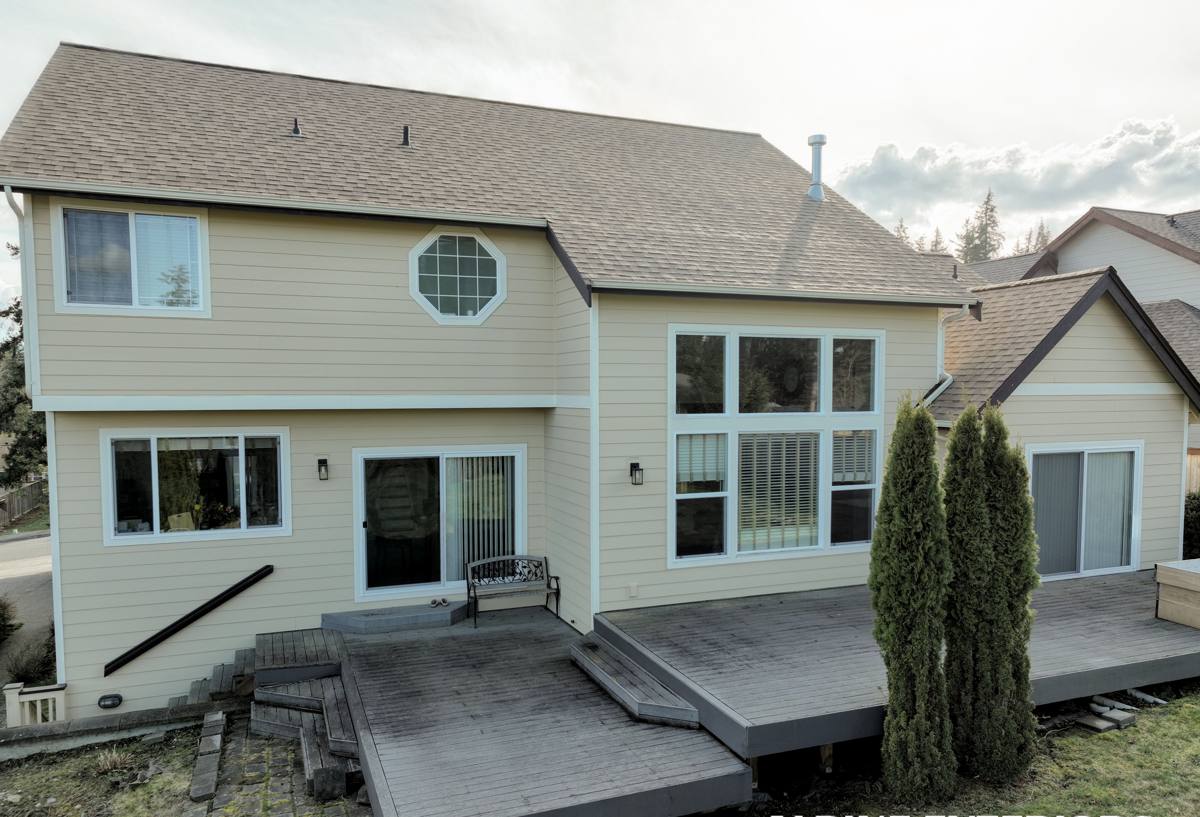
Why Decks in This Area Wear Differently
Salt Air and Metal Fasteners
Proximity to the water means airborne salt settles on every exposed surface, including the fasteners holding your deck together. Standard hot-dip galvanized nails and screws can hold up reasonably well inland, but that same hardware near Semiahmoo's shoreline corrodes faster, especially where the galvanized coating has been scratched or cut during original construction. Once a fastener starts rusting, it swells slightly, cracks the surrounding wood fibers, and lets water follow the metal down into the framing. This is one of the most common hidden failures we find — the decking looks fine from above, but the fasteners underneath are compromised.
Driving Rain and Wind-Driven Moisture
Birch Bay gets plenty of rain that falls straight down, which most deck designs handle fine. The problem is wind-driven rain, which comes in at an angle and finds its way into joints, ledger connections, and the gap between decking boards and any adjoining wall or door threshold. Over time this pushes moisture into areas that were designed to stay dry, particularly around the ledger board where the deck attaches to the house — a spot that, if compromised, affects the structural safety of the entire deck, not just its appearance.
Moss, Shade, and Extended Dry-Down Time
A long moss season means more months where your deck surface simply doesn't get a chance to dry out between rain events. Moss and algae hold moisture directly against the wood or composite surface, and on wood decks that moisture works its way into the grain, accelerating rot from the top down instead of just from underneath. Moss also makes decking dangerously slick, which is a safety issue on stairs and along step edges well before it becomes a structural one.
What a Proper Deck Repair Actually Involves
A repair that's done right in this environment goes beyond replacing whatever board looks the worst. Here's what we check and address on every deck repair in the Semiahmoo area:
- Ledger board attachment and flashing — the single most safety-critical connection on any attached deck
- Joist and beam condition, checked by probing for soft spots, not just visual inspection
- Fastener condition throughout, since corroded hardware is often worse than the decking it holds
- Post bases and any ground contact points, where moisture wicks up from below
- Stair stringers and railing posts, which take repeated flex stress and are common failure points
- Drainage and slope across the deck surface, so water actually sheds instead of pooling
- Moss and algae staining, addressed with proper cleaning methods that don't damage the wood surface or fiber cap on composite boards
Skipping any of these steps means you're patching a symptom while the underlying cause keeps working on the rest of the structure. We've seen decks where a homeowner replaced a few obviously rotted boards, only to have new soft spots appear a season later in areas that were already compromised but not yet visibly damaged.
Repair Versus Replacement: How We Make the Call
Not every deck problem calls for a full rebuild, and not every problem is safely fixed with a partial repair. The decision usually comes down to how far the damage has spread into the framing versus staying contained in the surface decking.
| Condition Found | Typical Approach | Why |
|---|---|---|
| Isolated rot in a few deck boards, framing solid | Board replacement | Framing is the expensive, structural part — if it's sound, targeted repair is honest and cost-effective |
| Soft or spongy joists near the ledger | Framing repair or partial rebuild | Structural members compromised near the house connection are a safety priority, not cosmetic |
| Corroded fasteners throughout, boards otherwise intact | Re-fastening with corrosion-resistant hardware | Addresses the root cause before it spreads further into the wood |
| Widespread rot across multiple framing members | Full or near-full rebuild | Piecemeal repair on failing framing doesn't restore structural reliability |
| Railing or stair instability only | Targeted railing/stair repair | These carry direct fall-safety risk and are often isolated from the rest of the deck's condition |
We'll always tell you honestly which category your deck falls into, including when a repair is the right call even if a full replacement would be more profitable for us. A deck with sound framing doesn't need to be torn out just because a few boards are cupping.
Materials: What We Recommend for This Location
Given the salt exposure and extended damp season around Semiahmoo, material choice matters more here than in drier parts of Whatcom County. For fasteners, we use stainless steel or high-grade coated hardware rated for coastal exposure rather than standard galvanized products — the small upfront cost difference is minor compared to redoing fastener work in a few years. For decking material, both quality pressure-treated lumber and composite boards can perform well here, but each comes with trade-offs worth understanding honestly:
- Pressure-treated wood is cost-effective and easy to spot-repair board by board, but it requires regular cleaning and periodic sealing to resist moss and moisture in this climate — skip that maintenance and it will show it.
- Composite decking resists moisture absorption and moss growth better with less ongoing maintenance, but it's a bigger upfront investment and, if damaged, individual boards are sometimes harder to source-match years later.
- Framing lumber, regardless of what decking sits on top, should always be pressure-treated and properly flashed at every ledger and post connection — this is not a place to cut corners since it's the hardest part to inspect once the deck is finished.
We don't push one material as universally "better" — we walk through what fits your budget, how much upkeep you're willing to do, and how the deck is used, then recommend accordingly.
Our Process for a Semiahmoo Deck Repair
Because we already work regularly in the Birch Bay area, we know what to look for before we even get up on the deck. Our process is straightforward:
- On-site inspection — we check framing, fasteners, ledger attachment, drainage, and surface condition, probing suspect areas rather than relying on a visual pass alone.
- Honest scope and estimate — you get a clear breakdown of what's cosmetic, what's structural, and what we recommend addressing now versus what can reasonably wait.
- Repair work — using corrosion-resistant hardware and properly treated or matched materials, with attention to flashing and drainage so the same failure doesn't recur.
- Final check — we walk the deck with you, point out what was done, and flag anything worth monitoring going forward.
We don't upsell repairs you don't need, and we don't quietly skip steps that matter just because they're less visible than a new board.
Why It Matters to Hire a Crew That Knows Semiahmoo
A contractor who mostly works inland may not think twice about fastener grade, or may not recognize how much moss buildup has already worked into a deck's joists by the time it's visible from the top. Working regularly in Birch Bay and the surrounding Whatcom County coastline means we've seen how salt air, wind-driven rain, and long damp stretches actually play out over years, not just how a deck looks on the day of the estimate. That local familiarity shows up in the details — the hardware we spec, where we check first, and what we flag as a priority versus a "keep an eye on it" item.
Simple Maintenance That Extends the Life of a Repair
Once repair work is done, a little seasonal upkeep goes a long way in this climate:
- Sweep debris and standing leaves off the deck surface regularly, especially in fall when moss growth accelerates
- Clean moss and algae buildup before it stains or embeds into the wood grain
- Check railings and stair connections for looseness at least once a year
- Keep gutters and downspouts near the deck clear so runoff isn't draining directly onto or under it
- Re-seal wood decking on the manufacturer-recommended schedule rather than waiting until it visibly grays
If your deck in Semiahmoo has soft spots, rusting hardware, persistent moss, or just doesn't feel as solid as it used to, we're happy to take a look. Reach out for a free, no-pressure estimate — we'll give you a straight answer on what's actually needed and what it will take to fix it right.