 Birch Bay Siding
 Why Decks in Cherry Point Wear Out Faster Than You'd Think
Cherry Point sits on Whatcom County's northern shoreline, close enough to the water that salt-laden air is a daily fact of life, not an occasional nuisance. That air finds every exposed fastener, every joist hanger, and every cut edge of lumber that isn't properly sealed. Combine that with the region's long stretch of driving rain each fall and winter, plus a moss season that can run from October well into spring, and you get a set of conditions that ages an ordinary deck much faster than the same structure would age fifty miles inland.
Most decks don't fail because the homeowner neglected them. They fail because they were built to a generic standard instead of a coastal Whatcom County standard. Standard hot-dip galvanized hardware, for example, holds up fine in a dry inland yard for decades. Near Cherry Point, the same hardware can start showing surface corrosion within a handful of years if it isn't rated for coastal exposure. The wood itself is usually the least of the problem — it's the connections, the flashing, and the drainage details underneath that decide whether a deck lasts fifteen years or thirty.
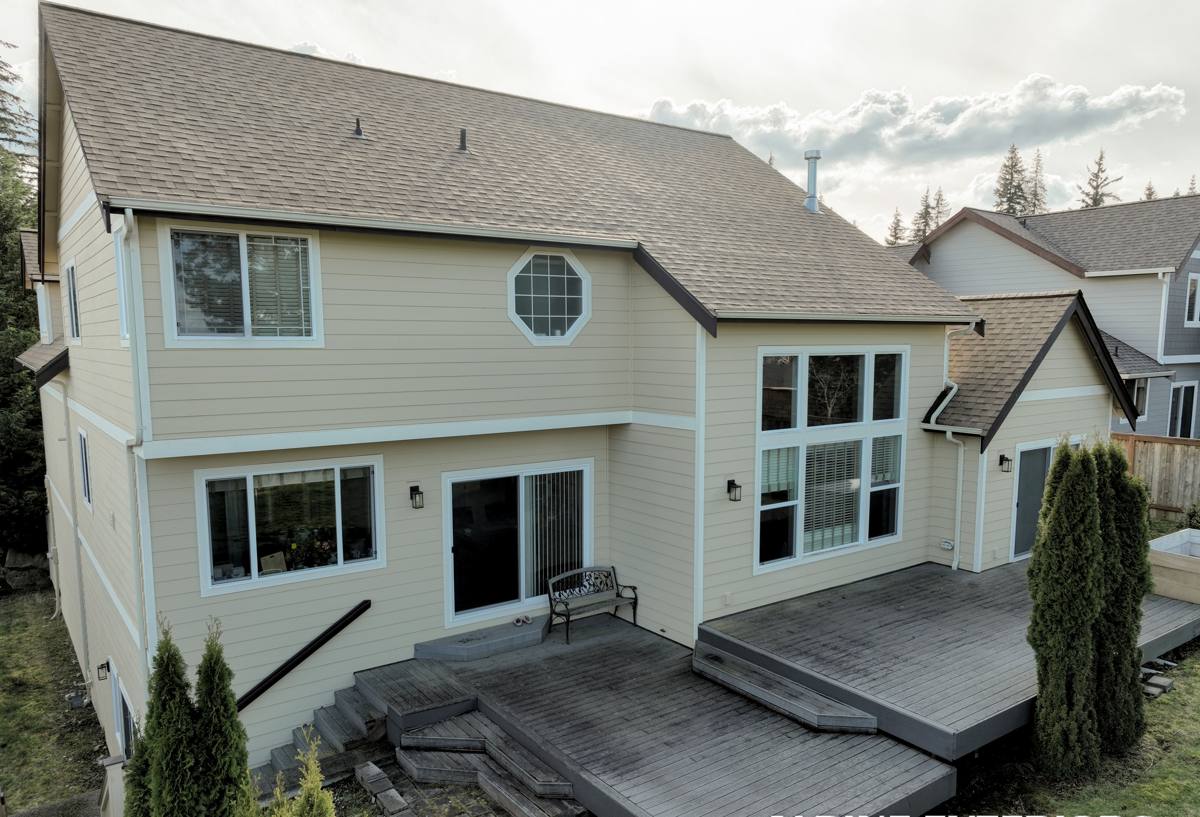
Signs Your Cherry Point Deck Needs Replacement, Not Just Repair
A repair makes sense when the problem is isolated — one soft board, one loose railing baluster, a few popped screws. Replacement becomes the honest recommendation when the damage has reached the structure itself, or when repairing one area would just push the same failure into the next area within a year or two.
Structural red flags
The most serious issues are usually invisible from a casual walk-around, which is why they get missed until a board finally gives way. Ledger board rot where the deck attaches to the house is the one we take most seriously, because a failure there is a fall hazard, not just a cosmetic one. Posts that have gone soft or spongy at or near ground level are a close second — moss and standing moisture at grade accelerate rot in exactly that spot.
Everyday warning signs a homeowner can spot
- Boards that feel spongy, bounce, or flex noticeably underfoot
- Persistent green or black moss buildup that returns within weeks of cleaning
- Railings or stair stringers that have developed play or wobble
- Rust streaking below fasteners or joist hangers
- Gaps opening up between decking boards beyond normal seasonal movement
- A musty smell coming from underneath the deck after rain
- Visible daylight or soft spots where the ledger meets the house siding
If two or more of these show up at once, it's usually a sign the deck's overall service life is running out rather than a single fixable defect.
What a Correct Deck Replacement Actually Involves
A deck replacement done right in this climate isn't just swapping old boards for new ones on the existing frame. The frame is almost always where the real problems live, and it's the part most tempted to reuse to save money. We evaluate the substructure honestly on every job — sometimes the framing is sound and only the surface needs replacing, but on coastal properties that have gone a decade or more without attention, the frame is usually due as well.
Ledger and flashing details
The ledger board connection to the house is the single most important detail on any deck, and it's the one spot where a shortcut causes the most damage over time. Proper flashing sheds water away from the house framing instead of trapping it against the rim joist. In a region with as much driving rain as Whatcom County sees, a poorly flashed ledger is often the reason a deck rebuild turns into a homeowner also discovering water damage in the wall behind it.
Fasteners and hardware
We use fasteners and structural hardware rated for coastal and treated-lumber exposure rather than standard-grade galvanized. It costs more up front and it's the difference between hardware that's still solid at year twenty and hardware that's visibly rusting by year five.
Drainage, slope, and airflow underneath
Decking needs a slight slope away from the house so water doesn't pool, and the framing underneath needs enough airflow that moss and mildew don't get a foothold in the shade beneath the boards. On lower decks close to grade, this often means grading or drainage work at the same time as the deck itself, not as an afterthought.
Choosing Materials That Hold Up to Salt Air and Moss
There's no single "best" decking material for every home — it depends on budget, how much upkeep you want to do, and how close the deck sits to salt spray and shade. Here's how the common options actually perform in this specific climate.
| Material | Moisture & Moss Behavior | Maintenance | Typical Lifespan |
|---|---|---|---|
| Pressure-treated wood | Absorbs water; needs sealing to resist moss and swelling | Annual cleaning, re-seal every 1-2 years | 10-15 years |
| Cedar | Naturally rot-resistant but still needs sealing near salt air | Cleaning and oil/sealer every year or two | 15-20 years |
| Composite decking | Doesn't absorb water like wood; moss wipes off more easily | Periodic washing, no sealing or staining | 25-30 years |
| PVC decking | Fully moisture-resistant; best option where salt spray is heaviest | Occasional washing only | 25-30+ years |
We don't push homeowners toward the most expensive option by default. A shaded, exposed deck close to the water is where composite or PVC earns its higher price tag fastest, because the maintenance burden of wood in that spot is genuinely heavy. A sunnier, more sheltered deck can do perfectly well in cedar or treated wood for a homeowner who doesn't mind the yearly upkeep. Framing underneath, regardless of what decking material sits on top, should still be pressure-treated or an equivalent structural-grade material rated for ground or near-ground exposure.
Our Deck Replacement Process
- On-site assessment — we inspect the ledger, framing, posts, and footings, not just the visible decking, and tell you honestly what's salvageable
- Design and material selection — sizing, railing style, and decking material chosen around your budget and how the deck is used
- Permitting — we handle the paperwork with Whatcom County where a permit applies
- Demolition — full removal of the old structure, with an inspection of the ledger connection and any hidden wall damage once it's exposed
- Framing — new or repaired substructure with coastal-rated fasteners and proper flashing at the ledger
- Decking and railings — installed to the correct slope and fastening pattern for the chosen material
- Cleanup and final walkthrough — site cleared, hardware checked, and a walkthrough so you know what maintenance (if any) the new deck needs
Permits and Local Codes
Deck replacements in Whatcom County typically require a permit once the structure exceeds a certain size or height above grade, and code requirements around railing height, guard spacing, and footing depth apply regardless of which material you choose. Property setbacks matter too, particularly on lots near the shoreline where additional review can apply. We handle this process as part of the job rather than leaving it to the homeowner to sort out, and we won't cut corners on code minimums even where enforcement is unlikely to catch it — those minimums exist because of real failure modes, not bureaucracy for its own sake.
Why a Crew That Already Works Cherry Point Matters
A contractor who mostly works inland doesn't build the same habits as one who works this stretch of coastline regularly. It shows up in small decisions: which fastener grade gets specified without being asked, how much slope gets built into the decking, whether the crew schedules around the weather windows that actually exist here rather than a generic construction calendar. It also shows up in troubleshooting — recognizing that a particular pattern of rot at the ledger is a flashing problem and not a wood-quality problem, because we've seen the same failure on other homes in the area.
Logistics matter too. Shoreline properties can have tighter access, more exposed work sites, and weather that turns faster than it does a few miles inland. A crew that's used to that isn't guessing at how to sequence the job around it.
Cost Factors for Deck Replacement
Exact pricing depends on size, framing condition, material choice, and railing style, so we always quote after an on-site look rather than over the phone. In broad terms, a straightforward deck replacement in pressure-treated wood tends to sit at the lower end of the range, cedar and composite in the middle, and PVC or larger multi-level decks with custom railings at the higher end. The biggest swing factor is usually what we find in the framing once the old decking comes off — a sound frame keeps costs down, while rot at the ledger or posts adds scope that wasn't visible during the initial estimate.
What tends to move the price
- Overall deck size and number of levels
- Condition of the existing ledger, posts, and footings
- Decking material chosen (treated wood, cedar, composite, or PVC)
- Railing style — simple vs. custom or glass-panel designs
- Height above grade and any required stair or landing work
- Site access and how far materials have to be carried
Maintaining a New Deck in This Climate
Whatever material you choose, a little seasonal attention goes a long way here. Clearing leaves and debris before the wet season keeps moss from getting a head start, and an annual rinse of the decking surface and the shaded framing underneath prevents the buildup that eventually stains and softens wood. Wood decks need re-sealing on a regular cycle to keep salt-laden moisture from working into the grain; composite and PVC decks mostly just need to stay clear of standing debris in shaded corners where moss likes to establish. None of this is difficult, but skipping it is exactly how a well-built deck ends up needing early repairs anyway.
If your deck in Cherry Point is showing any of the wear signs above, or you're simply ready to replace an aging one before it becomes a safety issue, we're happy to take a look and put together a free, no-pressure estimate — just fill out the form below.