 Birch Bay Siding
 Windows Built for the Ferndale Side of Birch Bay
Ferndale sits close enough to Birch Bay and the Strait of Georgia that homes here deal with the same coastal weather pattern the rest of Whatcom County's shoreline gets, just with a bit more tree cover and inland shelter mixed in. That combination is actually harder on windows than open coastline in some ways. You still get salt-laden air rolling in off the water, but you also get more shade, more standing moisture, and a longer moss season because the trees slow down drying time after every storm. A window that was built and installed for a drier inland climate does not hold up well here, and it shows up first at the window openings — swollen sashes, foggy glass, soft trim, and frames that won't latch square anymore.
Custom window work in this area isn't a luxury add-on. It's what's actually required when a house has settled, when openings are slightly out of square, when trim profiles are older or non-standard, or when the goal is to fix water intrusion that a stock replacement window would just repeat.
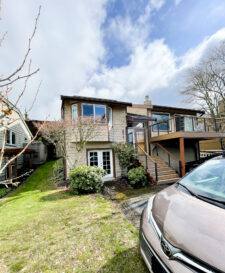
What "Custom" Means in Practice
A lot of homeowners hear "custom windows" and assume it means decorative shapes or high-end finishes. Sometimes that's part of it, but on most Ferndale-area jobs, custom means the window is built or modified to fit an opening that isn't a standard manufactured size. That's common in:
- Older homes where openings were framed by hand, before standardized window sizing existed
- Additions or remodels where the rough opening doesn't match a catalog size
- Houses that have settled slightly over decades, putting openings a bit out of square
- Replacing a window shape that's no longer manufactured in stock sizes
- Matching sightlines and grid patterns across a full elevation so the house reads as one cohesive design
Custom sizing costs more than a stock window because it's built to order, but it solves a problem stock windows can't: forcing a standard size into a non-standard opening usually means shimming gaps, extra caulk doing the work flashing should be doing, and a seal that fails years before it should.
When Custom Is the Right Call — and When It Isn't
Not every window on a house needs a custom order. If an opening is standard and square, a quality stock window installed correctly performs just as well and costs less. The honest answer is: we measure first, then tell you which openings actually need custom sizing and which don't. There's no reason to pay for custom work where it isn't needed.
What a Correct Window Job Involves
The window unit itself is only part of the job. In this climate, how the window is set into the wall matters as much as the window quality — a great window installed with poor flashing will still leak, and a modest window installed correctly will outperform it.
Flashing and Water Management
Driving rain off the water doesn't just fall straight down here — wind pushes it sideways and up under trim, sills, and siding laps. Correct installation means flashing tape and pan flashing at the sill that directs any water that gets past the exterior finish back out, not into the wall cavity. This is the step that gets skipped or done poorly on rushed jobs, and it's usually invisible until the rot shows up years later.
Sealing and Insulation
The gap between the window frame and the rough opening needs to be sealed and insulated correctly — not just caulked around the outside trim. A bead of caulk on the surface can look finished while air and moisture are still moving through the gap behind it. Low-expansion foam or backer rod and sealant in that cavity, combined with proper exterior sealant at the trim joints, is what actually stops both drafts and moisture.
Frame Material Considerations
Not every frame material handles salt air and constant damp shade the same way. We'll walk through the trade-offs honestly rather than push one product line, because the right choice depends on the specific wall, exposure, and budget.
Comparing Frame Materials for This Climate
| Frame Material | Salt Air / Coastal Behavior | Moisture & Moss Exposure | Maintenance |
|---|---|---|---|
| Vinyl | Does not corrode; performs well near salt air | Resists rot but seams and weep holes need periodic clearing | Low — occasional rinsing |
| Fiberglass | Very stable, resists pitting and corrosion | Excellent moisture resistance, minimal expansion/contraction | Low, though a higher upfront cost |
| Wood or wood-clad | Can be sensitive to salt residue if not maintained | Needs consistent finish upkeep to resist moss and rot in shaded areas | Higher — periodic refinishing required |
| Aluminum | Conducts cold and can show corrosion over time near salt air | Prone to condensation in damp, cool conditions without thermal breaks | Moderate |
For most Ferndale-area homes we work on, vinyl or fiberglass ends up being the practical choice because it holds up against the salt air without the ongoing upkeep wood requires. That said, on older homes where matching an existing wood trim profile matters for the look of the house, a wood or wood-clad option can still be the right call — it just needs an honest conversation about the maintenance commitment that comes with it.
Our Process on a Ferndale Window Project
1. On-Site Assessment and Measurement
We look at every opening individually — square, level, condition of the surrounding trim and sheathing — before recommending stock or custom sizing. This is also when we check for existing water damage or soft framing that needs to be addressed before a new window goes in, not covered up by it.
2. Careful Removal and Opening Prep
Old windows come out without tearing up more siding or trim than necessary. Any rot, soft sheathing, or failed old flashing gets repaired at this stage — installing a new window into a compromised opening just guarantees a repeat problem in a few years.
3. Installation and Flashing
New units get set, shimmed square and plumb, and flashed in the correct sequence — sill pan first, then jamb flashing, then head flashing lapped over the top so water always sheds outward and down, never into the wall.
4. Sealing, Trim, and Final Check
Interior and exterior sealant, trim reinstallation or replacement, and a final operation check on every sash before we call the job done. We also check that weep holes are clear so the window can drain the way it's designed to.
Signs Your Current Windows Are Already Failing
Because moisture problems around windows develop slowly, a lot of homeowners don't notice until the damage has spread into the wall. Worth checking for:
- Fogging or condensation between panes on a double- or triple-pane window (a sign the seal has failed)
- Soft or discolored trim or sheetrock around the window frame, especially at the bottom corners
- Visible moss or dark staining on the sill or exterior trim
- Windows that are hard to open, close, or latch, especially compared to how they worked a few years ago
- A noticeable draft near the frame on windy days
- Paint or finish that's bubbling or peeling specifically around the window opening, not the rest of the wall
Any one of these on its own isn't necessarily an emergency, but a couple of them together usually means moisture has already gotten into the framing, and that's worth addressing before it spreads further.
What Actually Drives the Cost
Every window job is priced on its own specifics, but the factors that move the number up or down are consistent:
- Stock versus custom sizing — custom-built units to fit a non-standard opening cost more than off-the-shelf sizes
- Frame material — vinyl is generally the most economical, fiberglass and wood cost more upfront
- Glass package — double-pane versus triple-pane, and any low-E or gas-fill upgrades
- Condition of the opening — hidden rot or framing repair found during removal adds labor and material
- Number of windows and access — a full-house replacement is more efficient per-window than one or two isolated units
- Trim and siding tie-in — matching existing trim profiles or repairing siding disturbed during the swap
We'd rather walk your specific windows and give you real numbers than quote a range that doesn't mean much until we've seen the openings.
Why It Matters That the Crew Already Works This Area
A window crew that's worked other homes around Ferndale and Birch Bay already knows what this climate does to a wall over time — where moss tends to build up, which exposures take the worst of the driving rain, and how salt air residue behaves on different frame finishes. That's not something you can fully compensate for with a good product alone. Installation sequence, flashing detail, and material choice all get adjusted based on the specific exposure of the house, and a crew with local experience makes those calls without guesswork.
It also means straightforward answers about what your home actually needs versus what's being upsold. Whatcom County's marine climate rewards doing the water management right the first time — redoing a poorly flashed window a few years later, after it's caused framing damage, costs a lot more than getting it right up front.
Living With Custom Windows in a Marine Climate
Even a correctly installed window benefits from a little seasonal attention here. A rinse of the exterior frame and sill a couple times a year clears off salt residue and slows moss growth, especially on shaded elevations. Checking that weep holes along the bottom of the frame stay clear of debris keeps the drainage path working the way it was designed. And an occasional look at the exterior caulk lines — especially after a hard windstorm — catches small sealant cracks before they become water intrusion.
None of this is heavy maintenance, but skipping it entirely is how a well-installed window ends up with the same problems as a poorly installed one, just on a longer timeline.
If your Ferndale-area home has windows that are fogging, sticking, drafting, or showing moss and staining around the trim, we're happy to take a look and give you a straightforward, no-pressure estimate — including whether custom sizing is actually needed or a stock window will do the job just as well. Use the form below to get started.