 Birch Bay Siding
 Lynden Siding Has to Answer to Birch Bay's Weather, Not Ignore It
Lynden sits back from the water compared to the bluffs and waterfront lots right along Birch Bay, but the difference matters less than most homeowners assume. Whatcom County's marine air moves inland on the prevailing wind, and homes around Lynden still deal with salt-laden moisture, long stretches of driving rain off the Strait of Georgia weather systems, and a moss season that can run most of the year in the shaded, damp conditions typical here. Siding that would hold up fine in a drier inland climate often struggles on this side of the state. Whatever you put on a Lynden home needs to handle constant dampness, not just occasional rain.
That reality shapes everything about how we approach a siding job in this area — the material we install, the way we detail it, and the maintenance we recommend afterward. This page focuses specifically on fiber cement siding for Lynden homes: what the climate does to siding over time, what correct installation actually involves, and why a crew that already works this part of Whatcom County will do a better job than one seeing it for the first time.
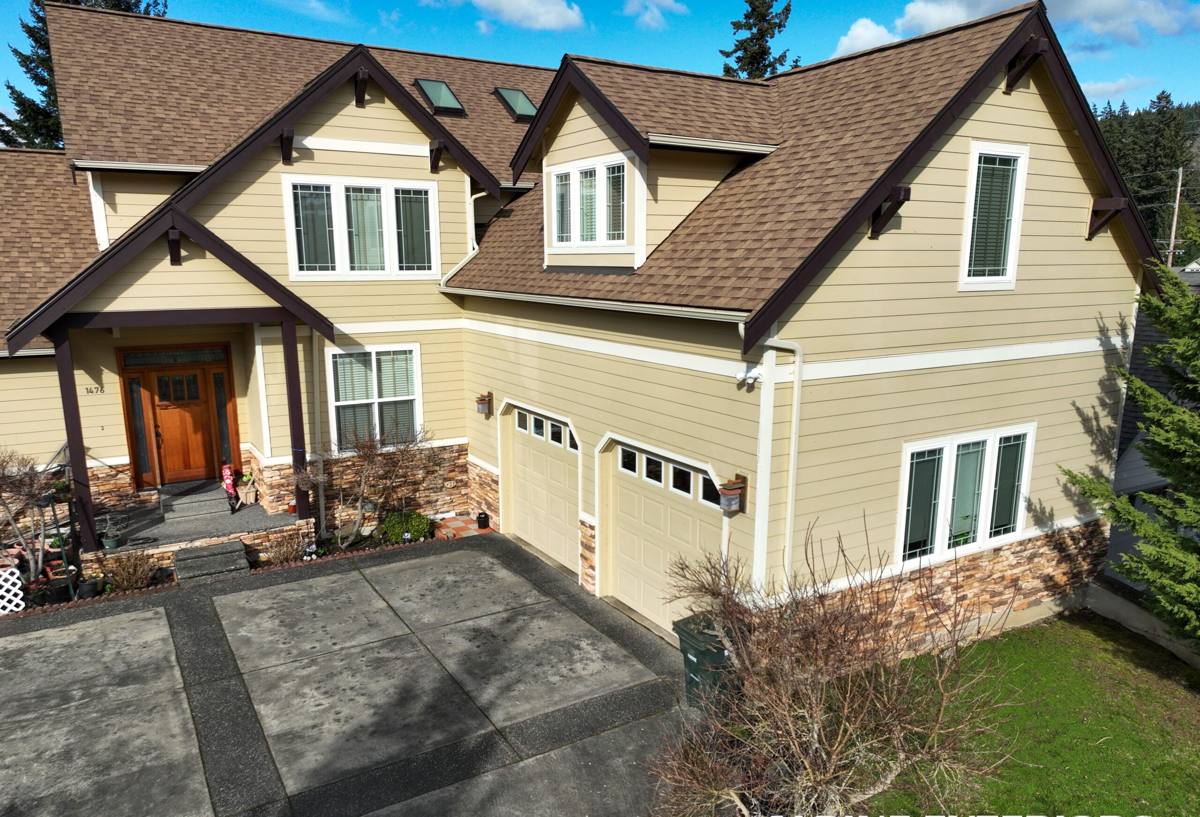
What Salt Air, Driving Rain, and a Long Moss Season Do to Siding
Salt Air and Corrosion
Airborne salt from Birch Bay and the Strait doesn't stop at the waterline. It travels on wind and settles on exterior surfaces for miles inland, including around Lynden. Over years, that salt accelerates corrosion in exposed metal fasteners, trim flashing, and any hardware that isn't properly rated or protected. Siding materials that depend on paint film alone for protection tend to show chalking, fading, and edge deterioration faster in this kind of environment than manufacturer literature written for a national audience would suggest.
Wind-Driven Rain and Moisture Intrusion
Whatcom County storms frequently push rain sideways rather than straight down. That matters more than most homeowners realize, because siding systems are engineered to shed water moving downward — wind-driven rain finds every gap in flashing, every under-caulked joint, and every place where siding sits too close to trim or grade. Once moisture gets behind the cladding, it has few ways to dry out in a climate where humidity stays elevated for much of the year. The result is hidden rot in sheathing and framing long before anything looks wrong from the street.
A Moss Season That Doesn't Really End
Shade, dampness, and mild temperatures give moss and algae a long growing window around Lynden — often closing in on year-round. Porous or textured siding surfaces give moss and algae something to grip, and once established, that growth holds moisture directly against the material. On wood-based products, that combination speeds up decay. On any siding, it's an ongoing cosmetic and maintenance burden that a well-chosen material and finish can substantially reduce.
Why We Install Only James Hardie Fiber Cement Here
We standardized on James Hardie fiber cement for every home we side, including in Lynden, because it holds up against exactly the conditions described above. Fiber cement is non-combustible and dimensionally stable, so it doesn't swell, warp, or delaminate the way some wood-based and engineered wood products can when they take on repeated moisture exposure. James Hardie's HZ5 product engineering is built specifically for climates with sustained damp conditions and freeze-thaw cycling, which fits Whatcom County's weather pattern better than a generic siding spec.
The factory-applied ColorPlus finish is also a real factor in a climate like this. Because it's baked on in a controlled facility rather than field-applied, it resists fading, chalking, and moisture-driven finish failure far better than site-applied paint on wood or engineered siding — which matters when salt air and UV exposure are working against the finish every day. We stand behind the product with a strong transferable warranty, and just as important, we back our own installation work, because fiber cement's long-term performance depends heavily on getting the details right the first time.
What a Correct Fiber Cement Installation Involves
Clearance and Drainage Planning
James Hardie siding needs proper clearance from grade, roofing, decks, and other transitions so water has somewhere to go and the bottom edge of the siding never sits in standing moisture. In a driving-rain climate, we also pay close attention to drainage planes behind the siding — a rainscreen gap or drainage-capable house wrap gives incidental moisture a path to drain and dry instead of pooling against the sheathing.
Flashing and Weather-Resistive Barrier
Every window, door, and penetration is a place where wind-driven rain will try to get behind the cladding. Correct installation means flashing that's layered properly — upper courses overlapping lower ones — and a continuous weather-resistive barrier underneath the entire field of siding, not just around openings. This is the step that gets rushed on lower-quality jobs, and it's the one most responsible for hidden rot years later.
Fastening and Joint Treatment
James Hardie specifies fastener type, spacing, and embedment for a reason — in a salt-air environment, using corrosion-resistant fasteners rated for the exposure isn't optional. Butt joints and panel seams also need to be treated correctly, whether that's factory-finished joints designed to shed water or properly caulked and backed seams, so moss and standing moisture don't have an easy entry point.
Factory Finish vs. Field Touch-Up
Because ColorPlus is factory-cured, cut edges and any field touch-up need manufacturer-approved edge sealer and touch-up product to maintain the finish's protection. Skipping this step is a common shortcut that leaves cut ends vulnerable to moisture wicking, which shows up as localized deterioration well before the rest of the siding shows any wear.
Fiber Cement Compared to Other Siding Options in This Climate
Homeowners in Lynden often ask how James Hardie stacks up against other materials they've seen or been quoted. Here's an honest comparison based on how each performs under sustained coastal moisture and salt air, not just on initial cost.
| Material | Moisture Tolerance | Salt Air Durability | Maintenance | Typical Lifespan |
|---|---|---|---|---|
| James Hardie Fiber Cement | Excellent — dimensionally stable, engineered HZ5 line | Strong with correct fasteners and detailing | Occasional wash; factory finish resists fading | 30+ years with proper install |
| Vinyl Siding | Fair — can warp or gap over time | Moderate; can chalk and become brittle | Low, but damage is hard to repair invisibly | 15-25 years |
| Cedar/Wood Siding | Poor to fair without diligent upkeep | Weak — salt accelerates weathering and decay | High — regular refinishing and moss treatment | 10-20 years without heavy maintenance |
| Engineered Wood (e.g. LP SmartSide) | Fair — sensitive to sustained moisture at edges/joints | Moderate; edge swelling risk in wet climates | Moderate — finish and edge maintenance matter | 20-30 years, install-dependent |
Every one of these products has legitimate uses somewhere. In a climate defined by salt air, driving rain, and a long moss season, though, fiber cement's combination of moisture stability and factory-cured finish is why it's the only material we put on homes we side ourselves.
How We Handle a Lynden Siding Project
Our process doesn't change dramatically from one job to the next, but the details we check are shaped by what we've seen fail in this part of Whatcom County.
- Site assessment and moisture check. Before quoting, we look at existing siding condition, moss and algae buildup, and any signs of trapped moisture around windows, corners, and the bottom courses.
- Tear-off and sheathing inspection. Once old siding comes off, we inspect the sheathing and framing underneath for rot or soft spots — common in older homes where the original moisture barrier has failed. Any damaged material gets replaced before new siding goes on, not covered up.
- Weather barrier and flashing install. We install or repair the weather-resistive barrier and flashing at every window, door, and penetration, prioritizing this step because it's the one that determines how the siding performs in wind-driven rain.
- Fiber cement installation. Panels or planks go on per James Hardie's fastening and clearance specifications, with corrosion-resistant fasteners appropriate for a salt-air environment.
- Finish work and cleanup. Cut edges are sealed, joints are treated, and the site is cleaned up with a final walkthrough so you know exactly what was done and why.
Maintenance Checklist for Lynden Homeowners
Fiber cement is low-maintenance compared to wood or vinyl, but "low-maintenance" isn't "no-maintenance" in this climate. A short annual routine goes a long way:
- Rinse siding once or twice a year to remove salt residue and organic buildup before moss gets a foothold.
- Trim back vegetation and tree cover that keeps siding shaded and damp longer than necessary.
- Check caulking at joints, trim, and window edges annually and re-caulk any cracked or separated sections.
- Keep gutters and downspouts clear so roof runoff doesn't wash directly down the siding face.
- Look at the bottom courses near grade each fall for gaps, staining, or soft spots before winter rains set in.
- Address touch-up on cut edges or fastener heads promptly rather than waiting for a full repaint cycle.
Why Hiring a Crew That Already Works This Area Matters
Siding contractors who mostly work drier, inland climates tend to under-detail flashing and drainage because they've rarely seen what happens when they skip it. A crew that regularly works Lynden and the surrounding Birch Bay area has already seen which details actually matter here — where moisture tends to collect, how far salt air travels inland, and which corners of a house take the worst of the wind-driven rain each winter. That experience shows up in fewer callbacks and siding that's still performing well a decade or two later, not just on installation day.
Local familiarity also helps with the practical side of a project — knowing Whatcom County permitting expectations, working efficiently around the area's weather windows for tear-off and install, and being reachable afterward if a question comes up rather than being a crew that passed through once and moved on.
If you're weighing a siding replacement or repair on a Lynden-area home, we're happy to take a look and give you a straight assessment of what your home actually needs. Reach out using the form below for a free, no-pressure estimate.