 Birch Bay Siding
 Roof Repair Built for Lummi Island's Climate
Lummi Island sits out in the water, reached by a short ferry crossing from the mainland, and that setting shapes what a roof there actually needs from a repair. Salt-laden marine air moves across the island constantly, working on exposed fasteners and flashing metal in ways an inland home never deals with. Storms off the water rarely just fall straight down here — wind drives rain sideways and forces it up under shingle edges and around flashing details that were never built to take water from that angle. And on shaded, wooded, or north-facing roof planes, moss doesn't just show up in a wet month and disappear — it settles in for a long season and keeps working against the roof until well into the warmer part of the year.
None of that means a leak or a patch of storm damage on a Lummi Island roof is unusual or unfixable. It means a repair done right has to account for what's actually causing the failure in this specific environment, not just patch the spot where water happens to be showing up inside the house. This page is about what a correct roof repair looks like for a home on Lummi Island specifically — the common problems we get called out for, what separates a repair that holds from one that fails again in a year, and how we handle the job from the first look to the final walkthrough.
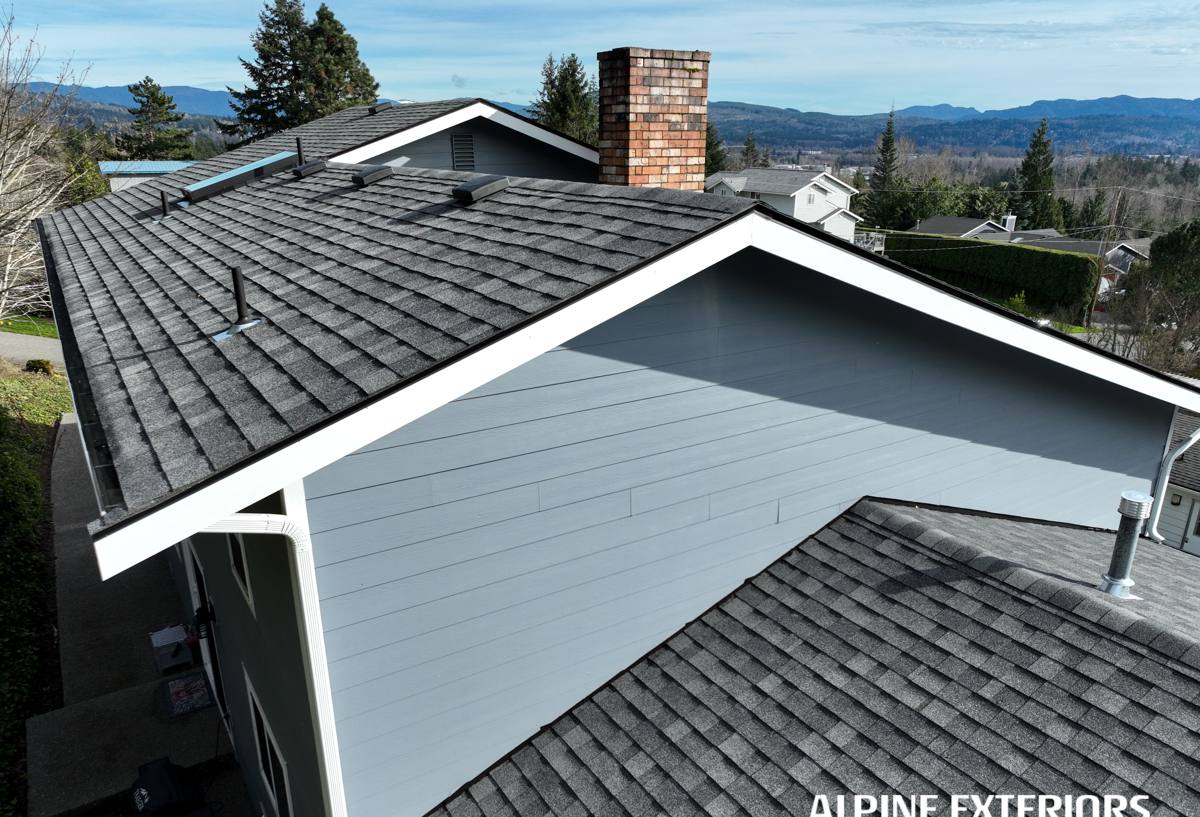
Common Roof Repairs We're Called Out for on Lummi Island
Most of the repair calls we get on the island fall into a handful of recurring categories. None of them are exotic — they're the predictable result of salt air, wind-driven rain, and a long moss season working on a roof year after year.
- Flashing failures at valleys, chimneys, and skylights: Corroded or improperly lapped flashing is the single most common source of leaks we find, and it's rarely the shingle field itself that's letting water in.
- Wind-lifted or torn shingles: Exposed lots and elevated properties catching direct wind off the water see edge and ridge shingles lift, crack, or blow off entirely during winter storms.
- Moss-related shingle damage: Moss holds moisture against shaded or north-facing roof planes, and the granule loss and shingle degradation that follow show up first on exactly those sections.
- Isolated leaks at penetrations: Plumbing vents, exhaust vents, and skylights are common failure points once the boot or seal around them ages and cracks.
- Storm and debris damage: Wooded, tree-covered lots common on the island mean falling branches and wind-driven debris are a real, recurring source of localized roof damage.
- Corroded gutter and edge flashing: Years of salt exposure take a visible toll on drip edge and gutter flashing well before the shingles themselves show their age.
What a Correct Roof Repair Actually Involves
A roof repair that actually holds up on this island starts with figuring out where the water is really coming from, not just where it's showing up. Water travels along the underlayment and roof deck before it ever drips through a ceiling, and a patch placed at the visible stain is often several feet away from the real point of entry.
Diagnosis Before Patching
We trace a leak back to its actual source before opening anything up — following the path along the deck and underlayment rather than assuming the wet ceiling spot sits directly under the failure. Sealing over the wrong spot is one of the most common reasons a "fixed" leak reappears the next time it rains hard.
Reflashing, Not Recaulking
When flashing has corroded or opened up at a valley, chimney, or wall intersection, the correct fix is to rebuild that flashing detail and integrate it properly with the underlayment, not to run a bead of caulk over the gap and call it done. Caulk is a short-term seal at best in a climate where salt air and driving rain work on it constantly.
Matching Materials and Tying In Properly
A repair patch needs to tie into the surrounding roof as one system, with shingles and underlayment that integrate with what's already there rather than sitting on top of it as a separate layer. Where an exact shingle match isn't available, we'll tell you that honestly upfront rather than let a mismatched patch be a surprise later.
Checking the Deck, Not Just the Surface
Any time we open up a section of roof for repair, we check the decking underneath for soft spots or hidden rot before closing it back up. Sealing new shingles over a deck that's already been quietly absorbing moisture just delays the same problem, and on a shaded or moss-prone section it often doesn't take long to resurface.
Repair or Replace? How We Help You Decide
Not every roof problem calls for a full replacement, and not every leak can be permanently solved with a patch. We'd rather give you an honest read on which situation you're actually in than talk you into more work than the roof needs, or send you home with a repair that's really just delaying a bigger job.
| Factor | Repair Often Makes Sense | Replacement Is Usually the Better Call |
|---|---|---|
| Roof age | Well within its expected lifespan | Already near or past the shingle's rated life |
| Extent of damage | Localized to one section or detail | Widespread across multiple roof planes |
| Repair history | First or second repair in this area | Same section has needed repeated patching |
| Deck condition | Solid decking found once opened up | Rot or soft spots found in multiple areas |
| Moss and granule loss | Isolated to a small section | Widespread across shaded or north-facing planes |
When a roof genuinely falls in the repair column, we'll say so and scope the job that way. When it doesn't, we'll walk you through exactly why, so the decision is based on what we actually found on your roof, not a default toward the bigger job.
Cost Factors in a Lummi Island Roof Repair
Roof repair pricing varies more than people expect, mostly because "roof repair" covers everything from a single flashing rebuild to a multi-section shingle and deck repair. Understanding what drives the number makes it much easier to judge whether an estimate is fair.
| Factor | What It Affects |
|---|---|
| Size of the damaged area | How many shingle courses and how much underlayment need to come out and go back |
| Flashing scope | Whether one detail needs rebuilding or several valleys, chimneys, and walls are involved |
| Deck repair needed | Whether rotted or soft decking has to be cut out and replaced before new shingles go down |
| Matching existing shingles | Whether a close match is available or a visible patch is the honest reality |
| Roof pitch and access | Staging, safety equipment, and labor time on steeper or harder-to-reach sections |
| Scheduling around ferry and weather | Materials and crew logistics on island jobs, and working around wet-season windows |
A written estimate that breaks these factors out separately, rather than a single flat number, tells you far more about what you're actually paying for and makes it easier to compare bids that look different on paper.
How Our Process Works
Repair work deserves the same clear communication as a full replacement, just scaled to the size of the job.
- In-person inspection: We get on the roof and, where relevant, into the attic to trace the actual source of the problem rather than guessing from a description over the phone.
- Written estimate: You get a clear scope covering diagnosis, flashing or shingle work, any deck repair, and cleanup, not a vague single line item.
- Emergency tarping when needed: If a storm has left your roof actively leaking, we can get a temporary tarp in place to stop further damage while the permanent repair is scheduled.
- Scheduling around the ferry and weather: We plan materials and crew time around island logistics and realistic weather windows, rather than treating either as an afterthought.
- The repair itself: Flashing, shingles, and any deck repair go in to manufacturer specification, tied properly into the surrounding roof system.
- Final walkthrough: We review the completed repair with you in person and do a site and magnetic nail sweep before we call the job done.
Why Hiring a Crew That Already Works Lummi Island Matters
Island logistics change how repair work has to be planned in ways that don't come up on the mainland. Getting a crew and the right materials over on short notice takes real coordination around ferry schedules, and a company without an established routine on the island can turn a same-week repair into a much longer wait. A crew that already works Lummi Island regularly has that logistics figured out, and has also already seen firsthand how salt air corrodes underspecified flashing and which roof orientations hold moss longest through the wet months here.
It matters after the repair is finished, too. A workmanship warranty is only worth as much as the company standing behind it, and a contractor with an ongoing, established presence on the island is one you can actually reach if a question comes up later, rather than a name that did one job and moved on.
A Practical Checklist Before You Choose a Roof Repair Contractor
- Do they diagnose the actual source of the leak, not just patch where the stain appears?
- Does the estimate specify flashing, shingle, and any deck work separately, rather than one vague line item?
- Do they check the deck for hidden rot any time a section is opened up?
- Do they carry current WA contractor licensing, liability insurance, and workers' compensation?
- Can they realistically schedule materials and crew time around island ferry logistics?
- Will they tell you honestly if the roof actually needs replacement instead of repair?
Signs Your Lummi Island Roof Needs Repair Now
Roof problems on this island tend to give warning signs well before a leak shows up inside the house. Catching them early is usually the difference between a modest repair and a much bigger job once water has had time to work its way in.
- Water staining on ceilings or in the attic, especially near valleys, chimneys, or vent penetrations
- Missing, cracked, or curling shingles, particularly after a windstorm off the water
- Visible moss buildup or granule loss concentrated on shaded or north-facing roof sections
- Rusted or visibly corroded flashing at valleys, chimneys, or roof-to-wall intersections
- Daylight visible through the roof deck from inside the attic
- Sagging along a section of roofline, which often points to deck-level moisture damage underneath
If any of this sounds familiar, it's worth having the roof looked at before the next stretch of heavy weather rather than waiting for a small problem to turn into a bigger one.
If you'd like an honest look at what your Lummi Island roof actually needs and a written estimate you can compare against anything else you've received, we're glad to come take a look. Use the form below to request a free, no-pressure estimate.