 Birch Bay Siding
 Siding Installation Built for Nooksack Conditions
Nooksack sits inland along the Nooksack River, but it still lives under the same wet, gray Whatcom County sky that defines siding performance for the entire region. Homes here deal with long stretches of driving rain, high humidity off the river bottom, heavy tree cover that keeps siding shaded and damp, and a moss season that can run from October well into spring. Add in the salt-tinged marine air that moves through the county from the coast, and you have a climate that is genuinely hard on exterior materials — not dramatic, just relentless. Siding installation in this area isn't about picking a color and nailing up panels. It's about choosing a product and a fastening system that will still be flat, sealed, and sound in twenty years, not five.
Birch Bay Siding Company installs James Hardie fiber cement siding exclusively across our Whatcom County service area, including Nooksack. That's a deliberate standard, not a sales pitch, and it shapes every recommendation in this page.
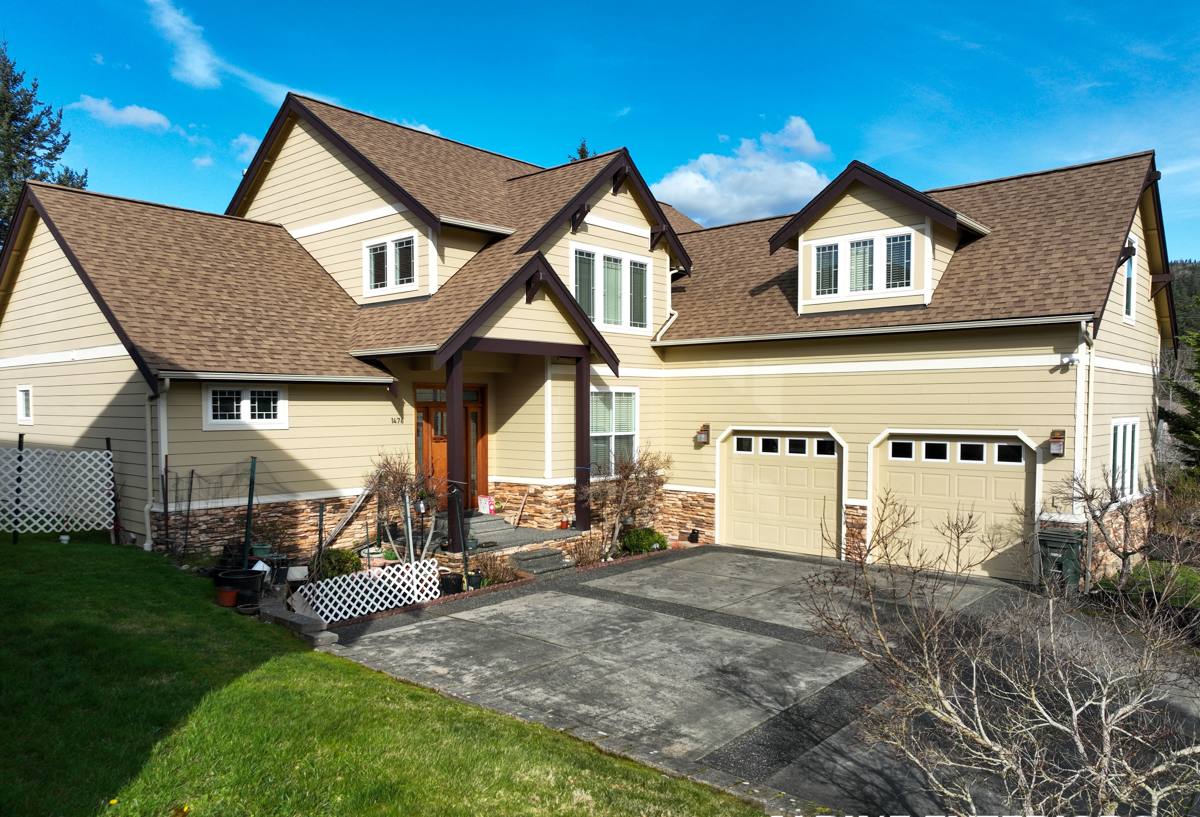
What Nooksack Homes Actually Need From Their Siding
Moisture Is the Real Enemy
Rain itself rarely destroys siding. What destroys siding is rain that gets behind it, or moisture that sits against it long enough to feed rot, mold, or paint failure. In a river valley community with heavy shade and slower drying times than open coastal lots, that means the water-resistive barrier, flashing details, and drainage plane behind the siding matter as much as the siding material itself.
Moss and Organic Growth
Whatcom County's moss season is long, and shaded north-facing walls in Nooksack hold moisture longer than sun-exposed sides. Siding that absorbs water — even a little — becomes a growth medium for moss and mildew over time. Non-absorbent siding doesn't stop spores from landing on it, but it does stop the substrate underneath from staying wet enough to rot while moss sits on the surface.
Temperature Swings and Material Movement
Wood-based and some engineered products expand and contract with seasonal moisture swings, which over years works caulk joints loose and opens hairline gaps at butt joints and trim. A dimensionally stable material holds its paint lines and joints far longer, which matters on a 20+ year ownership timeline.
Why We Only Install James Hardie
We used to get asked why we don't offer vinyl, LP SmartSide, or one of the other fiber cement brands like Cemplank or Allura. The honest answer is that after years of installs, repairs, and callbacks across this climate, we standardized on one product because it consistently performs and the others come with trade-offs we're not willing to put our name behind.
- Non-combustible: Hardie fiber cement is Class 1(A) fire-rated, which matters more every wildfire season in the Pacific Northwest.
- Engineered for wet Pacific Northwest climates: Hardie's HZ5 product line is specifically formulated for high-moisture, freeze-thaw regions like ours.
- ColorPlus factory finish: a baked-on finish that resists fading and chipping far longer than field-applied paint, which matters when repainting a Nooksack house means scaffolding around trees and slower dry times.
- Proven track record: decades of real-world performance in wet coastal and river-valley climates, not a newer product still building a track record.
- Strong transferable warranty: backed by the manufacturer, not just the installer, and it stays with the house if you sell.
That doesn't mean every alternative is a bad product across the board — vinyl is inexpensive, LP SmartSide has genuine fans, and other fiber cement brands have real installations that hold up. But we've made a professional call that we'd rather install one system extremely well than offer five and hope each one works out. On a Nooksack property, where drying time is slower and moss pressure is higher than a sunny inland site, that call matters more, not less.
What a Correct Hardie Installation Involves
The material is only half the equation. Fiber cement is unforgiving of shortcuts, and a poor install on a great product will fail the same way a great install on a poor product does — just for different reasons. Here's what we actually do on a Nooksack siding job:
- Tear-off and substrate inspection. We remove existing siding and check the sheathing underneath for rot, soft spots, or prior water damage — common on older homes in shaded, damp lots.
- Repair before covering. Any compromised sheathing or framing gets replaced. We do not side over known problems.
- Water-resistive barrier. A new weather barrier goes on correctly lapped, shingle-style, so water sheds down and out, never behind the next layer.
- Flashing at every penetration. Windows, doors, hose bibs, vents, and roof-to-wall intersections all get proper flashing — this is where most real-world leaks start, not in the field of the siding.
- Rainscreen or proper drainage gap where conditions call for it, so moisture that does get behind the cladding has somewhere to go.
- Correct fastening. Hardie has specific nailing patterns, blind-nail vs. face-nail requirements by product line, and minimum embedment depths — done wrong, this voids the manufacturer warranty even though the siding "looks" installed.
- Proper joint and butt-seam treatment. Sealed and back-flashed per manufacturer spec, not just caulked and painted over.
- Trim and finish detailing so water sheds away from every transition — corners, soffits, and the base of the wall.
Comparing What Nooksack Homeowners Are Actually Choosing Between
| Factor | Vinyl Siding | LP SmartSide | James Hardie Fiber Cement |
|---|---|---|---|
| Moisture tolerance | Doesn't absorb, but can trap moisture behind it if installed poorly | Engineered wood — vulnerable if the outer seal is breached | Engineered for wet climates; doesn't rot |
| Fire rating | Combustible | Combustible | Non-combustible (Class 1A) |
| Finish longevity | Can fade and become brittle over time | Factory-primed; needs field paint upkeep | ColorPlus factory finish holds color for years |
| Moss/mildew resistance | Moderate — surface growth on shaded walls | Moderate to low if edges aren't sealed | High when installed and maintained correctly |
| Warranty structure | Varies widely by manufacturer | Manufacturer-backed, product specific | Strong transferable manufacturer warranty |
| Upfront cost | Lowest | Mid-range | Mid to upper-mid range |
Cost is a real factor, and we won't pretend fiber cement is the cheapest option up front. What we tell every Nooksack homeowner is to weigh it against repaint cycles, moisture repair costs, and how long you actually plan to own the home — over a 20-year horizon, the math usually favors the material that needs the least intervention.
Our Process, Start to Finish
1. Estimate and Assessment
We walk the exterior, look at current siding condition, note problem areas (shaded walls, moss buildup, trim damage), and talk through which Hardie product line and profile fits the house.
2. Proposal and Product Selection
You'll get a clear, written scope — product line, ColorPlus color, trim details, and what's included. No vague allowances.
3. Scheduling Around Weather
Fiber cement installation has real weather requirements. In a climate like ours, that means we plan installation windows around forecasted dry stretches rather than fighting the rain.
4. Tear-off, Repair, Install
As outlined above — substrate first, barrier and flashing second, siding last.
5. Final Walkthrough
We walk the finished job with you, check every elevation, and confirm trim, caulking, and touch-ups are complete before calling it done.
Why Hiring a Crew That Already Works This Area Matters
Siding crews that mostly work drier, sunnier markets sometimes underestimate how much moisture management matters in a river-valley Whatcom County town like Nooksack. A crew that installs across this county every week already knows which walls hold moss longest, which flashing details actually get tested by our winters, and how much drying time a job realistically needs before a coat of anything goes on. That local repetition is what keeps a warranty-backed install from becoming a callback two years later.
Signs It's Time to Talk About Replacement
- Paint that's peeling, bubbling, or chalking heavily on shaded sides of the house
- Soft spots or visible warping in existing siding boards
- Persistent moss or mildew staining that returns shortly after cleaning
- Gaps opening at butt joints, corners, or trim over the past few seasons
- Visible water staining on interior walls near exterior corners
- Siding that's original to a home built more than 20-25 years ago
None of these alone means an emergency, but two or three together are a sign the current siding is past the point where patching makes sense.
What to Expect on Cost
Every Nooksack property is different — square footage, number of stories, trim complexity, and how much repair work the substrate needs all move the number. Rather than quote a misleading flat rate, we walk the house in person and give a written estimate broken down by scope, so you know exactly what you're paying for and why.
If your Nooksack home's siding is showing its age, or you're planning ahead rather than reacting to a problem, we're happy to walk the property with you and talk through what James Hardie fiber cement would look like on your specific house. There's no pressure and no obligation — just a straight answer from a crew that installs this product, and only this product, across Whatcom County. Use the form below to request a free estimate.