 Birch Bay Siding
 Board & Batten Siding Built for Point Roberts' Marine Climate
Point Roberts sits on its own peninsula, surrounded on three sides by water and cut off by land from the rest of Whatcom County. That geography is part of what makes the community special, and it's also exactly why siding here takes more punishment than siding fifteen miles inland. Homes on this peninsula face onshore wind, salt-laden air, driving winter rain, and a wet season that can stretch on long enough to grow moss on anything that stays damp too long. Board and batten siding, when it's the right style for the home and installed correctly, holds up well against all of it — but "correctly" is doing a lot of work in that sentence, and it's worth understanding what that actually means before you sign a contract.
This page is about one service in one place: board and batten siding for Point Roberts homes. Not a general overview of siding options, not a sales pitch for a style that doesn't fit your house. If board and batten is the right call for your home, here's what you should know about how the local climate treats it, what a correct installation involves, and how we approach these projects.
What the Point Roberts Climate Does to Exterior Siding
Every coastal Whatcom County community deals with wind and rain, but a few conditions show up more consistently on this peninsula because of how exposed it is to open water.
Salt Air and Corrosion
Salt-laden air doesn't just sit on the surface of a wall — it works into fasteners, trim joints, and any exposed metal on the exterior. Over years, ordinary fasteners and flashing corrode faster near open water than they do a few miles inland. That corrosion is rarely dramatic; it's slow, and it shows up first as rust streaking below a nail head or a fastener that's lost its grip. The fix isn't complicated, but it has to be planned for from the start: corrosion-resistant fasteners and flashing rated for coastal exposure, not whatever happens to be in the truck.
Driving Rain and Wind-Driven Moisture
Open exposure means rain doesn't just fall straight down here — wind pushes it sideways, and sideways rain finds every gap a vertical siding system has. Board and batten's seams run vertically, which is good for shedding water down and off the wall, but only if the drainage plane behind the siding, the flashing at every penetration, and the joint spacing are all done right. Get any of those wrong and wind-driven rain gets pushed past the surface layer and into the wall assembly, where it causes damage long before anyone sees a stain on the outside.
Moss, Shade, and the Long Wet Season
Whatcom County's wet season runs long, and shaded, north-facing walls or areas under tree cover stay damp for extended stretches. That's exactly the environment moss and algae need to take hold. Moss growth on siding isn't just a cosmetic issue — it holds moisture against the surface and, on the wrong substrate, that trapped moisture accelerates deterioration underneath. Material choice and surface finish both affect how much of a foothold moss actually gets.
Why Board and Batten Is a Good Fit for This Coastline
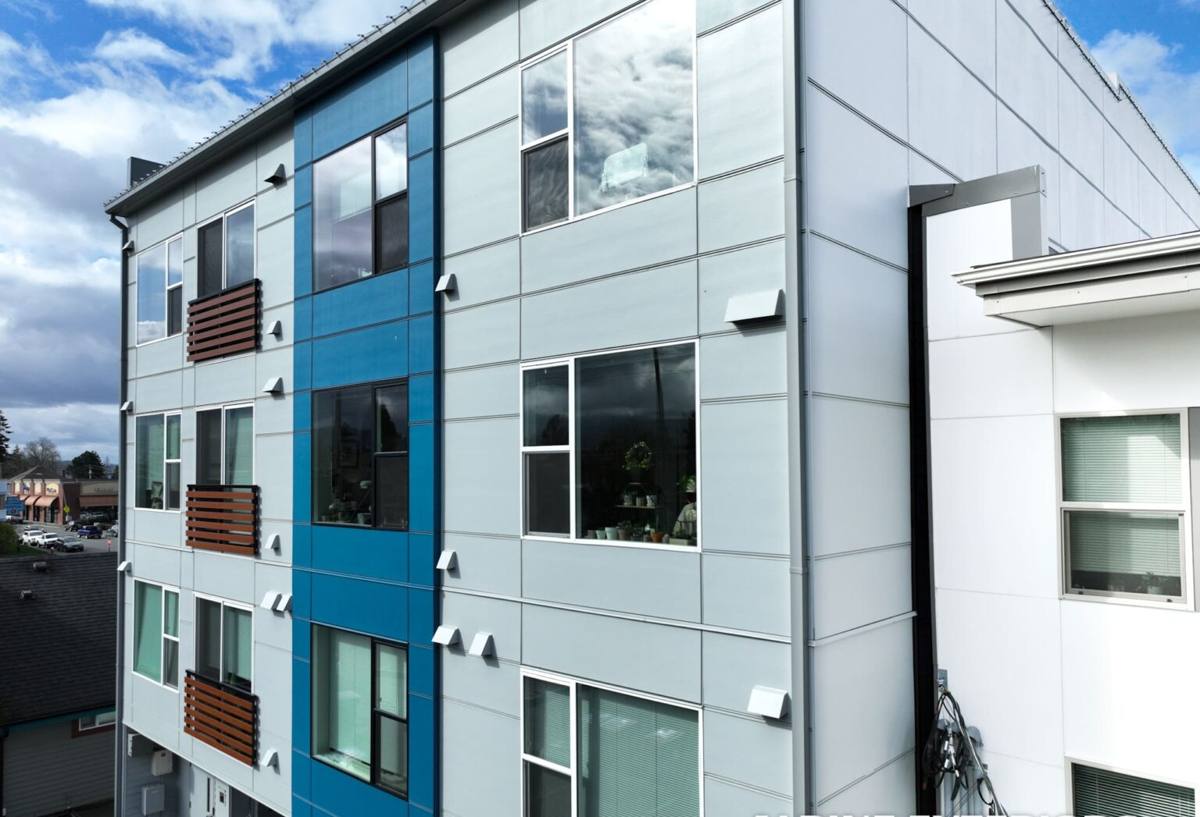
Board and batten is a strong style choice for exposed coastal homes for a practical reason, not just an aesthetic one: the vertical board-and-batten profile sheds water downward along clean lines instead of trapping it in horizontal laps, and it reads well on the kind of straightforward, durable exterior that holds up to wind and salt exposure without a lot of fussy detail to maintain. It also suits a range of home styles common around Birch Bay and Point Roberts, from modern coastal builds to more traditional cabins, without looking out of place on either.
None of that matters if the material underneath the style can't handle the environment. That's the part homeowners often don't get a straight answer on.
What a Correct Board & Batten Installation Actually Involves
Board and batten looks simple from the street — wide panels, narrow battens over the seams — but the parts you can't see are what determine whether it lasts. A correct installation on an exposed Point Roberts wall includes:
- A continuous weather-resistant barrier behind the siding, lapped correctly at every seam
- Properly sized furring or battens where needed to create a drainage gap, so any moisture that gets behind the siding can drain and dry instead of sitting against the sheathing
- Corrosion-resistant, manufacturer-approved fasteners driven at the correct spacing and depth — not overdriven, which cracks fiber cement, and not underdriven, which lets panels move
- Flashing at every window, door, roof intersection, and penetration, installed to shed water down and out, not into the wall
- Kickout flashing at roof-to-wall intersections so runoff is directed into the gutter instead of down behind the siding
- Correct gapping and sealant only at the joints the manufacturer specifies — not caulk used as a substitute for proper flashing
- Factory-primed or factory-finished cut edges sealed in the field, since a raw cut edge is the fastest path for moisture into fiber cement
- Adequate clearance between the bottom of the siding and grade, decks, or roof lines to keep splashback and standing moisture away from the material
Skip any one of these and the siding can still look fine for a year or two. The problems that come from skipping them don't show up on day one — they show up three, five, or ten years in, usually as moisture damage that costs far more to fix than it would have cost to do right the first time.
The Material Question: Why We Install James Hardie and Nothing Else
Board and batten siding is available in several materials, and homeowners in this area sometimes come to us already comparing options. We only install James Hardie fiber cement, and it's worth being direct about why, rather than just saying "trust us."
| Material | Salt air / corrosion | Moisture behavior | Moss resistance | Long-term maintenance |
|---|---|---|---|---|
| Vinyl board and batten | Doesn't corrode, but can warp or become brittle with UV and temperature swings over time | Panels can trap moisture behind them if installation isn't precise; not dimensionally stable when wet | Smooth surface resists some growth, but poor drainage details invite it at seams | Low upfront maintenance, but limited repairability and shorter realistic lifespan on exposed walls |
| Primed wood or cedar | No metal corrosion issue, but the wood itself is vulnerable to the marine environment | Absorbs moisture readily; repeated wet-dry cycling drives cupping, splitting, and rot at joints | Organic material with texture is a favorable surface for moss and algae in shaded, damp conditions | Highest ongoing maintenance — repainting, caulking, and spot repair on a recurring cycle |
| James Hardie fiber cement | Non-combustible, dimensionally stable material; corrosion risk is limited to fasteners and flashing, which we spec for coastal exposure | Engineered HardieZone HZ5 formulation for the Pacific Northwest resists moisture-related damage when installed to spec | Dense, factory-finished surface gives moss and algae less to hold onto than raw wood | ColorPlus factory finish is warranted against fading and cracking; no repainting cycle |
We're not going to tell you vinyl or wood siding is a bad product across the board — both have legitimate uses and plenty of homes wear them fine in milder settings. Our position is narrower than that: on an exposed peninsula with the salt air, driving rain, and moss pressure this area sees, we've made James Hardie our standard because it's the material we're confident holding up over decades, not just years, and because its transferable warranty backs that confidence up. That's a professional judgment call, and it's the same standard we apply to every home we side, not a claim about what any competitor does or doesn't do well.
How We Approach a Board & Batten Project in Point Roberts
Assessment First
Before we talk product or price, we look at the specific exposure the home faces — which walls take the most wind-driven rain, where shade keeps a wall damp longer, and what the current siding or sheathing tells us about existing moisture history. That assessment shapes the flashing and drainage details, not just the panel layout.
Planning Around the Peninsula
Point Roberts is only reachable by land through a border crossing, which means material delivery and crew scheduling need to be planned ahead rather than handled on the fly. A crew that regularly works this area already accounts for that in scheduling, staging materials, and coordinating timelines, so a project doesn't stall waiting on something that should have been anticipated.
Installation to Spec
We install to James Hardie's published specifications and local code requirements — fastener type and spacing, clearances, flashing details, and joint treatment. On coastal exposure, we don't cut corners on fastener or flashing material to save a few dollars; it's the part of the job nobody sees until it fails.
Final Walkthrough
Once the siding is up, we walk the exterior with you, checking sealant lines, trim, and any transitions to roof, deck, or foundation, so nothing is left to discover after the crew has moved on.
Maintenance: What Owning Board & Batten Here Actually Looks Like
One appeal of a correctly installed James Hardie system is how little ongoing maintenance it asks for compared to wood. That doesn't mean zero attention. In this climate, we recommend:
- Rinsing the exterior periodically to clear salt residue and organic buildup before moss gets established
- Keeping gutters and downspouts clear so roof runoff doesn't sheet down the siding
- Trimming back vegetation and tree cover that keeps a wall in constant shade and dampness
- Checking caulked joints every year or two and re-sealing only where the manufacturer specifies sealant, not everywhere
- Having any impact damage or fastener issues addressed promptly rather than left to let moisture in
None of this is heavy lifting, but it's the difference between siding that reaches the upper end of its service life and siding that starts showing problems early because small issues went unaddressed.
Why It Matters That We Already Work This Area
A crew unfamiliar with Point Roberts might treat it like any other job site — same schedule, same generic material spec, figure out the border crossing and delivery logistics as they go. That approach costs time and, more importantly, it means the crew isn't necessarily thinking about wind exposure, salt air, or moss-prone shade patterns as part of the plan from day one. We treat those factors as baseline requirements for every board and batten project on this peninsula, not an afterthought. That's a direct result of having done the logistics and the installation here before, not a generic promise.
Get a Free Estimate
If you're considering board and batten siding for a home in Point Roberts or elsewhere around Birch Bay, we're happy to take a look, walk you through what your specific exposure calls for, and give you a straightforward, no-pressure estimate. There's a form below to get started.