 Birch Bay Siding
 Building Decks for Point Whitehorn's Shoreline Climate
Point Whitehorn sits close enough to the water that its homes take a different kind of weather beating than houses further inland in Whatcom County. Salt-laden air off the Strait works on metal fasteners and hardware year-round. Driving rain off Birch Bay finds every gap in flashing and decking that isn't detailed correctly. And the long, damp moss season here — often stretching from fall through late spring — turns any shaded or poorly-drained deck surface into a slip hazard within a year or two if it wasn't built with that in mind.
A deck built to a generic spec sheet will survive a season or two looking fine. Out here, the difference between a deck that lasts 20+ years and one that needs board replacement by year five almost always comes down to decisions made before the first board goes down: the framing lumber, the fasteners, the flashing details, and how much airflow the structure gets underneath.
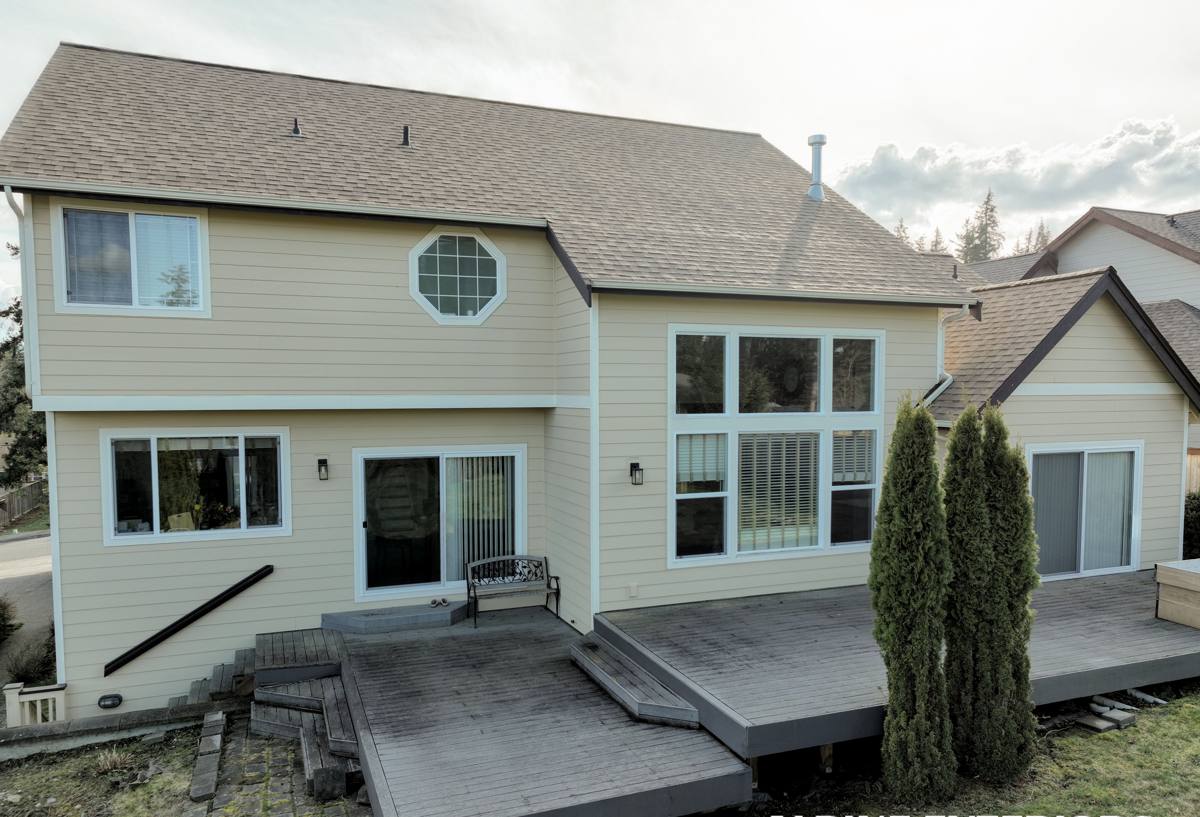
What Point Whitehorn Homes Actually Need From a Deck
Every deck we build near the water in this part of Whatcom County has to answer to the same set of conditions, whether it's a small entry landing or a full-width deck facing the bay.
- Corrosion resistance — salt air accelerates rust on any fastener, hanger, or bracket that isn't rated for it
- Drainage and airflow — standing moisture under and around the deck is what feeds moss and rot
- Wind exposure — railings and any overhead structure need to be anchored for gusts off open water, not just calm-day loads
- UV and rain cycling — Pacific Northwest decks go through repeated wet-dry cycles that stress joints and finishes differently than a drier climate would
- Traction underfoot — smooth or heavily grained surfaces get slick fast once moss and algae take hold
None of these are exotic problems. They're the same forces every deck on this stretch of coastline deals with — but a lot of decks we get called out to repair were built by crews who don't work this area regularly and didn't plan for them.
Where a Deck Sits Matters as Much as How It's Built
Orientation and shade play a bigger role here than most homeowners expect. A deck tucked under tree cover or on the north side of a house will hold moisture and grow moss far faster than one that gets sun and wind exposure. We factor that into board spacing, joist spacing, and even the decking profile we recommend, since a deck in a shaded, moss-prone spot needs more airflow underneath than one in full sun.
Choosing Decking Material for Salt Air and Moss
There's no single "best" decking material — the right choice depends on budget, how much upkeep you're willing to do, and how exposed the deck is. Here's how the common options actually perform in this climate.
| Material | Moisture / Salt Air Behavior | Moss & Algae Resistance | Maintenance | Typical Lifespan |
|---|---|---|---|---|
| Pressure-treated fir/pine | Good if properly sealed and re-coated; fasteners must be rated for treated lumber | Needs regular cleaning and re-sealing to resist moss | Annual cleaning, re-stain/seal every 2-3 years | 15-20 years with upkeep |
| Western red cedar | Naturally moisture and rot resistant, ages well near salt air | Still needs periodic cleaning, especially in shaded spots | Cleaning plus occasional oil or stain if you want to keep color | 20-25 years |
| Composite decking | Excellent — doesn't absorb moisture or swell | Better resistance but surface can still grow algae film if shaded and unwashed | Occasional wash, no staining or sealing | 25-30+ years, manufacturer-backed |
| PVC decking | Best moisture performance of the group, fully non-organic | Best resistance to moss and rot since there's no wood fiber to feed on | Lowest — wash as needed | 25-30+ years |
We install all of these depending on what a homeowner wants, but we're upfront about the trade-offs: wood costs less up front and looks great, but it's a maintenance commitment in a climate that never really dries out for long. Composite and PVC cost more initially and carry that cost into every linear foot, but they take the moss-and-moisture fight out of your hands almost entirely. Neither choice is wrong — it's about matching the material to how much deck maintenance you actually want to do every year.
Substructure and Fasteners: Where Decks Actually Fail
Most deck failures we see near the water aren't decking board problems — they're substructure problems that took years to show up. The ledger board attachment, the flashing behind it, the joist hangers, and the fasteners holding it all together do the real structural work, and they're the parts most likely to get shortcut on a budget build.
On every deck we build, that means:
- Stainless steel or hot-dip galvanized fasteners rated for coastal/salt-air exposure — not standard coated deck screws that will bleed rust within a couple seasons
- Proper ledger flashing where the deck ties into the house, so water is directed away from the band joist and siding rather than trapped behind the ledger
- Joist hangers and structural connectors matched to the fastener type, since mixing metals accelerates corrosion on both
- Footings sized and set below frost depth per Whatcom County code, not just poured to "look deep enough"
- Adequate clearance and airflow under the deck to keep the substructure drying out between rain events instead of staying damp
A deck can look finished and solid for years while the ledger connection or the hangers underneath are quietly corroding. That's the part of the job that doesn't show up in photos but determines whether the deck is safe in year 15.
Railings, Fascia, and the Surfaces That Grow Moss First
Railings and fascia boards take a disproportionate amount of weather because they're vertical, often shaded by the house or trees, and don't get the same wash-off from foot traffic that the deck surface does. We pay particular attention to railing post attachment — this is a common failure point in wind-exposed coastal builds — and we detail fascia boards with a slight gap or drip edge where possible so water doesn't wick up behind them and start feeding moss from the back side, where you won't see it until it's advanced.
Cable and metal railing systems have gotten more common on view decks in this area because they hold up well to salt air when the hardware is correctly specified, and they don't offer moss the same footholds that wood balusters do.
Our Deck Building Process
1. Site Visit and Design
We walk the site, look at sun/shade exposure, drainage, and how the deck will tie into the house, and talk through material options against your budget and how much upkeep you want long-term. This is also when we flag anything unusual about the site — slope, soil, existing drainage issues — that affects footing and framing decisions.
2. Permitting
Most attached decks in Whatcom County require a building permit, and many freestanding decks above a certain height do too. We handle that paperwork as part of the job so you're not tracking down inspections yourself.
3. Construction
Footings, framing, ledger flashing, and structural connections go in first and get inspected before decking, railings, and fascia go on. We don't cover up substructure work before it's been checked — that's the part that's expensive to fix later and impossible to inspect once it's buried under finished decking.
4. Final Walkthrough
We walk the finished deck with you, cover basic care for whatever material you chose, and make sure railings, stairs, and gates meet code and feel solid before we call it done.
Maintenance Checklist for a Salt-Air, Moss-Season Climate
Whatever material your deck is, a little seasonal attention goes a long way out here. This is the routine we recommend to homeowners after the build:
- Sweep debris and standing leaves off the deck surface regularly, especially in fall
- Wash the deck surface and railings at least once a year to remove algae film before it takes hold
- Check ledger flashing and any visible fasteners for rust streaking or corrosion
- Keep gutters and downspouts near the deck clear so runoff isn't dumping directly onto or under it
- Trim back overhanging branches that keep the deck shaded and slow to dry
- For wood decks, re-seal or re-stain on the schedule recommended for the product — don't wait until it's visibly gray and dry
- Check under the deck once a year for moisture pooling or blocked airflow
Why a Crew That Already Works Point Whitehorn Matters
Deck building isn't exotic work, but coastal deck building has a learning curve most crews only get by doing it repeatedly in the same conditions. A contractor who mostly builds decks inland can still frame a structurally sound deck — but they may not default to salt-rated fasteners, they may not think about ledger flashing the same way, and they may not factor moss-prone shade patterns into board spacing and airflow the way a crew that deals with it constantly does. Those aren't dramatic differences on install day. They're the differences that show up as callbacks and repairs five to ten years down the road.
We build decks throughout Birch Bay and the surrounding Whatcom County coastline, and Point Whitehorn's conditions are ones we plan for as a matter of course, not an afterthought.
If you're planning a new deck, replacing an aging one, or just want an honest read on whether your current deck's substructure is holding up, we're happy to take a look. Reach out for a free, no-pressure estimate using the form below.