 Birch Bay Siding
 Why Sandy Point Decks Wear Out Faster Than Inland Decks
If you own a home in Sandy Point, you already know your deck works harder than a deck fifteen miles inland. Sitting close to the water in Whatcom County means near-constant exposure to salt-laden air, wind-driven rain that gets pushed sideways into ledger boards and railings, and a long, damp moss season that can run from fall through spring. Add in UV exposure during the brief but intense summer stretch, and you've got a structure that's cycling between soaked and dried-out more often than most decking materials were designed for.
None of that means a deck can't last in Sandy Point — it means the materials, fasteners, and detailing have to be chosen with that environment in mind from the start. A deck built the same way you'd build one in a dry inland subdivision is going to show problems years earlier here. That's really the whole story behind why "deck replacement" looks different on the Birch Bay waterfront than it does elsewhere in the county.
What Salt Air Actually Does
Salt air doesn't just make hardware rust faster — it accelerates corrosion in anything ferrous, breaks down certain finishes and sealants ahead of schedule, and can leave a fine residue on surfaces that holds moisture longer than plain rainwater would. Fasteners, joist hangers, and structural connectors are usually the first casualties, often failing well before the visible decking boards look bad.
What Driving Rain and Moss Add to the Problem
Wind-driven rain finds its way into places vertical rain never would — under railing caps, behind fascia boards, and into ledger connections at the house. Combined with the shade and dampness that feed moss growth on north-facing and low-light areas, you end up with wood that stays wet longer between dry spells. Trapped moisture under moss or debris is one of the most common reasons we find rot in framing that looked fine from the surface.
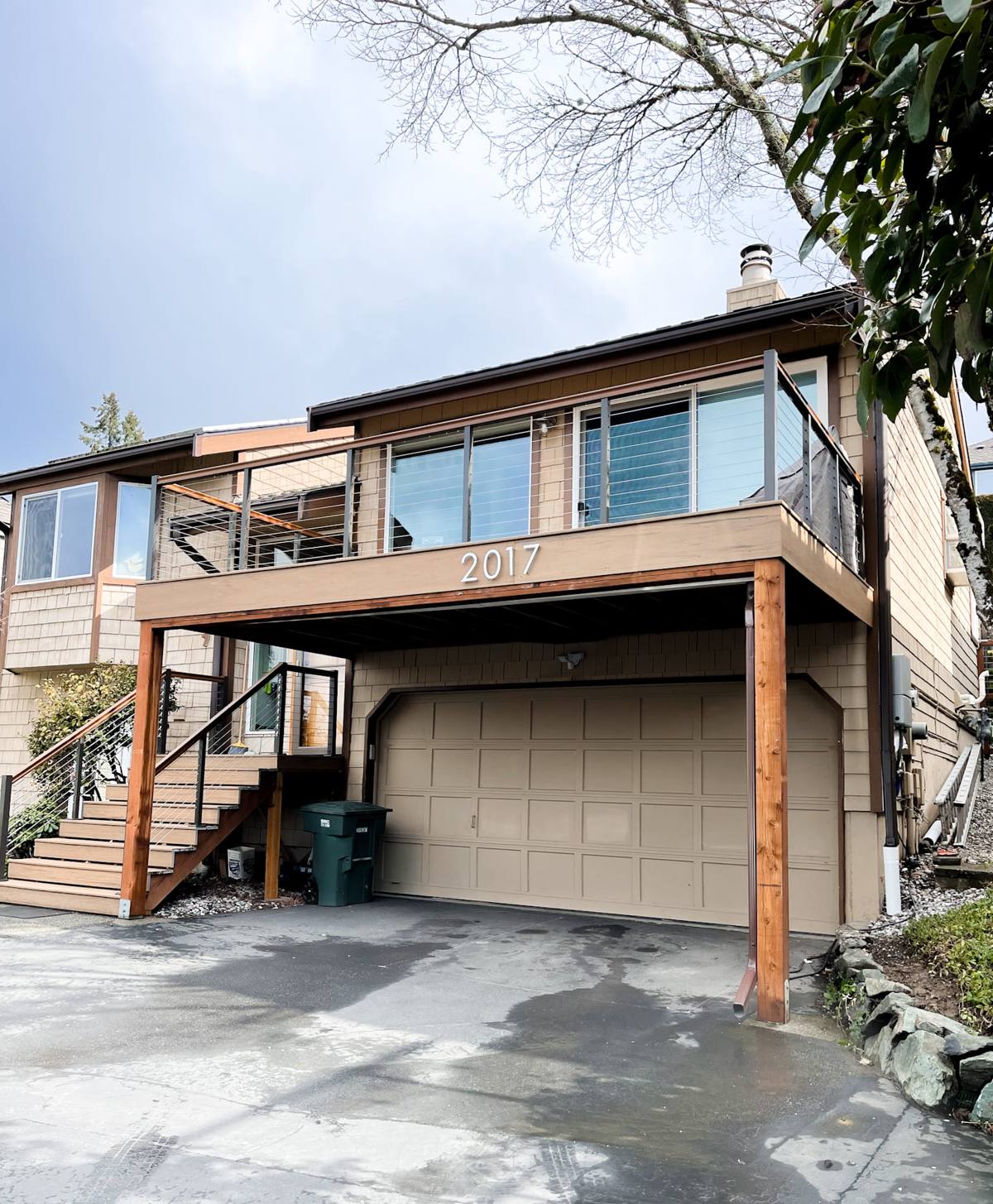
Signs a Sandy Point Deck Needs Replacement, Not Just Repair
Not every problem deck needs a full teardown. But there's a point where patching individual boards is throwing money at a structure that's failing underneath. Here's what tells us a deck has crossed that line:
- Soft, spongy, or springy spots in the decking or around the ledger board
- Visible rot, splitting, or delamination in more than a few boards
- Rust streaking or corrosion on visible fasteners, brackets, or hangers
- Persistent moss or algae buildup that returns within weeks of cleaning
- Railings that flex, wobble, or feel loose when leaned on
- Gaps opening up between the ledger board and the house
- A deck that's more than 20-25 years old and has never been substantially rebuilt
- Structural posts or footings showing cracking, heaving, or rot at the base
If you're seeing two or more of these, it's usually more cost-effective — and safer — to replace than to keep chasing repairs on a structure whose framing is already compromised.
What a Correct Deck Replacement Actually Involves
A deck replacement is only as good as what's underneath it. Anyone can screw new boards to old joists and call it a remodel — that's not what we do, and it's not what holds up in this climate.
Framing and Footings
We evaluate the ledger connection, joists, beams, posts, and footings before deciding what stays and what goes. In a coastal environment, framing that's been exposed to years of salt air and moisture often needs full replacement even when the decking boards on top still look presentable. Footings get checked for frost depth and soil condition, since ground movement and moisture around Birch Bay can shift undersized or shallow footings over time.
Ledger Flashing
The ledger board — where the deck attaches to your house — is the single most common failure point on any deck, and it's especially vulnerable here because it's a horizontal surface exposed to driving rain. Proper flashing that directs water away from the house band board, rather than letting it pool or wick behind the siding, is non-negotiable on every replacement we do.
Fasteners and Hardware
Given how quickly ordinary hardware corrodes near saltwater, we build with fasteners and structural connectors rated for coastal or high-moisture exposure. That's a small line-item cost difference upfront and a major difference in how long the connections actually hold.
Decking and Railing Materials
Final material choice depends on your budget, maintenance appetite, and how exposed the deck is to sun, wind, and salt spray. We'll walk through the realistic trade-offs rather than just selling whatever's easiest to install.
Choosing a Decking Material for a Salt-Air Site
There's no single "best" decking material — there's the best material for your specific site, sun exposure, and how much upkeep you want to do. Here's how the common options actually perform in a Birch Bay / Sandy Point coastal setting:
| Material | Salt Air & Moisture Performance | Maintenance | General Notes |
|---|---|---|---|
| Pressure-treated wood | Good if detailed and finished correctly; vulnerable at cut ends and fastener points | Regular cleaning and refinishing every 1-3 years | Lowest material cost; most sensitive to moss and moisture if neglected |
| Cedar | Naturally rot-resistant but still needs sealing near saltwater | Periodic cleaning and sealing | Attractive, common regionally, but a softer wood that wears with heavy foot traffic |
| Capped composite | Strong resistance to moisture and salt; won't rot | Occasional washing, no staining or sealing | Higher upfront cost, long service life, consistent appearance over time |
| PVC decking | Excellent moisture resistance; unaffected by salt exposure | Lowest maintenance of the group | Highest material cost; some homeowners prefer the look of wood-grain composites instead |
Our honest take: in a shoreline location like Sandy Point, capped composite or PVC decking tends to earn back its higher upfront cost through drastically reduced maintenance and a longer service life before the next replacement. Wood isn't wrong — it's a legitimate choice with a different maintenance commitment — but it does require more diligence in this climate than it would twenty miles inland.
Where Coastal Decks Actually Fail — Fasteners and Flashing
Most deck failures we see near the water aren't from the decking boards themselves — they're from what's holding everything together. Standard galvanized fasteners and connectors can corrode noticeably faster in salt air than the same hardware would inland. Stainless steel or coated fasteners rated for coastal exposure cost more per piece, but the difference between a deck that needs hardware replaced in eight years versus twenty-five years usually comes down to this one decision made at build time.
Flashing detail matters just as much. Anywhere water can collect against wood — the ledger, post bases, stair stringers meeting concrete — needs a barrier between the fastener or wood and standing moisture. It's not a glamorous part of the job, but it's the part that determines whether your new deck is still solid in fifteen years.
Moss, Drainage, and Long-Term Upkeep
Whatcom County's damp shoulder seasons mean moss and algae are a fact of life on north-facing and shaded decks, especially near tree cover or close to the water. A well-built deck won't eliminate moss entirely, but good design reduces how bad it gets:
- Proper gapping between boards so water drains through instead of pooling
- Grooved or textured board surfaces designed to shed water rather than trap it
- Adequate slope away from the house at the ledger connection
- Clear space under the deck for airflow, rather than a sealed, damp crawlspace
Even with good drainage, plan on an annual cleaning — a stiff brush and appropriate cleaner for your decking material — to keep moss from getting a foothold. It's a lot easier to prevent moss buildup than to remove it once it's established and staining the wood.
Our Process for a Sandy Point Deck Replacement
- On-site assessment. We inspect the existing deck, ledger connection, framing, footings, and any visible rot or corrosion, and give you a straight answer on repair versus replacement.
- Material walkthrough. We go over decking, railing, and hardware options based on your budget, sun exposure, and how much maintenance you want to take on.
- Written estimate. You get clear scope and pricing before any work starts — no surprise change orders for things we should have caught upfront.
- Permitting. We handle the permit process through Whatcom County where required, based on the size and structure of the project.
- Demolition and framing. Old decking, and any compromised framing or footings, comes out and gets rebuilt to current code with coastal-rated hardware and proper ledger flashing.
- Decking, railing, and finish work. Your chosen materials go in with attention to drainage, fastener placement, and clean finish detail.
- Final walkthrough. We walk the finished deck with you before calling the job done.
Permits and Local Considerations
Most deck replacements in Whatcom County — particularly those involving structural changes, height above grade, or attachment to the home — require a permit. Requirements can vary depending on your specific property and whether you're in an unincorporated area near Birch Bay or under a different jurisdiction, so we check the specifics for your address rather than assuming. If your property has any shoreline-adjacent considerations, that's also worth confirming early, since it can affect setback or design requirements. We fold this into the process so it isn't something you have to chase down yourself.
Why Hire a Crew That Already Works in Sandy Point
A contractor who mostly builds decks inland may not think twice about standard galvanized hardware or a basic wood species — because in a drier, less salt-exposed environment, that approach holds up fine. On the Birch Bay waterfront, those same choices can mean hardware replacement or visible wear years ahead of schedule.
Working regularly in coastal Whatcom County means we've seen firsthand which fastener grades actually hold up, which flashing details prevent ledger rot, and which materials are worth the extra upfront cost versus which ones aren't. That's not a sales pitch — it's the practical benefit of building repeatedly in the specific conditions your home sits in, rather than treating every deck the same regardless of where it is.
Cost is also worth being straightforward about: a full deck replacement is a real investment, and depending on size, framing condition, and material choice, most complete replacements land in a broad range of roughly $15,000 to $35,000 or more. The right number for your project depends on the specifics, which is exactly what an on-site estimate is for.
If your Sandy Point deck is showing its age — or you just want an honest opinion on repair versus replacement — we're glad to take a look. Use the form below to request a free, no-pressure estimate, and we'll walk the deck with you and give you a straight assessment.