 Birch Bay Siding
 Point Whitehorn Is a Different Kind of Exposure
Point Whitehorn sits on the wooded, bluff-lined edge of Whatcom County where the Strait of Georgia meets the shoreline near the Point Whitehorn Marine Reserve. Homes out here don't face the same conditions as a house a few miles inland in Blaine or Ferndale. They take wind straight off the water, carry salt residue on siding and trim, and sit under enough tree cover that shaded north and west walls rarely get a full dry-out between storms. That combination — salt, wind-driven rain, and shade-fed moss — is exactly the kind of exposure that separates siding that lasts twenty-plus years from siding that starts failing in five.
We install James Hardie fiber cement siding, and only James Hardie. On a site like Point Whitehorn, that's not a brand preference — it's a response to what the material actually has to survive. Before we talk about the install, it's worth being specific about what this location does to a wall assembly.
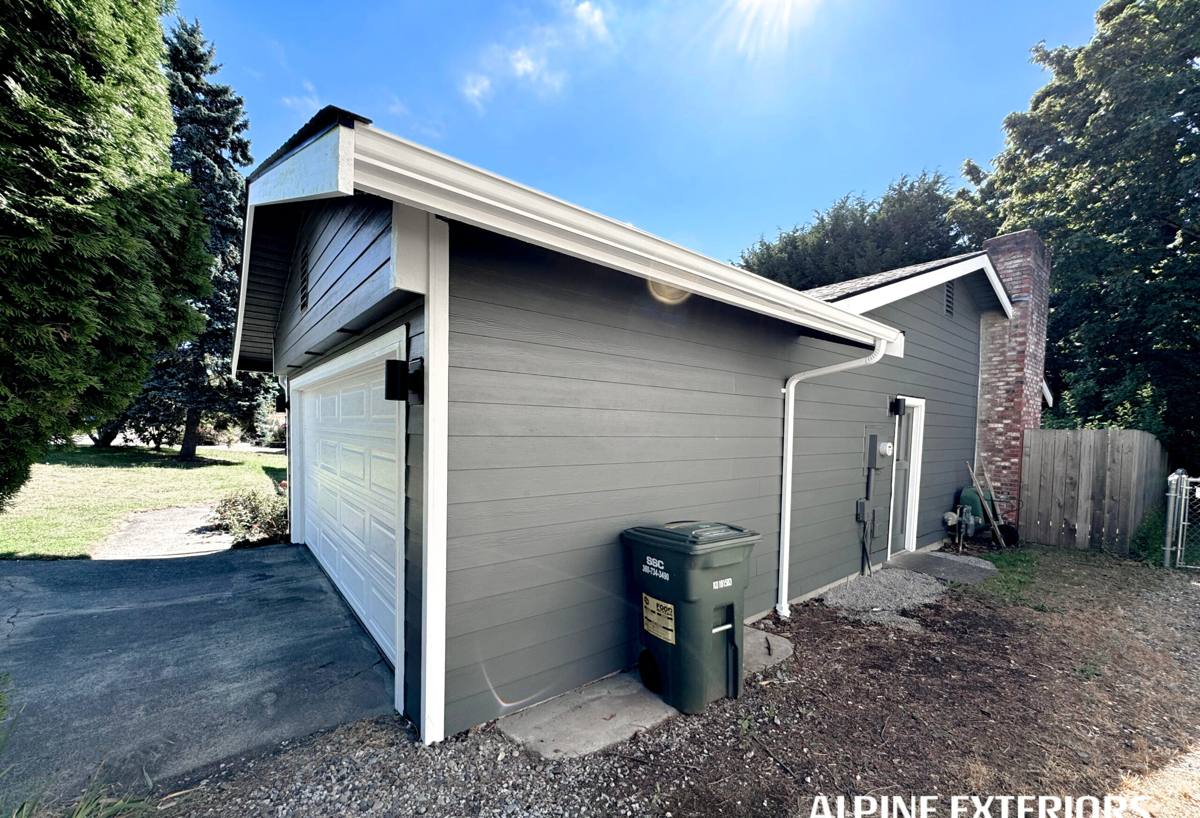
What Salt Air, Driving Rain, and Moss Actually Do to Siding
Salt air
Airborne salt from the Strait settles on every exterior surface within reach of the wind, not just the water-facing wall. It accelerates corrosion on exposed fasteners, staples, and cheaper trim hardware, and it can dull or streak paint finishes that weren't engineered to resist it. Over years, a siding product with a weak factory finish will show chalking, fading, or blotching on the windward elevations well before the rest of the house.
Driving rain
Wind off open water doesn't just fall as rain — it drives it sideways and up under laps, trim, and butt joints. Any siding system with soft or poorly sealed seams will start wicking moisture at those joints. On a Point Whitehorn lot with real wind exposure, the flashing details and joint treatment matter as much as the siding material itself.
Moss
Wooded lots near the water hold shade and humidity longer than open, sunny sites. That's ideal moss and algae territory, especially on north- and west-facing walls that stay damp after every rain. Moss growth on siding isn't just cosmetic — trapped organic material holds moisture against the surface, which is a real problem for any product that isn't dimensionally stable when wet.
Why James Hardie Holds Up Where Other Products Struggle
James Hardie fiber cement is engineered specifically to resist the failure modes above, which is why it's the only product we put on homes in this area.
- Non-combustible core: Hardie's fiber cement doesn't rot, delaminate, or feed insects the way wood-based siding can, which matters on shaded, damp lots where moisture sits longer.
- ColorPlus factory finish: a baked-on finish applied under controlled conditions, formulated to resist fading and hold color better than field-applied paint — a real advantage on salt-exposed elevations.
- HZ5 climate engineering: Hardie makes region-specific product formulations, and the HZ5 line is built for wetter, harsher climates like ours, rather than a one-size-fits-all formula.
- Dimensional stability: fiber cement doesn't swell and shrink with moisture cycling the way wood-based products can, which reduces the joint movement that lets wind-driven rain find its way behind the siding.
None of that means Hardie is maintenance-free. It means the material itself isn't the weak link — the installation is where the performance is won or lost, especially on an exposed site like this one.
What a Correct Installation Involves Here
On a standard inland lot, a sloppy install might get away with itself for a while. On a Point Whitehorn shoreline lot, it won't. The details that matter most on this kind of site:
Flashing and water management
Every window, door, and penetration needs proper flashing integrated with the weather-resistive barrier — not just caulk. Wind-driven rain finds any gap in that system, and caulk alone is not a substitute for flashing.
Gapping and fastening
Hardie panels and lap siding require specific gapping at butt joints and trim, and fastener placement per Hardie's published instructions. Fasteners driven wrong, or spaced wrong, are one of the most common causes of premature siding problems — and they're invisible once the job is painted.
Starter strips and clearances
Correct starter strip installation and proper clearance from grade, decks, and roof lines keeps splash-back and standing water away from the bottom course, which is where rot and moss problems usually start first.
Caulking and joint treatment
On a windward wall, joint sealant needs to be the right product, applied correctly, at every seam that's exposed to driving rain — not just the visible ones.
Correct Installation vs. Common Shortcuts
| Detail | Done Right | Common Shortcut |
|---|---|---|
| Window/door flashing | Integrated flashing tied into the water-resistive barrier | Caulk used in place of flashing |
| Fastening | Manufacturer-spec nail placement and spacing | Fasteners driven too high, too close to edges, or overdriven |
| Joint gapping | Gapped and caulked per Hardie spec for expansion | Panels butted tight with no gap |
| Bottom clearance | Proper clearance from grade, decks, and roofing | Siding installed too close to grade or a roofline |
| Cut edges | Field-cut edges sealed per Hardie instructions | Raw cut edges left unsealed |
How We Approach a Point Whitehorn Job
Because we already do this work in Birch Bay and the surrounding coastal stretches of Whatcom County, we start every estimate with a walk of the exterior specifically looking for the problems this climate causes: soft trim, moss buildup on shaded walls, staining near grade, and any spots where wind exposure has clearly been hardest on the existing siding. That tells us where extra attention to flashing and water management needs to go before a single panel goes up.
From there, our process is straightforward:
- On-site assessment of the existing siding, trim, and any moisture or rot issues found during removal.
- Repair or replacement of any damaged sheathing or framing uncovered once old siding comes off.
- Installation of a proper weather-resistive barrier and flashing details at every penetration.
- Hardie panel or lap installation to manufacturer spec, with fastening and gapping done correctly the first time.
- Final trim, caulking, and a walk-through so you know exactly what was done and why.
We don't skip the assessment step to save time on an estimate. On an exposed coastal lot, what's happening behind the old siding often matters more than what the old siding looks like from the driveway.
Color and Finish Choices That Hold Up to Salt Air
James Hardie's ColorPlus line gives you factory-applied color options engineered to resist fading, which is worth prioritizing over a primed product you'd have to field-paint yourself. On a salt-exposed elevation, a factory finish with a real warranty behind it is going to outperform a job-site paint job over time, both in appearance and in how long it is before you're repainting. We can walk through color and texture options — lap profiles, shingle-style panels, and trim combinations — that fit the wooded, coastal character of Point Whitehorn without over-brightening a shaded lot.
Living With Hardie Siding in a Moss-Prone Climate
Fiber cement resists the structural damage moss can cause to wood siding, but moss and algae can still grow on the surface of any siding in a shaded, damp spot — it's a climate issue, not a material defect. A little routine attention keeps it from building up:
- Rinse shaded, north- and west-facing walls once or twice a year, especially after the wetter months.
- Keep gutters clear so overflow isn't running down the siding face.
- Trim back vegetation that's shading walls and keeping them damp longer than necessary.
- Check caulked joints periodically, especially on the windward side of the house, and have any cracked sealant redone before a wet season sets in.
- Have a professional look at any spot where you notice staining, soft trim, or a section that seems to stay wet longer than the rest of the house.
What Affects the Cost of a Point Whitehorn Siding Project
| Factor | Why It Matters Here |
|---|---|
| Existing damage | Coastal moisture exposure means more homes need sheathing or trim repair once old siding comes off |
| Access and site conditions | Wooded, sloped, or bluff-adjacent lots can affect staging and scaffolding needs |
| Product line and profile | Lap, panel, and shingle-style Hardie products vary in material and labor cost |
| Trim and detail work | More window/door openings and architectural detail mean more flashing and finish work |
| Finish choice | ColorPlus factory finishes vs. field painting affect both cost and long-term maintenance |
We give you a real, itemized number after seeing the house, not a generic square-footage guess — coastal lots vary too much for a one-size number to mean anything.
Why Local Experience on This Coastline Matters
A crew that mostly installs siding on inland, sheltered lots doesn't automatically know what a Point Whitehorn wall needs. The flashing details, fastening discipline, and moisture-management choices that hold up here are learned by doing this work on this coastline, repeatedly, and seeing what actually happens to a house a few years after the crew leaves. That's the standard we hold every install to, whether it's a full re-side or a smaller section repair.
If you're weighing a siding project on a Point Whitehorn home, we're happy to take a look and give you a straightforward, no-pressure estimate — no invented urgency, just an honest read on what your house needs and what it would take to do it right.