 Birch Bay Siding
 Terrell Creek's Climate Is Harder on Siding Than It Looks
Terrell Creek sits in the Birch Bay area of Whatcom County, close enough to the water that salt-laden air is a daily fact of life on exterior surfaces, and shaded enough in spots — tree cover along the creek corridor, mature landscaping, north-facing walls — that moss and algae get a long runway every year. That combination is a specific kind of stress test for siding. It's not one big storm that causes damage out here; it's the slow, cumulative wear from months of dampness that never fully dries out between rain events.
Homes in this pocket of Whatcom County deal with three things at once: airborne salt that accelerates corrosion on fasteners and hardware, driving rain that gets pushed sideways into wall assemblies during winter systems off the Strait of Georgia, and a moss season that can run from late fall through spring. Siding that isn't dimensionally stable, isn't properly moisture-managed, or isn't finished with a durable factory coating starts showing problems in this environment faster than it would in a drier inland location.
We work in Birch Bay and the surrounding Whatcom County area regularly, and Terrell Creek homes tend to show a consistent pattern: siding failure isn't random. It shows up at the same details every time — bottom courses near grade, butt joints that weren't caulked or flashed correctly, and shaded elevations where moss holds moisture against the wall. Understanding that pattern is most of what it takes to do this job right the first time.
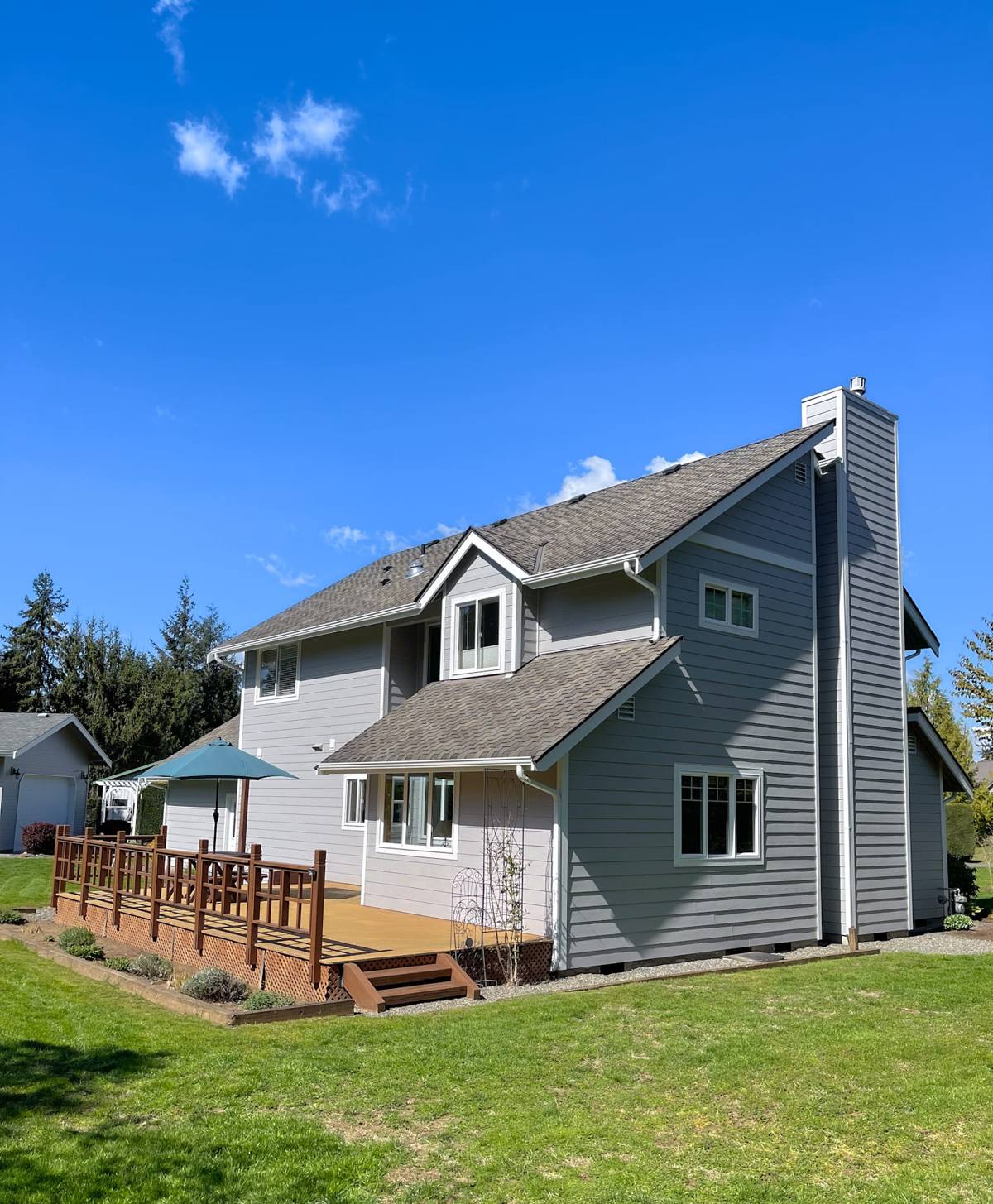
What Fiber Cement Siding Actually Needs to Do Here
Fiber cement is the right base material for this climate because it doesn't rot, doesn't feed insects, and doesn't expand and contract the way wood-based products do when they take on moisture. But the material is only half the equation. A fiber cement installation in a salt-air, high-moisture setting like Terrell Creek has to get several details right that a lower-stakes job might get away with skipping:
- Correct clearance from grade, decks, and roof lines so water has somewhere to go instead of wicking into the bottom edge of the siding
- A continuous drainage plane and properly lapped weather-resistive barrier behind the siding, not just the siding itself
- Stainless or coated fasteners sized and placed to manufacturer spec — ordinary fasteners corrode faster in salt air and that corrosion telegraphs through the finish
- Flashing at every horizontal transition — window heads, trim boards, roof-to-wall intersections — installed to shed water outward, not just caulked over
- Factory-applied finish rather than field-applied paint, so the color coat resists UV and moisture the same way on day one and year fifteen
Skip any one of these and the siding itself can be excellent material and the wall assembly still fails early. This is why we treat installation detailing as the actual product, with the siding panel as one component of it.
Why We Only Install James Hardie
We standardized on James Hardie fiber cement and don't install vinyl, LP SmartSide, cedar, primed spruce, Cemplank, or Allura. That's a deliberate professional choice, not a sales position. Vinyl distorts and can crack in cold snaps and doesn't hold up as a long-term air/water barrier partner at seams. Wood-based and engineered wood products need more diligent field sealing at cut ends and joints to keep moisture out, which is a harder standard to hold consistently across a whole house, especially in a wet climate. Other fiber cement brands may be reasonable products, but we've built our install process, our warranty conversations, and our crew training around one system, and Hardie's HZ5 product line is engineered specifically for climates like ours — freeze-thaw cycling, sustained moisture, and coastal exposure.
Hardie's ColorPlus finish is baked on at the factory under controlled conditions, which matters in an area where field-painted finishes get tested hard by moss growth and damp shade. The warranty is also transferable, which is a real factor for Terrell Creek homeowners who may sell in a market where buyers are increasingly asking what siding is on the house and how it's documented.
What This Means for Your Specific Lot
If your property has heavy shade, proximity to the creek corridor, or a north-facing wall that stays damp longer than the rest of the house, that's worth flagging before we quote. It can change recommendations on trim details, ventilation behind cladding, and how aggressively we address moss on adjacent surfaces (roof, fencing, retaining walls) as part of the same visit, since moss spreads.
How the Job Actually Runs
1. Walkthrough and Assessment
We look at the whole envelope, not just the siding — soffit and fascia condition, existing flashing, grade clearance, any visible moss or algae staining, and how water currently moves off the roof and around the foundation. This tells us if there's more going on behind the old siding than what's visible from the yard.
2. Tear-Off and Substrate Check
Old siding comes off and we inspect sheathing underneath. In a moisture-prone area like Terrell Creek, this step matters — it's the only point in the project where hidden rot or a failed barrier is fully visible and correctable before it gets covered back up.
3. Weather-Resistive Barrier and Flashing
New house wrap or building paper goes on with correct lapping (upper layers over lower, always shedding down and out), followed by flashing at every window, door, and horizontal trim transition.
4. Hardie Panel Installation
Panels are installed to manufacturer clearance and fastening specifications, with attention to butt joint treatment and consistent reveal lines. This is where crew experience shows — a rushed install can look fine on day one and start failing at joints within a couple of wet seasons.
5. Caulking, Trim, and Final Detail
Sealant goes only where Hardie specifies it (not everywhere — over-caulking can trap moisture instead of releasing it), trim is finished, and every penetration is checked.
6. Walkthrough and Cleanup
We walk the finished job with the homeowner, cover care basics for the first year, and clear the site.
Mistakes We Correct Most Often on Older Siding in This Area
A lot of our Terrell Creek and broader Birch Bay work involves fixing the consequences of a prior install rather than a first-time job. The patterns repeat:
- Siding installed tight to grade or a deck surface with no drainage gap, so the bottom edge stays wet
- Missing or reused flashing at window heads, leading to staining and rot starting above openings
- Butt joints caulked instead of properly flashed, which fails within a few seasons in this rainfall pattern
- Ordinary fasteners that have corroded and bled rust streaks through the finish
- Moss and organic growth left untreated on shaded walls, holding moisture against the cladding long-term
Cost Factors for a Terrell Creek Fiber Cement Project
Every home is different, and we'll only give you real numbers after a walkthrough, but these are the variables that most affect the estimate on a job like this:
| Factor | Why It Matters Here |
|---|---|
| Tear-off scope | Full removal to inspect sheathing costs more up front but is often necessary given moisture history in this area |
| Wall complexity | Dormers, multiple gables, and trim detail add labor time regardless of siding brand |
| Substrate repair | Rot found during tear-off (more likely on shaded, damp elevations) adds cost but prevents re-covering a hidden problem |
| Flashing and trim upgrades | Bringing older window and roof-line flashing up to current standards is often the highest-value spend on a coastal property |
| Siding profile and color | Lap width, shingle-style panels, and ColorPlus color selection affect material cost but not longevity |
Maintaining Fiber Cement Siding in a Salt Air, High-Moss Environment
Fiber cement is low-maintenance compared to wood, but "low" isn't "none," especially this close to Birch Bay's water and shade conditions. A short, honest checklist:
- Rinse siding annually, focusing on shaded and north-facing walls where moss and algae take hold first
- Keep gutters clear so water isn't overflowing directly onto siding runs below
- Trim back vegetation and tree cover that keeps a wall surface damp longer than the rest of the house
- Watch caulked joints for cracking or gaps and have them addressed before a wet season, not after
- Have flashing and trim checked periodically — most siding failures we see start at a flashing detail, not the panel itself
Why a Crew That Already Works Terrell Creek Matters
Siding installation isn't uniform across Whatcom County. A crew that mostly works drier, inland jobs can do competent work and still under-detail a coastal, moss-prone property because they're not used to treating those details as mandatory. We work this specific area regularly, which means we already know where water tends to collect on these lots, which elevations need extra attention to moss and shade, and how the local weather pattern actually behaves against a wall over a full year — not just on install day.
That local familiarity shows up in small decisions during the job: where we add extra flashing even when it's not strictly required, how we sequence work around a wet forecast, and which details we refuse to shortcut because we've seen what happens when they're skipped on a house just like yours.
If you're weighing a siding project in Terrell Creek or elsewhere around Birch Bay, we're glad to walk the property, look at what your current siding is telling us, and put together a straightforward estimate — no pressure, no upsell script, just what the house actually needs.